
Primary sources
Read the document
The papers behind the stories: telegrams, memoranda, internal histories, hearings and court records, now public. 60 of these 74 files are hosted here as the released scan, with their full text page by page; the rest are read on the government's own site. Each page gives our account of the document and a few passages quoted word for word, checked against the text on every rebuild.
This week The Afghan program begins: the Special Coordination Committee, 26 June 1979
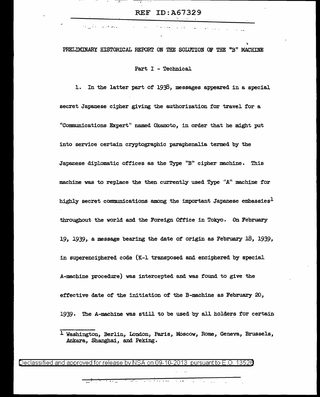 14 October 1940 · 27 p.Friedman's report on breaking PURPLE (14 October 1940)William F. Friedman, Principal Cryptanalyst, Signal Intelligence Service, US ArmyWilliam Friedman's account, written three weeks after the event, of how the Army's Signal Intelligence Service solved Japan's 'B' cipher machine, and his roll of the team who did it. The founding document of MAGIC.
 1941 · 26 p.Richard Sorge's own typescript: the discarded Shanghai draft of his confession (1941)Richard Sorge, in the custody of the Tokyo District Criminal Court procurator's office (German typescript, corrected in his hand); cover pages added by the CIATwenty-four pages Sorge typed in German in a Tokyo prison in late 1941 on his Shanghai years, later replaced in his statement. The prosecutor kept them and gave them to US Army G-2 in 1949.
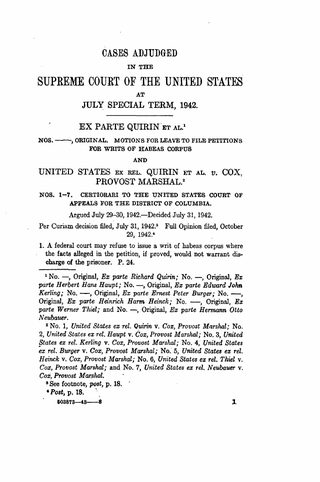 29 October 1942 · 48 p.Ex parte Quirin (1942): the Supreme Court and the Nazi saboteursSupreme Court of the United States (opinion by Chief Justice Harlan F. Stone)The Supreme Court's 1942 ruling that the eight German saboteurs landed by U-boat could be tried by Roosevelt's military commission. The judgment came on 31 July; the reasons followed in October, after six had been executed.
- 10 June 1943The BRUSA agreement on 'Special Intelligence' (1943), with the War Department's covering memoMilitary Intelligence Division (G-2), War Department General Staff: covering memorandum signed by Maj. Gen. George V. Strong, Assistant Chief of Staff, G-2; agreement of 17 May 1943 signed by Strong and E. W. Travis, Deputy Director (Services), GC&CSThe May 1943 agreement that gave the US Army a share in Ultra: Britain to read German and Italian army and air ciphers, America Japanese, with US officers at Bletchley Park and Britain's Ultra security rules.
 1944 · 41 p.Team Frederick in Brittany: the OSS London war diary, 1944OSS London, Special Operations Branch (war diary, vol. 4, Jedburghs)Pages from the OSS London Special Operations war diary on Jedburgh team Frederick: its June 1944 drop into Brittany, its radio traffic with London, and its leader's report on arming some 4,200 resistance fighters.
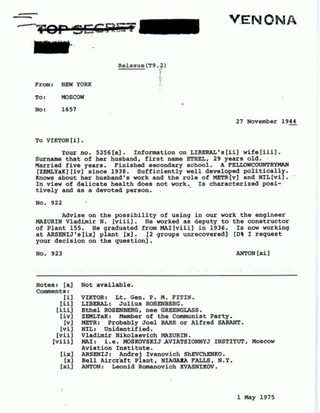 27 November 1944 · 1 p.A Venona decrypt: New York 1657, 27 November 1944KGB New York residency, signed ANTON (Leonid Kvasnikov)A short KGB cable from New York to Moscow describing LIBERAL's wife, "first name ETHEL." Broken by Army codebreakers years later, it became the most argued-over Venona message in the Rosenberg case.
- 22 May 1945Dulles and Gaevernitz's report on SUNRISE-CROSSWORD: 'The First German Surrender' (1945)Allen W. Dulles, OSS Bern, and Gero von Gaevernitz, his assistantThe OSS Bern account, written three weeks after the event, of the secret talks with SS General Karl Wolff that ended in the surrender of German forces in Italy on 2 May 1945, sent to OSS director William Donovan.
 7 August 1945 · 30 p.The OSS interrogation of Richard Kauder, alias Klatt (August 1945)Office of Strategic Services, Detachment A, Austria: SCI Unit A, Salzburg (Maj. E. P. Barry, commanding)The first American interrogation report on the Viennese Jew who ran the Abwehr's 'Klatt Bureau' in Sofia and Budapest, whose reports on the Red Army may have been a Soviet deception.
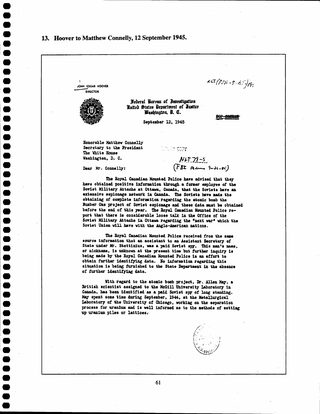 12 September 1945 · 7 p.Hoover tells the White House about Gouzenko (September 1945)J. Edgar Hoover, Director, Federal Bureau of InvestigationTwo FBI letters written within three weeks of Igor Gouzenko's defection in Ottawa: the first warning to Truman's White House of a Soviet spy network in Canada, an atomic spy, and a source inside the State Department.
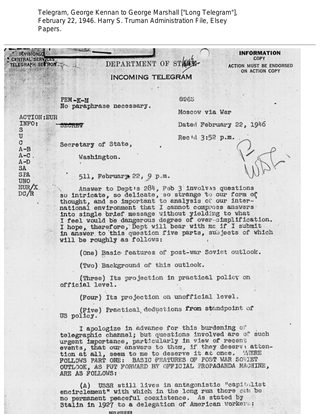 22 February 1946 · 19 p.The Long Telegram (1946)George F. Kennan, Chargé d'Affaires, US Embassy MoscowGeorge Kennan's telegram 511 from Moscow, 22 February 1946: a five-part analysis of Soviet conduct that described a 'concealed Comintern' and shaped the American strategy of containment.
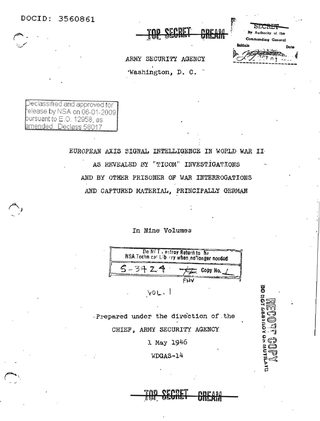 1 May 1946 · 36 p.What the Germans could read: the TICOM report, Volume 1, Synopsis (1946)Army Security Agency, War Department (prepared under the direction of the Chief, ASA)The US Army Security Agency's 1946 summary of what TICOM learned from captured German codebreakers: which American and British systems the Axis read, which it could not, and how Germany's six agencies worked.
- 30 August 1946Truman approves the expansion of Paperclip (August–September 1946)Dean Acheson, Acting Secretary of StateDean Acheson's memorandum asking President Truman to approve bringing up to 1,000 German and Austrian specialists, with their families, to the United States. Truman wrote "Approved 9/3/46" in the margin.
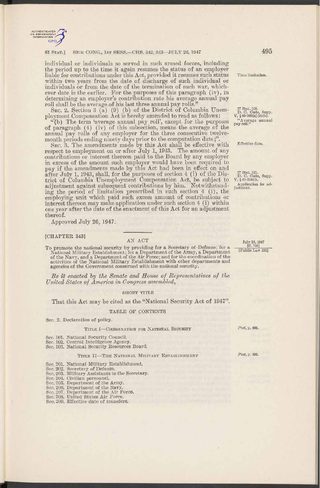 26 July 1947 · 16 p.The National Security Act of 194780th Congress of the United States (S. 758); signed by President Harry S. TrumanPublic Law 80-253, signed on 26 July 1947, created the National Security Council, the Central Intelligence Agency and a Secretary of Defense. One elastic clause later became the CIA's warrant for covert action.
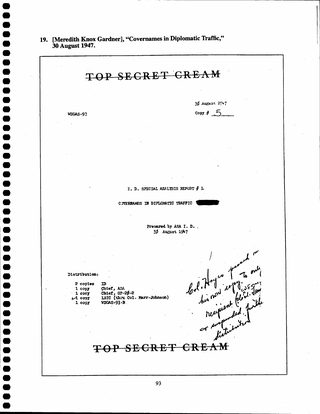 30 August 1947 · 11 p.Meredith Gardner's first Venona report: "Covernames in Diplomatic Traffic" (1947)Army Security Agency, Intelligence Division (I.D.); prepared by Meredith Knox GardnerThe Army codebreaker's August 1947 catalog of the cover names he could read in wartime Soviet cables, including an unidentified LIBERAL whose wife was called Ethel: the start of Venona's spy hunt.
- 18 June 1948NSC 10/2: covert action authorized (1948)National Security Council (text circulated by the Executive Secretary, Sidney W. Souers)The June 1948 National Security Council directive that put peacetime covert operations inside the CIA, defined them, and wrote the idea of 'plausible deniability' into American policy.
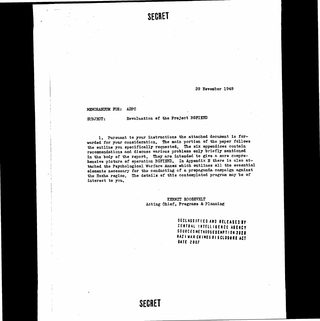 29 November 1949 · 18 p.OPC's revaluation of the Albanian operation (29 November 1949)Office of Policy Coordination, Programs and Planning staff (covering memorandum signed by Kermit Roosevelt, Acting Chief, Programs & Planning)Written weeks after the first landings in Albania, this OPC paper counts the losses, admits the operation was no secret, and still recommends pressing on with armed teams and arms drops to overthrow Hoxha.
 27 January 1950 · 32 p.FBI file: 'Stay-Behind Special Agent Program in Alaska', the 1950 papers (Part 1, opening pages)Federal Bureau of Investigation: SAC Anchorage (John H. Williams), FBI headquarters (D. M. Ladd, A. H. Belmont) and the Interdepartmental Intelligence ConferenceThe first FBI papers on what became Operation WASHTUB: an Anchorage memo of January 1950 on a military plan for 'sleeper agents' in Alaska, and the Bureau's wary response through mid-1950.
 14 April 1950 · 72 p.NSC 68 (1950)Department of State and Department of Defense study group (Policy Planning Staff director Paul H. Nitze, chair); circulated by NSC Executive Secretary James S. Lay, Jr.The April 1950 State–Defense review that recast containment as a military build-up and called for covert political and economic warfare to stir 'unrest and revolt' in the Soviet satellites.
 9 August 1951 · 140 p.Hearings on American Aspects of the Richard Sorge Spy Case (HUAC, 1951)Committee on Un-American Activities, US House of Representatives (John S. Wood, chairman; Frank S. Tavenner Jr., counsel)The House Un-American Activities Committee's 1951 hearings with the procurator who interrogated Sorge and MacArthur's intelligence chief, Charles Willoughby: how the confession was made, and a Cold War case built on it.
- 28 August 1953Iran 1953: Kermit Roosevelt's debriefing at CIA headquartersCentral Intelligence Agency, Directorate of Plans (reporter's record; drafter's name not declassified)A verbatim record of 28 August 1953, printed in the 2017 FRUS retrospective volume on Iran, in which the CIA's field commander told agency leaders how the TPAJAX coup against Mosaddeq was saved after it failed.
 30 September 1954 · 78 p.The Doolittle Report (1954)Special Study Group on the Covert Activities of the CIA: Lt. Gen. James H. Doolittle (chairman), William B. Franke, Morris Hadley, William D. PawleyEisenhower's private 1954 review of CIA covert operations, best known for its line that 'there are no rules in such a game,' and otherwise a hard-headed audit of personnel, security and money.
- 27 January 1955Dulles asks Egypt to spare the Lavon affair prisoners (27 January 1955)Department of State (John Foster Dulles, Secretary of State; drafted by John D. Jernegan, who signed for Dulles)A one-page State Department telegram in which John Foster Dulles asked Egypt, informally, to commute the death sentences passed on two members of Israel's sabotage network in Cairo. Four days later both men were hanged.
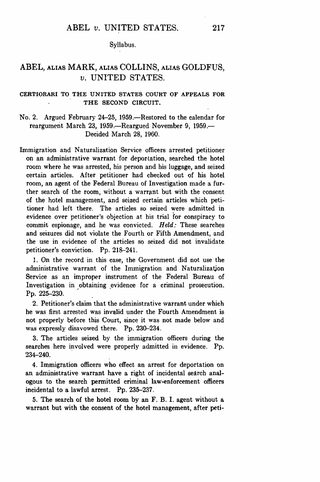 28 March 1960 · 40 p.Abel v. United States: the Supreme Court and the spy's wastebasket (1960)Supreme Court of the United States (opinion of the Court by Justice Felix Frankfurter; dissents by Justice William O. Douglas and Justice William J. Brennan Jr.)The 5–4 Supreme Court decision that upheld the conviction of the Soviet illegal known as Rudolf Abel, and with it the immigration arrest and warrantless searches that produced his hollow pencil and cipher pad.
- 9 May 1960After the U-2: the President and his advisers (May 1960)Marion W. Boggs, National Security Council staff (drafted 13 May 1960)The record of the 9 May 1960 National Security Council meeting, where Eisenhower told his advisers to 'endure the storm' over Francis Gary Powers's downed U-2 and the CIA assessed why Khrushchev was exploiting it.
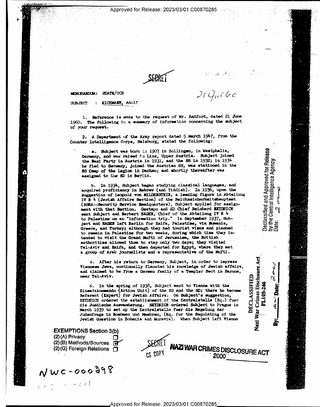 21 July 1960 · 4 p.What the CIA told the State Department about Eichmann (July 1960)Central Intelligence Agency (sender's office and drafter shown only by routing initials)A three-page CIA summary, sent to the State Department two months after Mossad seized Adolf Eichmann, of everything in the agency's files on him, including a 1958 report that he had lived in Argentina as 'Clemens'.
- 27 August 1960Allen Dulles's cable on Lumumba: 'an urgent and prime objective' (August 1960)Central Intelligence Agency headquarters (drafted by Director of Central Intelligence Allen W. Dulles, sent under the pseudonym Ascham)The CIA director's cable to the Leopoldville station of late August 1960 declaring Patrice Lumumba's removal 'an urgent and prime objective' and widening the station's authority, the cable the Church Committee placed at the start of the assassination plot.
 October 1961 · 158 p.The Inspector General's survey of the Cuban operation (1961)Lyman B. Kirkpatrick Jr., Inspector General, Central Intelligence AgencyCIA Inspector General Lyman Kirkpatrick's October 1961 post-mortem on the Bay of Pigs blamed the agency's own planning, intelligence and organization. Twenty copies were made; it was released in 1998.
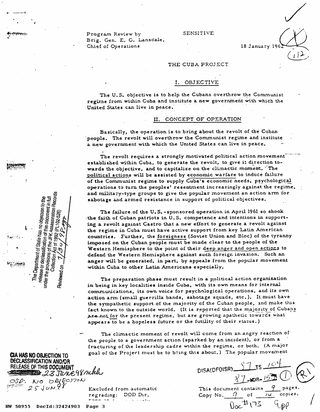 18 January 1962 · 9 p.Lansdale's first Cuba Project program review (18 January 1962)Brig. Gen. Edward G. Lansdale, Chief of Operations, the Cuba ProjectSeven weeks into Operation Mongoose, Brig. Gen. Edward Lansdale set out its goal, admitted how little the CIA had inside Cuba, and handed the agencies 32 tasks with February deadlines.
- 20 February 1962Lansdale's "The Cuba Project" (1962)Brig. Gen. Edward G. Lansdale, USAF, Chief of Operations, Operation MongooseBrig. Gen. Edward Lansdale's program review of 20 February 1962 for Operation Mongoose, with a six-phase timetable that aimed at an 'open revolt and overthrow' of the Castro government in October 1962.
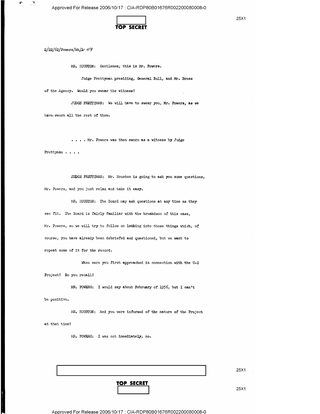 22 February 1962 · 63 p.Francis Gary Powers before the CIA Board of Inquiry (22 February 1962)CIA Board of Inquiry (Judge E. Barrett Prettyman presiding), stenographic transcriptThe transcript of U-2 pilot Francis Gary Powers's sworn testimony to the CIA's Prettyman board, twelve days after his release: his briefings, the shoot-down near Sverdlovsk, his capture and his interrogation.
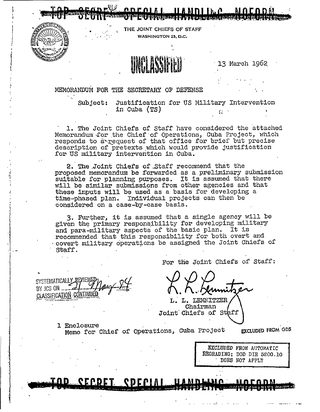 13 March 1962 · 15 p.The Northwoods memorandum (1962)General Lyman L. Lemnitzer, Chairman, for the Joint Chiefs of StaffOn 13 March 1962 the Joint Chiefs sent the Secretary of Defense a list of staged incidents that could justify invading Cuba, from a fake attack on Guantanamo to a sham terror campaign in Florida. None was carried out.
 19 September 1962 · 4 p.SNIE 85-3-62: the estimate that ruled out missiles in Cuba (1962)Director of Central Intelligence, for the United States Intelligence Board (drafted by the Office of National Estimates, CIA)The conclusions of the US intelligence community's estimate of 19 September 1962, which judged Soviet missiles in Cuba unlikely four weeks before a U-2 photographed them. Printed by the CIA History Staff in 1992.
- 16 October 196216 October 1962: the first White House meeting on the missile sitesWhite House taping system (transcript of audiotape 28.1, President's Office Files, Kennedy Library)The transcript of the meeting at which President Kennedy and his advisers first discussed U-2 photographs of Soviet medium-range missile sites in Cuba, and began weighing an air strike against a blockade.
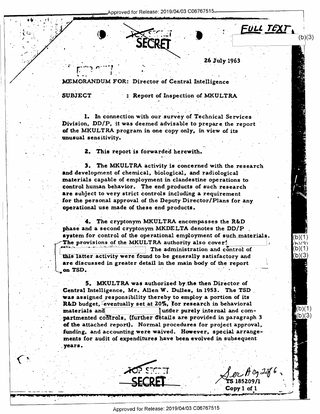 26 July 1963 · 46 p.The CIA Inspector General's inspection of MKULTRA (1963)J. S. Earman, Inspector General, Central Intelligence AgencyThe 1963 report, prepared in a single copy, in which the CIA's Inspector General described the MKULTRA behavior-control program, its drug tests on unwitting Americans, and recommended ending those tests.
- 9 January 1964The CIA's Tibet program reviewed for the Special Group (January 1964)Central Intelligence Agency (no drafting information on the source text)A three-page CIA paper that put a price on the Tibet program for fiscal 1964: $1,735,000 for guerrillas in Nepal, a subsidy to the Dalai Lama, a Colorado training camp and Tibet Houses abroad.
 13 February 1964 · 153 p.Cuba 1962: Khrushchev's Miscalculated Risk (CIA staff study, 1964)CIA Directorate of Intelligence, Office of Research and Reports (DD/I Staff Study, SC 03387/64)A CIA staff study of February 1964 that rebuilt the Soviet missile deployment in Cuba from photography and reports, and argued that Moscow had judged the risk of an American military response to be slight.
 1966 · 22 p.Alias George Wood: CIA's case history of Fritz Kolbe (1966)Anthony Quibble; Studies in Intelligence, CIA Center for the Study of IntelligenceA classified Studies in Intelligence case history of Fritz Kolbe, the German diplomat who smuggled Foreign Office telegrams to Allen Dulles in Bern, including von Papen's first report on the spy 'Cicero'.
 March 1967 · 2 p.The CIA's trained-cats memo (1967)Central Intelligence Agency (office and author redacted; the National Security Archive places the project in the Directorate of Science and Technology)A two-page CIA memorandum of March 1967, heavily redacted, that closed the project later known as Acoustic Kitty: cats could be trained to move short distances, but the technique was not practical for the Agency.
 23 May 1967 · 137 p.The CIA Inspector General's report on plots to kill Castro (1967)J. S. Earman, Inspector General, CIA (written by Inspectors K. E. Greer and S. D. Breckinridge)Inspector General J. S. Earman's 1967 report for Richard Helms on CIA plots against Fidel Castro: the Mafia poison pills, their revival under William Harvey, and the AMLASH operation with Rolando Cubela.
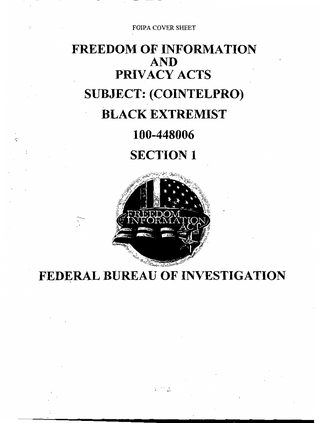 25 August 1967 · 5 p.The FBI letter that opened COINTELPRO against black nationalist groups (1967)Director, FBI (J. Edgar Hoover's headquarters)Hoover's FBI headquarters letter of 25 August 1967 to 23 field offices, setting up a counterintelligence program to 'expose, disrupt, misdirect, discredit, or otherwise neutralize' black nationalist organizations.
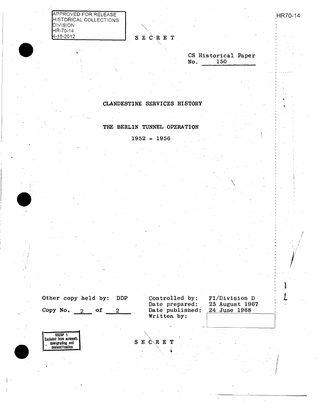 24 June 1968 · 91 p.The CIA's history of the Berlin Tunnel (1968)CIA Clandestine Service, FI/Division D (CS Historical Paper No. 150; written by the project's headquarters case officer, whose name is withheld)CS Historical Paper No. 150, the CIA's in-house account of PBJOINTLY: how the 1,476-foot tunnel was planned and dug, what it produced, how the Soviets found it, and the late discovery that George Blake had betrayed it.
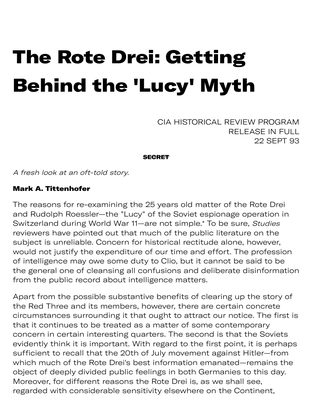 1969 · 44 p.The Rote Drei: CIA's study of the 'Lucy' radio traffic (c. 1969)Mark A. Tittenhofer; Studies in Intelligence, CIA Center for the Study of IntelligenceA classified Studies in Intelligence article that rebuilt the wartime Soviet network in Switzerland from 437 surviving radio messages, and found that 'Lucy' was a go-between rather than a master spy.
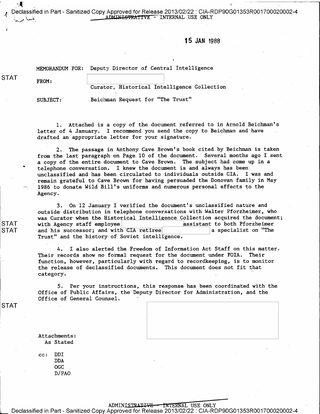 March 1969 · 86 p.'The Trust': the CIA's unpublished study of the OGPU's great deception (c. 1969)Central Intelligence Agency (internal study; author not named). Covering memorandum of 15 January 1988 from the Curator, Historical Intelligence CollectionAn internal CIA study, completed around March 1969 and never published, of the Soviet 'Trust' operation of 1921–27, with the 1988 memo explaining how a copy reached a historian outside the agency.
 17 February 1970 · 73 p.William Colby on Phoenix before the Senate (1970)Senate Committee on Foreign Relations (chairman: J. W. Fulbright); testimony of Ambassador William E. Colby, Deputy to the MACV Commander for CORDSThe opening day of the Senate Foreign Relations Committee's 1970 hearings on pacification, when William Colby, head of CORDS, defended the Phoenix program under oath and conceded that prisoners had probably been killed wrongly.
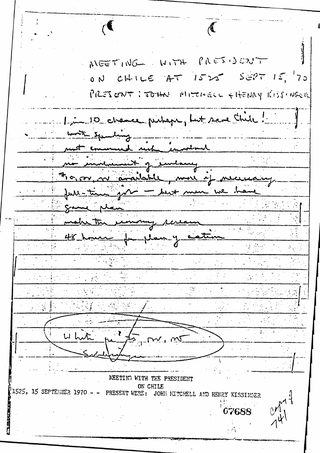 15 September 1970 · 2 p."Make the economy scream": Helms's notes of 15 September 1970Richard Helms, Director of Central Intelligence (handwritten notes, with a typed transcription)One page of handwritten notes, with a typed copy, that CIA Director Richard Helms took in the Oval Office when Nixon ordered the agency to stop Salvador Allende taking office in Chile: the founding record of Track II.
 1972 · 18 p.Penkovskiy's Legacy: a CIA analyst on the IRONBARK papers (1972)Len Parkinson, CIA Directorate of Intelligence (article in Studies in Intelligence, adapted from his February 1971 talk to the Midcareer Executive Development Course)A Secret 1972 Studies in Intelligence article by a CIA Directorate of Intelligence analyst explaining why the Soviet military documents Oleg Penkovsky photographed were still being mined for doctrine and weapons ten years on.
 May 1973 · 148 p.The "Family Jewels" (1973)CIA offices and senior officials, reporting to the Director of Central Intelligence under James R. Schlesinger's directive of 9 May 1973The CIA's own 1973 inventory of activities that might have broken its charter, from mail opening and wiretaps on reporters to plots against Castro. Kept secret for 34 years, it was released in June 2007.
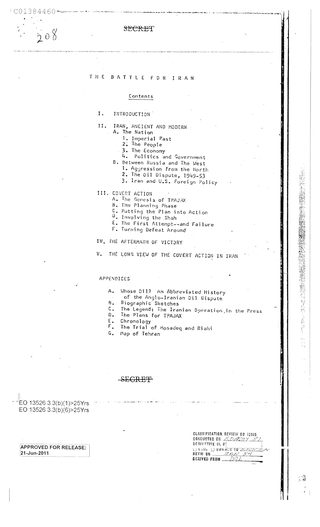 1974 · 128 p.The Battle for Iran: the CIA History Staff's account of the 1953 coup (c. 1974)CIA History Staff (author's name withheld)An undated CIA History Staff account of Iran and the 1953 coup, released in 2011 and posted in 2013. In it the CIA states that the coup was carried out under its direction as an act of US policy.
- May 1974Kissinger to Nixon on Brandt's fall: the blackmail reports (May 1974)Henry A. Kissinger, Assistant to the President for National Security Affairs (initialed for him by Brent Scowcroft)An undated Secret memorandum in which Henry Kissinger passed to President Nixon what a German security official said the Guillaume investigation had found, and press claims that fear of blackmail helped push Willy Brandt to resign.
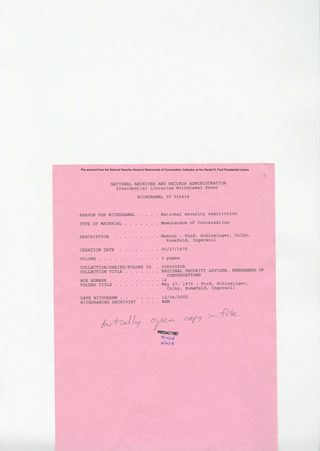 27 May 1975 · 5 p.Ford's meeting on the submarine leak (27 May 1975)White House, National Security Council staff (memorandum of conversation; classified by Henry A. Kissinger)The White House record of the hour President Ford spent with Schlesinger, Colby, Rumsfeld, Ingersoll and Scowcroft two days after the New York Times exposed US submarine spying off the Soviet coast, and talked of prosecuting the paper.
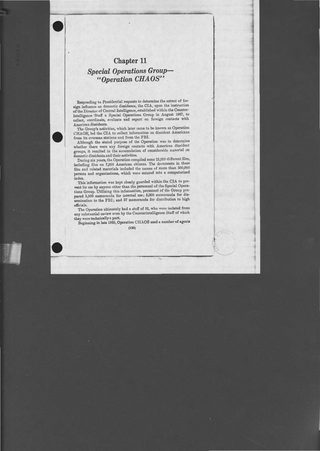 6 June 1975 · 21 p.The Rockefeller Commission on Operation CHAOS (1975)Commission on CIA Activities within the United States (chairman: Vice President Nelson A. Rockefeller)Chapter 11 of the 1975 Rockefeller Commission report: the first official account of the CIA's Special Operations Group, its 13,000 files and 300,000-name index, and its finding that CHAOS broke the CIA's charter.
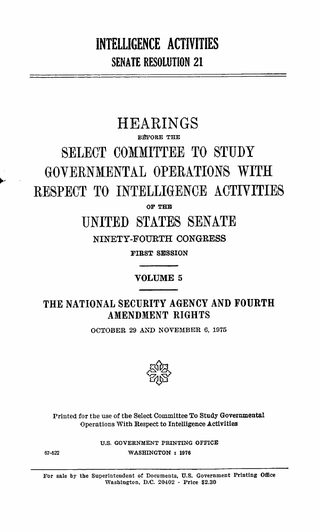 29 October 1975 · 166 p.Church Committee Hearings, Volume 5: The NSA and Fourth Amendment Rights (1975)Senate Select Committee to Study Governmental Operations with Respect to Intelligence Activities (Frank Church, chairman)The first public Senate testimony by an NSA director, Lew Allen's account of the watch lists, the committee's disputed vote to reveal SHAMROCK, and the 1969 MINARET charter and other NSA papers printed as exhibits.
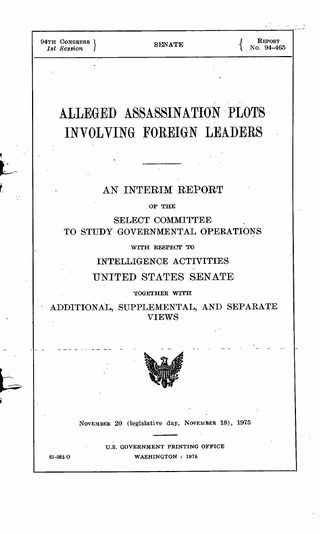 20 November 1975 · 85 p.Alleged Assassination Plots Involving Foreign Leaders (1975)Senate Select Committee to Study Governmental Operations with Respect to Intelligence Activities (Frank Church, chairman)The Church Committee's interim report of 20 November 1975 found that US officials plotted to kill Castro and Lumumba and backed plotters in three other countries where leaders died. Ford opposed publication.
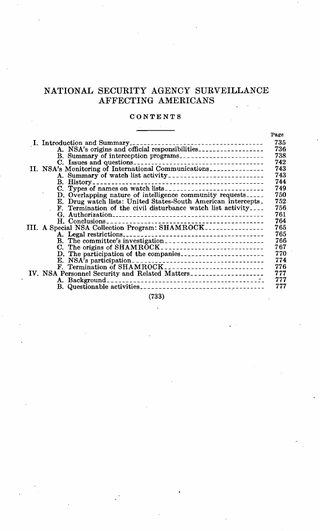 23 April 1976 · 50 p.The Church Committee's report on the NSA: 'National Security Agency Surveillance Affecting Americans' (1976)Senate Select Committee to Study Governmental Operations with Respect to Intelligence Activities (Frank Church, chairman)The Church Committee's 1976 staff report on the NSA: the MINARET watch lists, the drug intercepts, thirty years of telegram copying under SHAMROCK, and the NSA Office of Security's own files and break-ins.
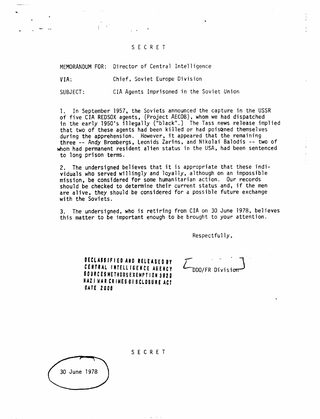 30 June 1978 · 1 p.'CIA Agents Imprisoned in the Soviet Union': a retiring officer's memo on captured REDSOX agents (1978)Retiring CIA officer, Directorate of Operations, FR Division (name withheld)On his last day at the CIA, 30 June 1978, an officer asked the Director to find out whether three Latvian REDSOX agents captured in 1957 were still alive and to consider them for an exchange.
- 26 June 1979The Afghan program begins: the Special Coordination Committee, 26 June 1979Special Coordination Committee, National Security Council (chaired by Zbigniew Brzezinski; summary drafted by Donald Gregg)The White House record of the 55-minute meeting at which Carter's advisers agreed to give Afghan insurgents covert cash and propaganda support, six months before the Soviet invasion: the first decision of the program later called Operation Cyclone.
 1980 · 5 p.The CIA Iran Task Force's account of the Canadian Caper (1980)Central Intelligence Agency, Iran Task Force (drafting office redacted)A short, heavily redacted CIA review written soon after January 1980. Its one surviving passage gives the Agency's own dated chronology of how six American diplomats were got out of Tehran.
- 9 May 1980The Afghan covert program in May 1980: INR's briefing for Secretary MuskieRonald I. Spiers, Director, Bureau of Intelligence and Research, Department of State (drafted by David Mark; sent through Under Secretary David Newsom)A short State Department briefing of 9 May 1980 for the new Secretary of State: how the CIA's Afghan program had grown from radio and cash to Soviet-made weapons flown via Saudi Arabia, with Egyptian SA-7s on the way.
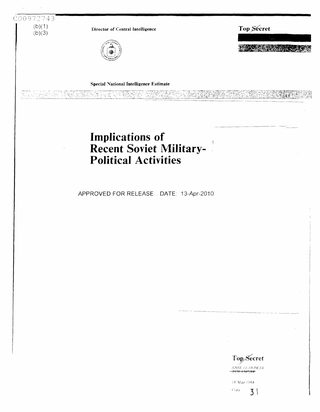 18 May 1984 · 12 p.SNIE 11-10-84: the intelligence community reads the war scare (May 1984)Director of Central Intelligence (National Intelligence Council); the National Foreign Intelligence Board concurringThe Special National Intelligence Estimate of 18 May 1984 that judged Soviet war talk after Able Archer 83 to be posturing, not fear of attack. Six years later the President's advisory board faulted its certainty.
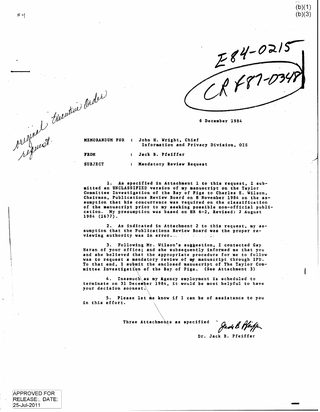 9 November 1984 · 84 p.The CIA historian's case against the Taylor Committee (1984)Jack B. Pfeiffer, CIA History StaffVolume IV of the CIA's official Bay of Pigs history: Jack Pfeiffer's attack on the 1961 White House inquiry led by Maxwell Taylor, arguing that the Kennedy administration, not the CIA, caused the defeat.
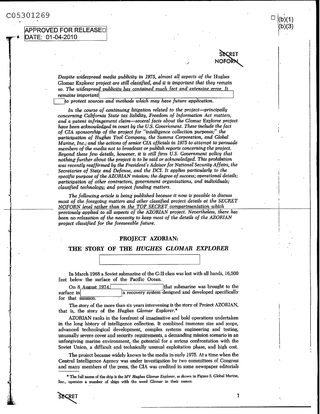 1985 · 50 p."Project AZORIAN: The Story of the Hughes Glomar Explorer"An unnamed CIA participant in the project, writing in Studies in Intelligence (CIA Center for the Study of Intelligence)A 50-page in-house CIA history of the 1974 attempt to raise the Soviet submarine K-129, written by an unnamed participant for Studies in Intelligence and released, heavily redacted, in 2010.
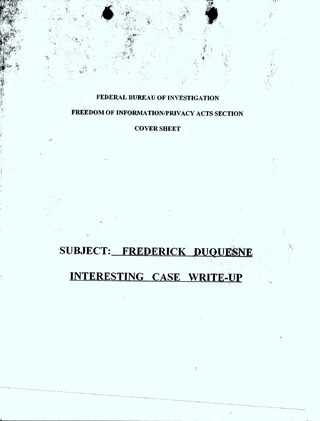 12 March 1985 · 16 p.The FBI's case write-up on the Duquesne spy ring (1985)Federal Bureau of Investigation, Washington, D.C. (file I.C. 65-8946)A 15-page FBI summary, dated 12 March 1985, of the 1941 case against 33 German agents: how William Sebold was turned, the Long Island radio, and what each spy did and got.
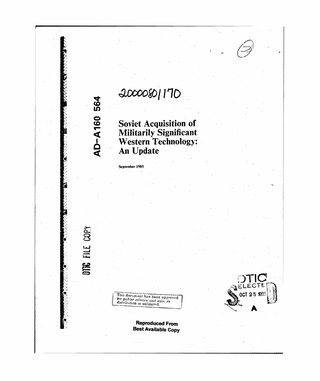 September 1985 · 39 p.Soviet Acquisition of Militarily Significant Western Technology: An Update (1985)US Government interagency white paper, prepared by a committee chaired by the CIA and issued through the Office of the Secretary of DefenseThe US government's 1985 white paper on the Soviet machine for acquiring Western technology, built on the Soviets' own statistics. It never names Farewell, but journalists tie its figures to Vetrov's documents.
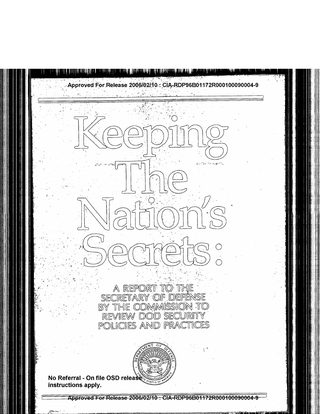 19 November 1985 · 117 p.Keeping the Nation's Secrets: the Stilwell Commission report (1985)DoD Security Review Commission (Commission to Review DoD Security Policies and Practices), Gen. Richard G. Stilwell, USA (Ret.), chairmanThe Pentagon's security review ordered after the Navy spy arrests of May 1985: 63 unanimous recommendations on clearances, polygraphs, document control and counterintelligence, delivered to Weinberger in November 1985.
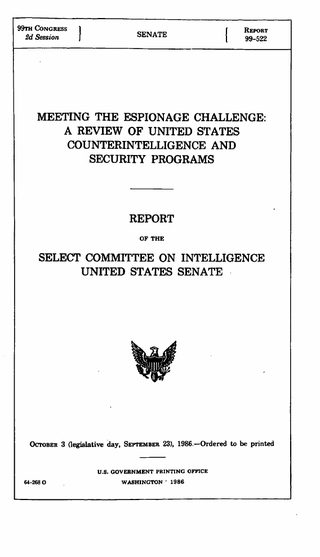 3 October 1986 · 122 p.Meeting the Espionage Challenge: the Senate's verdict on the Year of the Spy (1986)Senate Select Committee on Intelligence (chairman: Dave Durenberger; vice chairman: Patrick J. Leahy)The Senate Intelligence Committee's public report of October 1986 on US counterintelligence after the Walker, Pelton, Howard and Pollard cases: what the spies cost, what failed, and 95 findings and recommendations.
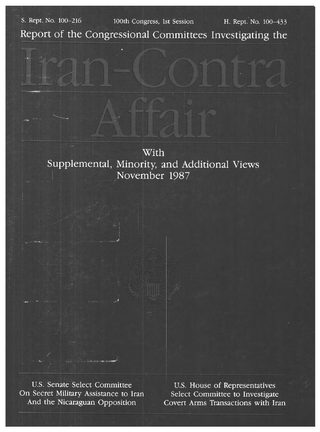 November 1987 · 49 p.The congressional Iran-Contra report (1987)Senate Select Committee on Secret Military Assistance to Iran and the Nicaraguan Opposition (Daniel K. Inouye, chairman) and House Select Committee to Investigate Covert Arms Transactions with Iran (Lee H. Hamilton, chairman)The joint House and Senate committees' report of November 1987: their executive summary of how the NSC staff sold arms to Iran, ran a private war in Nicaragua and diverted profits to the Contras, plus the chapter on the diversion.
 15 February 1990 · 25 p.The Soviet "War Scare" (PFIAB, 1990)President's Foreign Intelligence Advisory BoardA 1990 review by the President's Foreign Intelligence Advisory Board concluding that Soviet fear of a US first strike in 1983 was genuine, and that American intelligence had underrated it. Declassified in 2015.
 1992 · 50 p.The CIA's history of OXCART: 'The U-2's Intended Successor' (1992)Gregory W. Pedlow and Donald E. Welzenbach, History Staff, Central Intelligence AgencyChapter 6 of the CIA's in-house history of overhead reconnaissance: how the A-12 was chosen, built in titanium and tested at Area 51, flown over Vietnam and North Korea in 1967–68, and retired in favor of the SR-71.
 1994 · 105 p.Operation PBSUCCESS: the CIA's own history of the Guatemala coup (Cullather, 1994)Nicholas Cullather, History Staff, Center for the Study of Intelligence, Central Intelligence Agency (foreword by J. Kenneth McDonald, Chief Historian)The CIA History Staff's account of the 1954 operation against Jacobo Arbenz, written from the agency's files by Nicholas Cullather. It concludes that Arbenz fell to an army coup, not to CIA radio and bombing.
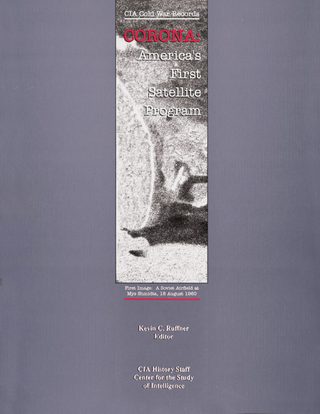 May 1995 · 66 p.CORONA: the CIA's 1995 documentary history of its first spy satelliteCIA History Staff, Center for the Study of Intelligence (Kevin C. Ruffner, editor); Part I is Kenneth E. Greer, "Corona," Studies in Intelligence, Supplement, Spring 1973The CIA History Staff volume published three months after CORONA was declassified in 1995. It reprints the Agency's 1973 Top Secret history of the program and the first reports built on its film.
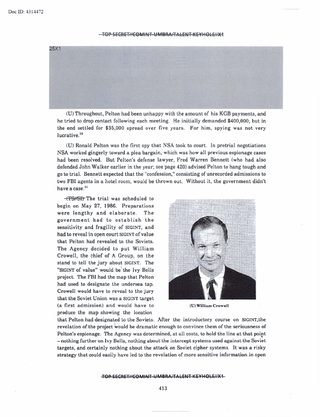 1999 · 3 p.NSA's secret history of the Pelton trial and the Ivy Bells leak (1999)Thomas R. Johnson, NSA Center for Cryptologic History (American Cryptology during the Cold War, 1945–1989, Book IV: Cryptologic Rebirth, 1981–1989)Four pages from Book IV of NSA's classified Cold War history, released in 2024: how the Agency took Ronald Pelton to trial, what it would and would not say about Ivy Bells, and its fight with the Washington Post.
 February 2001 · 92 p.The FBI's affidavit against Robert Hanssen (2001)Stefan A. Pluta, Special Agent, Federal Bureau of Investigation, Washington Field OfficeThe 100-page sworn statement that charged FBI agent Robert Hanssen with espionage in February 2001, rebuilding the KGB's 'B' operation letter by letter and drop by drop, and setting out the evidence that 'B' was Hanssen.
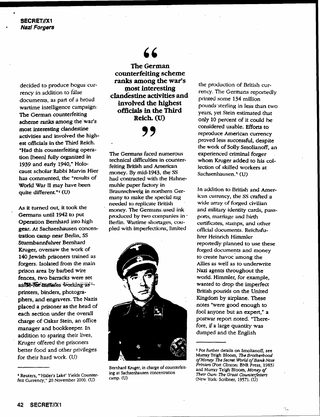 2002 · 12 p.On the Trail of Nazi Counterfeiters: a CIA historian on Operation Bernhard (2002)Kevin C. Ruffner, CIA History Staff; Studies in Intelligence, CIA Center for the Study of IntelligenceA classified 2002 Studies in Intelligence article by CIA historian Kevin Ruffner: how the OSS tracked the SS forgery ring in 1945, then hired its salesman, Friedrich Schwend, and a dealer, George Spitz, as agents.
 2006 · 95 p.Undercover Armies: the CIA's secret history of its war in Laos (2006)Thomas L. Ahern, Jr., CIA History Staff, Center for the Study of IntelligenceThomas Ahern's classified CIA History Staff account of the Agency's surrogate war in Laos, released with redactions in 2009. The pages here cover the 1960 crisis and the arming of Vang Pao's Hmong in 1961.
No document matches those filters.