
 Page 1 of 18
From the document
The British succeeded in landing thirty men in groups of five in the southern third of Albania from Malta.
The lack of security consciousness on the part of the Albanians with whom the British and U.S. are dealing has made it impossible to preserve the secrecy of the operation.
It would represent the first instance of the "roll-back" of Soviet power in the Satellites.
It is now clear to us and to the British that the Hoxha regime cannot be overthrown in the near future without considerable outside aid in the form of guns, supplies, leadership, and propaganda.
Excerpts are passages from a US government work (public domain), quoted exactly as they read in the scan, and checked against the full text on every rebuild.
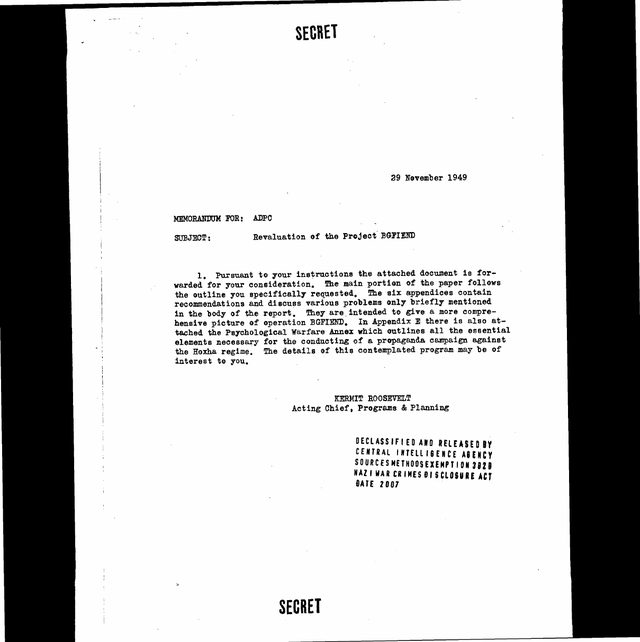
By late November 1949 the Anglo-American attempt to topple Enver Hoxha's government in Albania had been running for six months and had already gone badly. This paper is the Office of Policy Coordination's second stocktaking that autumn, written at the request of the head of OPC, the covert-action office then housed in the CIA. Kermit Roosevelt, acting chief of OPC's Programs and Planning staff, sent it up with a one-paragraph cover note on 29 November1. An earlier "revaluation" in September had already warned that Soviet intelligence was "undoubtedly aware" of the plans2.
What it says
The body runs to five typed pages. It restates the original concept: a policy aimed at "the overthrow of the Moscow-controlled regime," a project activated in May 1949 in three phases (an émigré committee, then reconnaissance and propaganda, then the overthrow itself), and an agreement with the British services, who modified their own plan, called VALUABLE, to fit it1.
Then comes the tally. The Committee for Free Albania had been formed in Paris in August but was deadlocked over a new chairman after the death of Midhat Frashëri. Of the thirty men the British had landed from Malta, fifteen had fled into Greece, one five-man team was still sending radio messages, and the rest were dead or missing. The American half of the reconnaissance, some fifty agents for northern and central Albania, never went, because the émigré leaders could not find even twenty recruits before the British closed their Malta base on 1 December. No propaganda broadcasts had begun: OPC could not get a radio ship1.
On security the paper is frank. French, Greek and Italian services knew of the operation; the Greek service had questioned the fifteen men who escaped; the Soviet, Albanian and Yugoslav services were assumed to know. Its one comfort was that there was "no evidence" Moscow held "conclusive proof" of the operation's full scope1.
It weighs the stakes (Soviet troops in Albania or retaliation elsewhere against a first "roll-back" of Soviet power, relief for Tito and Greece) and lists three choices: go on, switch to slow propaganda and courier work, or quit1. The appendices argue for going on. Appendix A calls the British teams "of a low quality" and proposes "armed reconnaissance" by guerrilla bands that would "shoot their way out," with arms dropped to local resisters. Appendix B looks for a new base for 250 Albanians, perhaps in the US Zone of Germany if John McCloy agreed. Appendix C judges that the USSR would probably not send troops. Appendix D recommends continuing under NSC 10/2 with an entirely new plan. Appendix F advises against bringing in the French1.
What is missing, and what followed
The cover note promises six appendices, including a psychological warfare annex as Appendix E; the released file holds A, B, C, D and F only, with blank backing pages between them1.
The recommendation to continue was taken. Operations went on for several more years; a 1952 OPC paper describes penetration and harassment missions, a clandestine radio station and leaflet drops in the name of the National Committee for a Free Albania3. Most teams were caught, and Hoxha stayed in power5. See Operation Valuable (Albania) for the whole story, including the dispute over how much Kim Philby, who arrived in Washington that autumn, contributed to the failure.
How to read it
This is an internal planning paper by the office that ran the operation, arguing for more resources. It says little about the British side beyond what OPC was told, and its casualty count is a snapshot from November 19491. Within the US government even the State Department's intelligence office complained in October that it knew almost nothing of the Albanian effort4. The CIA released the file in 2007 under the Nazi War Crimes Disclosure Act1.
Sources
- CIA Revaluation of the Project BGFIEND, 29 November 1949 (OBOPUS BG FIEND, vol. 2, document 0015), Central Intelligence Agency, FOIA Electronic Reading Room (copy fetched from the Internet Archive) (1949-11-29).
- CIA Revaluation of the Project BGFIEND, September 1949 (OBOPUS BG FIEND, vol. 2, document 0009), Central Intelligence Agency (released 2007; Internet Archive copy) (1949-09).
- CIA CIA/OPC 1952 Albanian Operations (OBOPUS BG FIEND, vol. 2, document 0001), Central Intelligence Agency (released 2007; Internet Archive copy) (1952).
- FRUS Foreign Relations of the United States, 1945–1950, Emergence of the Intelligence Establishment, Document 402, US Department of State, Office of the Historian (1949-10-17).
- Wikipedia Operation Valuable, Wikipedia.