
Albania in 1949 looked like the weakest point in the Soviet bloc: small, poor, cut off from the USSR by Tito's Yugoslavia after the Tito–Stalin split, and bordering Greece, where communist guerrillas were still being supplied across the frontier. British and American planners chose it for the first serious attempt to roll back a communist government by covert means.1,3
Planning
The British Secret Intelligence Service (SIS) called its part VALUABLE. The American side was run by the Office of Policy Coordination (OPC), the covert-action office then attached to the CIA under the authority of NSC 10/2, under the cryptonym BGFIEND.1,9
The OPC project outline, written in spring 1949 after conversations in Washington on 20–26 May with State Department, Foreign Office and British representatives, is blunt about the goal:1
The ultimate objective of this project is the overthrow of the present Soviet-dominated government in Albania…
It planned four phases: a political phase building an "Albanian National Committee" of émigré groups under US control; a propaganda phase; an organization and training phase; and finally a coup, to be attempted "when and only if" conditions were right. One stated restriction was that "United States participation shall not be provable before an international body."1 The outline noted that the British had already begun a project of their own, aimed mainly at stopping Albanian support for the Greek guerrillas, and that the two would be coordinated through a joint policy center in Washington.1 The outline was approved at the head of OPC on 22 June 1949, in a memorandum that asked for firmer timing, consultation with the State Department before each phase, and tighter control of spending.2
Infiltration
The public face was the National Committee for Free Albania, announced in Paris in August 1949.9 The first teams, trained by SIS on Malta, landed on the Albanian coast from the sea in October 1949; some were killed and the survivors made their way to Greece.9 Over the following years both services sent further teams by boat, on foot from Greece, and by parachute from aircraft flown by Polish émigré crews.4,9 The American program also ran a clandestine radio station and leaflet drops in the name of the National Committee.4
By 1952 the American plans had narrowed. The OPC paper for that year describes "penetration" operations to build small networks around high-level agents, and short "harassment" missions to keep up passive resistance and produce incidents for propaganda, coordinated with British operations.4 In December 1952 the responsible CIA division sent the Deputy Director (Plans) samples of BGFIEND intelligence and asked that the record show "a definite distinction between the British Albanian operations and our own."5
What went wrong
The Albanian security service, the Sigurimi, met many teams on landing or caught them soon after. Captured agents were put on public trial in Tirana, the last major group in April 1954.9 By the end of 1952 a State Department planner summarized the lesson for the whole Soviet bloc:7
No resistance organization can survive in the Soviet orbit, with the possible exception of Albania.
The American side had worried about security from the start. A memorandum of 7 September 1949, written in the month Kim Philby arrived in the United States to take up his Washington post, already judged that "U. S. (OPC) intentions in Albania are no longer secret and that Soviet Intelligence is undoubtedly aware of contemplated U. S.-British intervention in Albania." It also reported British pessimism and a British suggestion of a reserve "shock" force, which conflicted with the US rule that the operation must look Albanian.3 Inside the US government, coordination was thin: in October 1949 a State Department intelligence official complained that his office's "lack of knowledge of any efforts in Albania" limited its usefulness.6
Outcome
The operations ended without coming close to their stated objective. Hoxha remained in power until his death in 1985. The CIA's files on BGFIEND were released in 2007 under the Nazi War Crimes Disclosure Act, which is why they now sit in the agency's reading room.1,5
The documents
Declassified records of this operation, with the scans and their full text hosted here.
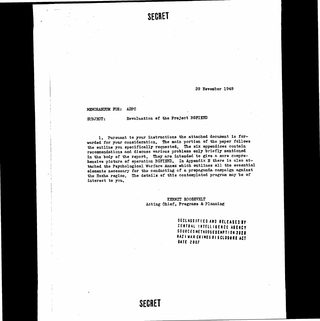 29 November 1949 · 18 p.OPC's revaluation of the Albanian operation (29 November 1949)Office of Policy Coordination, Programs and Planning staff (covering memorandum signed by Kermit Roosevelt, Acting Chief, Programs & Planning)Written weeks after the first landings in Albania, this OPC paper counts the losses, admits the operation was no secret, and still recommends pressing on with armed teams and arms drops to overthrow Hoxha.
- 18 June 1948NSC 10/2: covert action authorized (1948)National Security Council (text circulated by the Executive Secretary, Sidney W. Souers)The June 1948 National Security Council directive that put peacetime covert operations inside the CIA, defined them, and wrote the idea of 'plausible deniability' into American policy.
Checking the record
Dates and outcome compared in two independent sources: they agree.
- CIA
- Project outline approved June 1949; CIA plans for further agent operations in 1952; operation still producing intelligence in December 1952. Ultimate objective stated as overthrow of the Albanian government; no overthrow followed (later CIA and State papers treat Albania as still under Hoxha's control).
- Wikipedia
- Talks in 1949; first British landing October 1949; infiltrations to 1952–53; trials in April 1954. A failure; most agents were caught; often cited figure of about 300 killed.
The CIA files and Wikipedia agree on the 1949 start and the failure to dislodge Hoxha. The Wikipedia article includes claims (French participation, a precise toll of 300 dead) that the government sources here do not support; this page does not repeat them as fact.
Sources
- CIA Project outline: Code name BGFIEND (OBOPUS BG FIEND, Vol. 2, document 0003), Central Intelligence Agency, Office of Policy Coordination (released 2007; archived copy) (1949-06).
- CIA Memorandum, 22 June 1949, on approval of the BGFIEND project outline (OBOPUS BG FIEND, Vol. 2, document 0005), Central Intelligence Agency (released 2007; archived copy) (1949-06-22).
- CIA Memorandum, 7 September 1949: Revaluation of the Project BGFIEND (OBOPUS BG FIEND, Vol. 2, document 0009), Central Intelligence Agency (released 2007; archived copy) (1949-09-07).
- CIA CIA/OPC 1952 Albanian Operations (OBOPUS BG FIEND, Vol. 2, document 0001), Central Intelligence Agency (released 2007; archived copy) (1952).
- CIA Memorandum for Deputy Director (Plans), 1 December 1952: Operation BGFIEND (OBOPUS BG FIEND, Vol. 2, document 0046), Central Intelligence Agency (released 2007; archived copy) (1952-12-01).
- FRUS Foreign Relations of the United States, 1945–1950, Emergence of the Intelligence Establishment, Document 402, US Department of State, Office of the Historian (1949-10-17).
- FRUS Foreign Relations of the United States, 1950–1955, The Intelligence Community, Document 142, US Department of State, Office of the Historian (1952-12-31).
- Other Anglo-American Covert Action in Albania: Seven Critiques of the Orthodox Historiography of Operation BGFiend/Valuable (Stephen Long, Journal of Intelligence History, 2024), Xi'an Jiaotong-Liverpool University research portal (2024-12-24).
- Wikipedia Operation Valuable, Wikipedia.
- Wikipedia English Wikipedia article (used for cross-checking).
Elsewhere in the files
- Agency Secret Intelligence Service (MI6)
- Document 'CIA Agents Imprisoned in the Soviet Union': a retiring officer's memo on captured REDSOX agents (1978)
- Document NSC 10/2: covert action authorized (1948)
- Document NSC 68 (1950)
- Document OPC's revaluation of the Albanian operation (29 November 1949)
- Operation Operation Redsox
- Operation The Cambridge Five
- Person Kim Philby
Read next
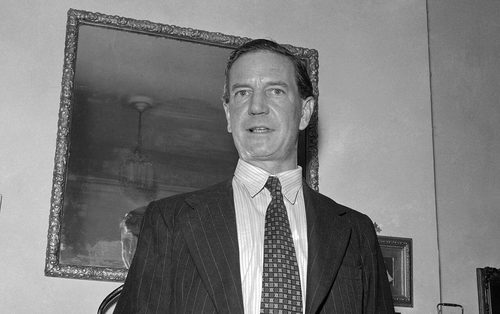 1912–1988
Kim Philby
SIS officer and Soviet agent from 1934 who served as British intelligence liaison in Washington, was publicly cleared in 1955, and fled from Beirut to Moscow in January 1963.
1949 – 1954
Operation Redsox
REDSOX was the CIA's early Cold War program for parachuting and smuggling émigré agents into the Soviet Union. It produced little intelligence and cost many agents their lives.
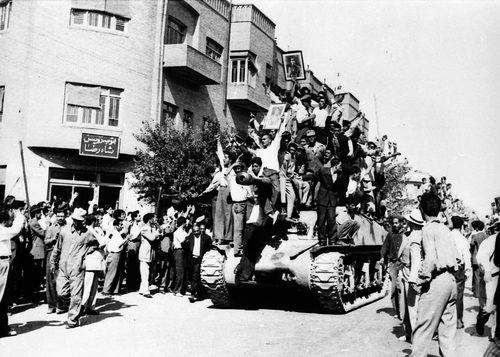 March – 19 August 1953
Operation Ajax (TPAJAX)
The 1953 Anglo-American covert operation that removed Iran's prime minister Mohammad Mosaddeq, as reconstructed from the CIA and State Department records published in 2017.
18 June 1948
NSC 10/2: covert action authorized (1948)
The June 1948 National Security Council directive that put peacetime covert operations inside the CIA, defined them, and wrote the idea of 'plausible deniability' into American policy.