
In the late 1940s Washington had very few sources inside the Soviet Union. One answer, adopted by the young CIA in 1949, was to recruit men from the displaced persons and wartime émigrés in Western Europe, train them, and send them back across the border, often by parachute. The umbrella cryptonym for these infiltrations was REDSOX1,3.
Who went, and why
The recruits came largely through émigré political organizations: Ukrainian, Baltic and Russian groups, and Circassians and others from the Caucasus2,3. Working through these organizations tied the CIA to their politics and to the wartime pasts of some of their leaders2.
The best-documented strand is Ukrainian. From 1949 the CIA backed the foreign representation of the Ukrainian Supreme Liberation Council (ZP/UHVR) under the project later known as AERODYNAMIC, working with Mykola Lebed and Ivan Hrinioch2,3. Lebed had been a wartime leader of the Bandera wing of the Organization of Ukrainian Nationalists; a 1947 US Army counterintelligence report had called him a collaborator of the Germans, yet the CIA came to regard him as indispensable and later shielded him from investigation2,6. The aim in Ukraine was to make contact with the nationalist underground, the UPA, which was still fighting Soviet security troops in the western provinces.
Into Ukraine and the Baltic
AERODYNAMIC's first phase was to drop CIA-trained Ukrainians into the country and bring others out. A joint report by the CIA's intelligence and covert-action offices in December 1950 described "a well established and secure underground movement" larger than earlier reports had suggested, and the head of covert operations, Frank Wisner, made it "a top priority project"2.
The optimism did not last. Members of teams sent between 1949 and 1953 were captured and killed. By 1954 Lebed's group had lost all contact with the underground; the CIA ended the "aggressive phase" of the project2. The British Secret Intelligence Service (Secret Intelligence Service (MI6)) ran its own Ukrainian lines through Lebed's rival Stepan Bandera, over strong American objections, until it broke with him in February 19542.
The Baltic states were the other main target. SIS landed Estonian, Latvian and Lithuanian agents from fast boats under its Operation Jungle; Soviet security penetrated that network and captured or turned most of its men5. In 1952 the CIA set up a domestic operations base, project AEACRE, to interrogate, assess, train and brief agents before dispatch into the USSR3.
The Soviet side of the ledger
Moscow chose when to make the losses public. On 27 May 1953 Soviet newspapers carried an Interior Ministry communiqué announcing the execution of four men it called American spies, said to have been dropped by parachute from an unmarked aircraft over Ukraine on 26 April with espionage equipment. According to the communiqué, they had been trained near Munich, flown out through Athens, and tried by a military tribunal of the Soviet Supreme Court before being shot4. The publicity served Soviet propaganda, and it told the CIA that the teams were being met.
Assessment
The State Department's historians summarize the outcome plainly: "given stringent Soviet controls, these attempts, codenamed Redsox, enjoyed very limited success. This was recognized by 1954." The CIA turned instead to REDSKIN, using legal travelers to the Soviet Union for short-term observation, and to REDCAP, formalized in 1951, which targeted Soviet officials abroad and encouraged defections1. The Ukrainian project survived as a publishing and broadcasting operation: from 1953 it ran through a New York research group that became the Prolog organization, sending literature into Ukraine for decades2.
Much of the operational record is in CIA files released to the National Archives between 2005 and 2007, and in agency histories that have been only partly released2. No full official account of REDSOX has been published.
The documents
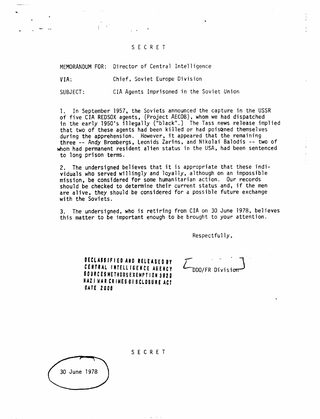
Declassified records of this operation, with the scans and their full text hosted here.
Checking the record
Dates and outcome compared in two independent sources: they agree.
- FRUS
- Attempts to infiltrate agents into the Soviet Union, codenamed Redsox, recognized as of very limited success by 1954 Replaced by REDSKIN, a program using legal travelers for short-term observation.
- Wikipedia
- British parallel program, 1949–1955 Soviet security penetrated the network and captured or turned most of the agents.
Wikipedia has no article on REDSOX itself, so the cross-check uses its article on the British program running in parallel against the same targets. The two sources agree that the émigré infiltration programs of 1949–55 largely failed. The dates here follow FRUS and the National Archives study.
Sources
- FRUS FRUS, 1950–1955, The Intelligence Community, Document 87: Report on the Office of Special Operations (Kirkpatrick), 31 August 1951, editorial footnote, US Department of State, Office of the Historian (2007).
- National Archives Richard Breitman and Norman J. W. Goda, Hitler's Shadow: Nazi War Criminals, U.S. Intelligence, and the Cold War, National Archives and Records Administration (2010).
- National Archives Research Aid: Cryptonyms and Terms in Declassified CIA Files (second release lexicon), National Archives and Records Administration, Nazi War Crimes and Japanese Imperial Government Records Interagency Working Group (2007).
- Other "Reds Admit Killing 4 Alleged Spies" (United Press), University Daily Kansan, 27 May 1953, University of Kansas Libraries (digitized newspaper) (1953-05-27).
- Wikipedia Operation Jungle, Wikipedia.
- Wikipedia Mykola Lebed, Wikipedia.
Elsewhere in the files
Read next
 United States · 1947
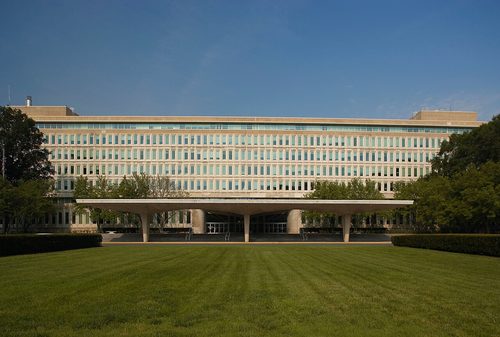
Central Intelligence Agency (CIA)
The US civilian intelligence service, created by the National Security Act of 1947 to coordinate foreign intelligence, which within a year also became Washington's instrument for covert action.
 Soviet Union · 1954–1991
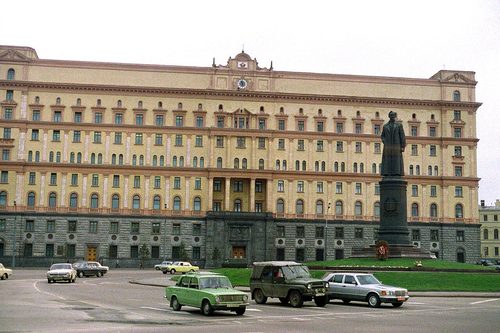
KGB
The Soviet Committee for State Security, 1954–1991: foreign intelligence, counter-intelligence, border troops and political police under one roof, from Khrushchev's reforms to the failed coup of August 1991.
1934 – 23 January 1963
The Cambridge Five
Five Cambridge graduates recruited by Soviet intelligence in the 1930s reached MI6, MI5, the Foreign Office and Bletchley Park, and were exposed one by one between 1951 and 1990.
 United Kingdom · 1909
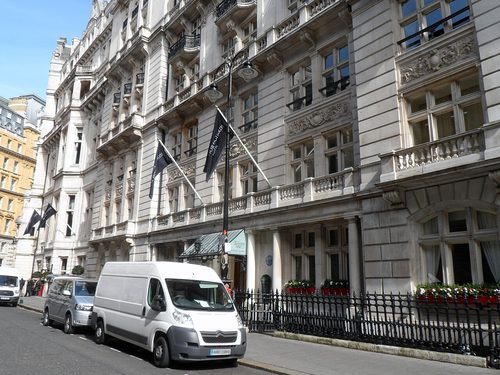
Secret Intelligence Service (MI6)
Britain's foreign intelligence service, founded in 1909 as the foreign section of the Secret Service Bureau, run by a chief known as 'C', and not placed on a statutory footing until the Intelligence Services Act 1994.