
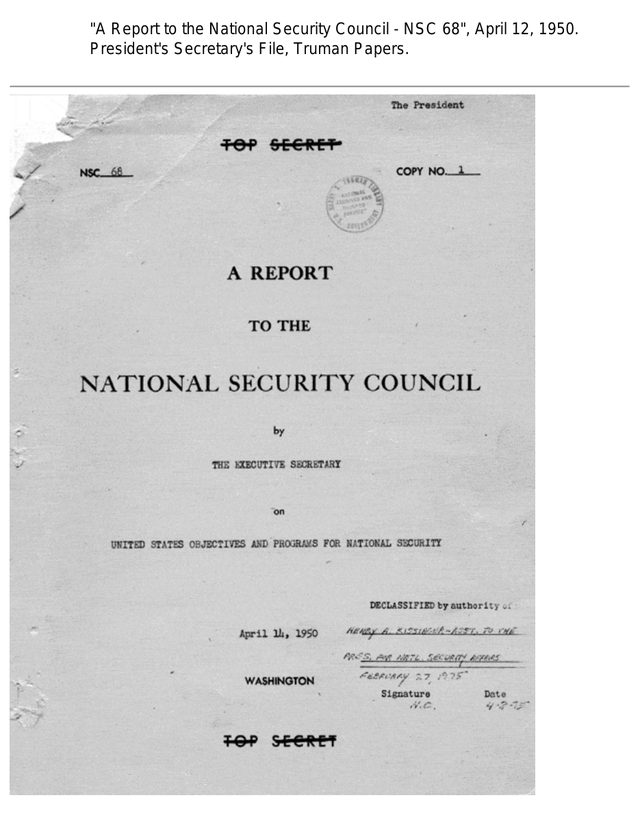
 Page 1 of 72
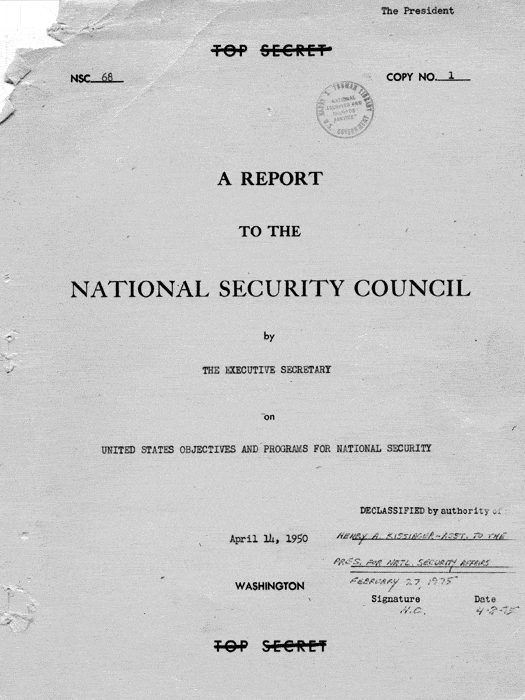

From the document
the Soviet Union, unlike previous aspirants to hegemony, is animated by a new fanatic faith, antithetical to our own, and seeks to impose its absolute authority over the rest of the world.
The integrity of our system will not be jeopardized by any measures, covert or overt, violent or non-violent, which serve the purposes of frustrating the Kremlin design
This estimate is admittedly based on incomplete coverage of Soviet activities and represents the production capabilities of known or deducible Soviet plants.
Intensification of affirmative and timely measures and operations by covert means in the fields of economic warfare and political and psychological warfare with a view to fomenting and supporting unrest and revolt in selected strategic satellite countries.
Excerpts are passages from a US government work (public domain), quoted exactly and checked against the text on history.state.gov on every rebuild.
On 31 January 1950, the day a special NSC committee reported to him on thermonuclear weapons, President Truman directed the Secretaries of State and Defense to reexamine "our objective in peace and war" in light of the Soviet Union's "probable fission bomb capability and possible thermonuclear bomb capability"1. The first Soviet atomic test and the Communist victory in China had already unsettled Washington3. The review that came back was NSC 68.
A joint State–Defense study group chaired by Paul Nitze, the new director of the State Department's Policy Planning Staff, drafted it6. It went to the President on 7 April 1950. On 12 April Truman passed it to the National Security Council, asking for the programs it implied and what they would cost, and on 14 April the NSC's executive secretary circulated it with a request that it be "handled with special security precautions"1,3.
The argument
The paper opens with history: two world wars, the Russian and Chinese revolutions, and the collapse of five empires had left power concentrated in two centers1. What made the situation dangerous, the authors argued, was the character of one of them. The Kremlin's "fundamental design" was to impose absolute authority at home and then over the rest of the world. The United States was the only obstacle that mattered1.
The middle chapters weigh "the idea of freedom" against "the idea of slavery" in language more like a sermon than a staff paper. They then turn to capabilities. Here intelligence enters the text directly. The paper relied on a CIA estimate, agreed by the military services and the Atomic Energy Commission, of how many atomic bombs the Soviet Union could make. The estimate ran from 10–20 by mid-1950 to 200 by mid-19541. The authors admitted that the figure rested on incomplete coverage and might be dangerously low. They treated a Soviet stockpile of 200 bombs as the critical date, since 100 bombs delivered on American targets "would seriously damage this country"1.
The paper then considers four courses: carry on with current policy, withdraw into isolation, go to war, or build up the free world's political, economic and military strength much faster. It rejects the first three1.
The covert-action clause
The recommended course lists the program it would "probably involve." Among higher taxes, more military aid and civil defense are two items aimed at the intelligence services. One calls for intensified covert economic, political and psychological warfare to foment "unrest and revolt in selected strategic satellite countries." The other calls for the "improvement and intensification of intelligence activities"1. An earlier chapter had already said that no measure, "covert or overt, violent or non-violent," would compromise American values if it served to frustrate the Kremlin1.
The first clause fell to the Office of Policy Coordination, the covert-action office created under NSC 10/2: covert action authorized (1948) two years earlier. Its operations expanded greatly in line with NSC 68. By late 1950 the new Director of Central Intelligence, Walter Bedell Smith, worried that so much covert work would crowd out the agency's main job of collecting intelligence4. For one of the office's operations against a Soviet satellite in these years, see Operation Valuable (Albania).
From paper to policy
Truman did not approve the paper in April. Nitze's group had left out cost figures, and the President wanted them1,3. The outbreak of war in Korea on 25 June 1950 changed the politics. On 30 September 1950, as NSC 68/2, Truman approved the conclusions "as a statement of policy to be followed over the next four or five years." He ordered that there be no public discussion of the program and no public quotation of figures2.
Declassification and debate
NSC 68 was declassified in 1975 and printed in the Foreign Relations volume for 1950 in 19771,3. Historians still argue over it. Some see it as an accurate warning about a growing threat. Others, following critics inside the government at the time, think it painted the Soviet Union in the worst possible light. The drafters set aside the more cautious readings of Soviet aims offered by George Kennan, Charles Bohlen and Llewellyn Thompson, who saw Stalin's first goal as holding on to what he already controlled3. Read beside the The Long Telegram (1946), which Kennan intended as a diagnosis rather than a call to arms, NSC 68 shows how containment became a large standing military and covert program3,5.
Sources
- FRUS Foreign Relations of the United States, 1950, National Security Affairs; Foreign Economic Policy, Volume I, Document 85, US Department of State, Office of the Historian (1977).
- FRUS Foreign Relations of the United States, 1950, Volume I, Document 129 (NSC 68/2, 30 September 1950), US Department of State, Office of the Historian (1977).
- Wikipedia NSC 68, Wikipedia.
- Wikipedia Office of Policy Coordination, Wikipedia.
- FRUS Foreign Relations of the United States, 1946, Eastern Europe, The Soviet Union, Volume VI, Document 475 (the Long Telegram), US Department of State, Office of the Historian (1969).
- Wikipedia Paul Nitze, Wikipedia.
- Wikipedia English Wikipedia article (used for cross-checking).