
 Page 1 of 19

From the document
At bottom of Kremlin's neurotic view of world affairs is traditional and instinctive Russian sense of insecurity.
they are in reality working closely together as an underground operating directorate of world communism, a concealed Comintern tightly coordinated and directed by Moscow.
Impervious to logic of reason, and it is highly sensitive to logic of force. For this reason it can easily withdraw—and usually does—when strong resistance is encountered at any point.
World communism is like malignant parasite which feeds only on diseased tissue.
Excerpts are passages from a US government work (public domain), quoted exactly and checked against the text on history.state.gov on every rebuild.
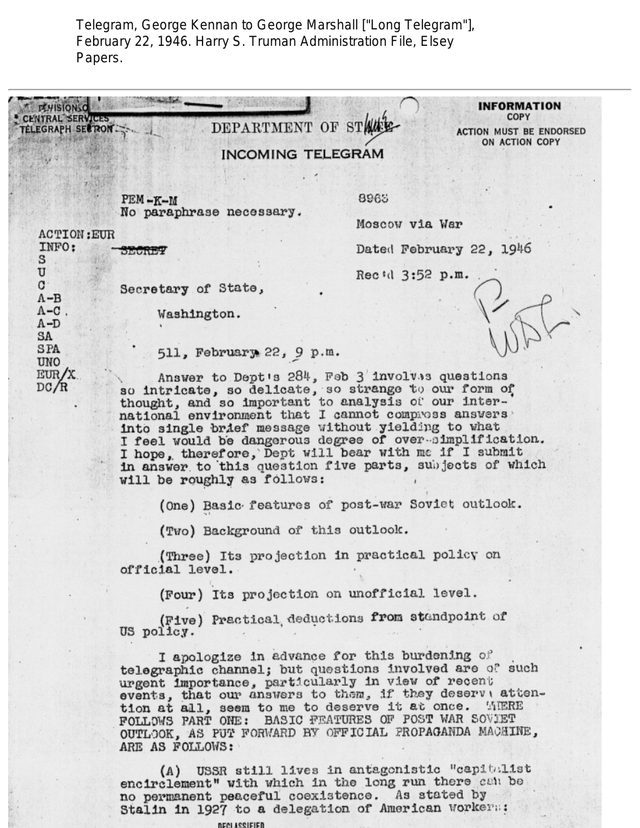
Telegram number 511 left the American embassy in Moscow at 9 p.m. on 22 February 1946 and was logged in Washington the same afternoon, allowing for the time difference. Its author, George F. Kennan, was running the embassy as chargé d'affaires. He was answering a routine request: the State Department wanted an interpretation of the speeches Stalin and other Soviet leaders had given before the February elections, and of what those speeches meant for Soviet policy1.
The department had asked for "an interpretive analysis" of how the announced Soviet policies would be carried out1. What came back ran to a little over 5,000 words, which is how it got its nickname3.
What the telegram says
Kennan apologized at the start for "burdening" the telegraph channel, then laid out five parts1.
Part 1 set out the Soviet worldview as the official propaganda presented it: the USSR lived in a hostile "capitalist encirclement," capitalist states were bound to fight each other, and Moscow should exploit their quarrels1.
Part 2, the part most often quoted, explained where that view came from. Kennan did not think it came from any honest reading of the outside world. He traced it to an old Russian insecurity, and to rulers who knew their system could not stand comparison with the West. On his account, Marxism gave those rulers a reason to treat the outside world as an enemy, and so a reason for the dictatorship they needed to stay in power1.
Part 3 covered official Soviet policy: building up military and industrial strength, probing outward where that looked safe, and using the new United Nations only as far as it served Soviet ends1.
Part 4 matters most to a history of espionage. Kennan described a "subterranean plane" of Soviet activity for which Moscow would accept no responsibility. He listed the instruments: the hidden inner core of foreign Communist parties, which he called a "concealed Comintern"; the open party membership; front organizations among unions, youth groups, women's groups and the press; international bodies that could be penetrated; the Russian Orthodox Church; and governments willing to serve Soviet purposes1. He predicted that these would be used to deepen divisions in Western countries, to set the Western powers against each other and to push hostile governments out of office, naming Turkey and Iran as likely targets1. For the counterintelligence cases of the same years, see The Gouzenko affair and The Venona project.
Part 5 drew the practical conclusions. Soviet power was dangerous but cautious. It would retreat when it met firm resistance. The West was still the stronger side, and much depended on "health and vigor of our own society." Kennan ended by warning Americans not to become like the people they were opposing1.
How Washington read it
Secretary of State James Byrnes praised it, and Navy Secretary James Forrestal had copies circulated widely around Washington3. Kennan was brought home that spring to teach at the new National War College3. In July 1947 he published a public version of the argument, under the pseudonym "X," in Foreign Affairs. That article put the word "containment" into general use2,3.
Containment as a policy reached well beyond diplomacy. When the National Security Council approved NSC 10/2: covert action authorized (1948) in June 1948, creating a covert-action office inside the CIA, Kennan, by then head of the State Department's Policy Planning Staff, was the key figure behind it5. NSC 68 (1950) in 1950 kept the containment framework but gave it a much more military form, and its drafters left out the more restrained reading of Soviet aims that Kennan and other Soviet specialists held4,6.
Publication and later use
The telegram was printed in full in 1969 in the Foreign Relations volume for 1946 on Eastern Europe and the Soviet Union, with the State Department's file number 861.00/2-22461.
Some historians caution against overstating its influence. Washington was already hardening its line before the telegram arrived. Byrnes gave a tougher speech on 28 February that had been drafted before he read it3. Seen that way, the telegram explained a turn that was already under way rather than causing it. The Soviet side wrote a counterpart that September, a telegram on American foreign policy from Ambassador Nikolai Novikov in Washington. Kennan wrote a commentary on it in 19913.
What the telegram does not contain is intelligence in the narrow sense. It cites no secret sources, no defectors and no intercepts. Its evidence is Soviet propaganda and official behavior, read closely by one diplomat1.
Sources
- FRUS Foreign Relations of the United States, 1946, Eastern Europe, The Soviet Union, Volume VI, Document 475, US Department of State, Office of the Historian (1969).
- Official history Kennan and Containment, 1947 (Milestones in the History of US Foreign Relations), US Department of State, Office of the Historian.
- Wikipedia X Article (section: The "long telegram"), Wikipedia.
- FRUS Foreign Relations of the United States, 1950, National Security Affairs; Foreign Economic Policy, Volume I, Document 85 (NSC 68), US Department of State, Office of the Historian (1977).
- Wikipedia Office of Policy Coordination, Wikipedia.
- Wikipedia NSC 68, Wikipedia.
- Wikipedia English Wikipedia article (used for cross-checking).