
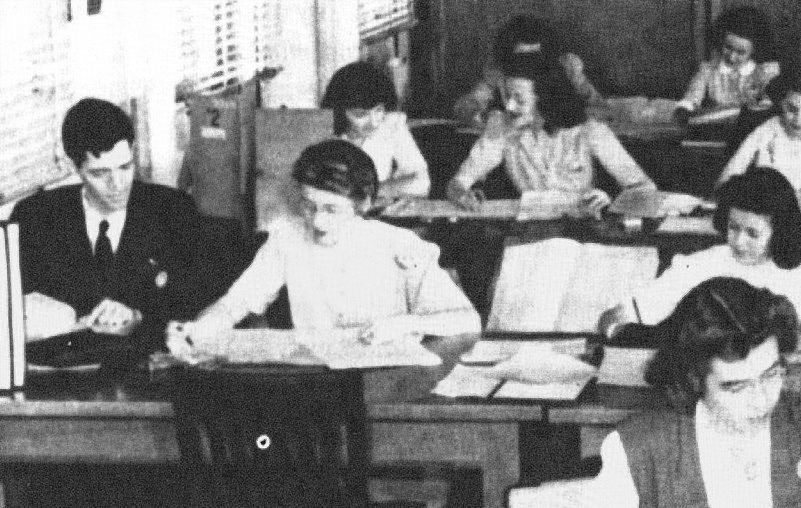

Collecting the cables was the easy part. Soviet intelligence stations in the United States sent their important messages home over commercial telegraph lines. As war approached in 1939 the US Army began collecting the enciphered telegrams, and soon thousands were piling up at its Signal Security Agency1,4. Reading them was supposed to be impossible: the Soviets encoded each message from a codebook and then enciphered the code groups with a one-time pad, a system that is unbreakable if every pad page is used once1.
A small program at Arlington Hall
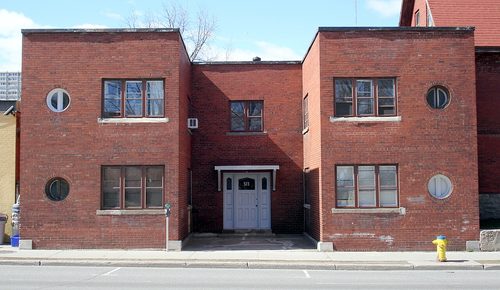
On 1 February 1943, on orders from Colonel Carter Clarke of the Army's Special Branch, the agency set up a small unit at Arlington Hall in northern Virginia to study the Soviet traffic. Clarke's concern was that Moscow might negotiate a separate peace with Berlin1. Gene Grabeel, a former Virginia schoolteacher, started the work and stayed on it for 36 years; she and her colleagues spent months sorting the telegrams by circuit until five separate cryptographic systems emerged1.
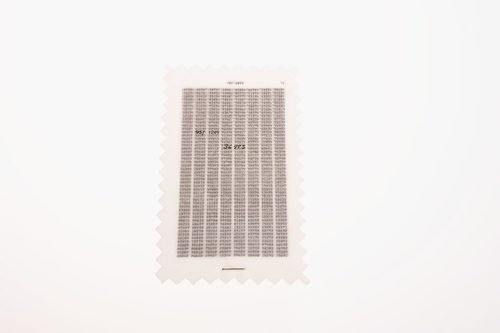
The break came from a manufacturing error in Moscow. For a few months in early 1942 the KGB's cryptographic center printed duplicate copies of the key on more than 35,000 pages of one-time pads and bound them into separate pad books1. In autumn 1943 Lieutenant Richard Hallock, working on the trade-mission traffic, found evidence of those duplicates. In November 1944 analysts solved the problem of finding where each message started in its pad, and by matching pages used twice they recovered the additive key for parts of hundreds of telegrams1. Cecil Phillips of NSA later wrote that the breakthrough was "a purely analytic accomplishment, achieved without the benefit of either Soviet codebooks or plain-text copies of original messages"1.
Reading the KGB
The key alone was not enough; analysts still had to rebuild the codebook. The linguist Meredith Gardner, who had worked on German and Japanese systems, broke the KGB codebook's "spell table" for English words late in 1946. Almost at once he was reading a December 1944 message that listed the leading scientists of the Manhattan Project1. By May 1947 he could see that the cables described Soviet espionage on a large scale1.
In late summer 1948 the Army quietly brought in the FBI. Special Agent Robert Lamphere became the link, swapping leads and identifications with Gardner1. Britain joined from 1948, and the material was given the control term BRIDE in 1950, DRUG in the late 1950s and VENONA only in 19611. The National Security Agency, formed in November 1952, inherited the work; the CIA received its first translations in 19531.
Names behind the covernames
Venona's yield came mostly from messages of 1944 and 1945. The covernames were then matched to real people by investigation4:
- Donald Maclean. From February 1949 analysts saw British Foreign Office telegrams quoted in KGB traffic; by May 1951 the source HOMER had been narrowed to Maclean, who fled to Moscow with Guy Burgess1. See The Cambridge Five.
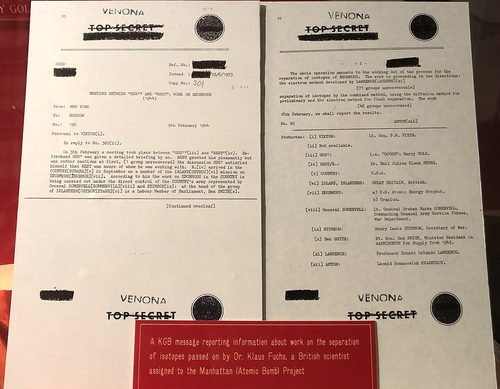
- Klaus Fuchs. In September 1949 the FBI matched REST and CHARLES to Fuchs, author of a paper quoted in one message1.
- The Rosenberg network. In June 1950 the FBI found that LIBERAL, earlier ANTENNA, fitted Julius Rosenberg1,5. A cable of 21 September 1944 names Ruth Greenglass in clear text, and one of 27 November 1944 describes LIBERAL's wife, "first name ETHEL, 29 years old"2.
- Theodore Hall. A cable of 12 November 1944 records the recruitment of Theodore Hall by name. The FBI questioned him in 1951, but he was never prosecuted, probably because the case would have exposed the codebreaking1,2.
The decrypts also corroborated much of what Elizabeth Bentley and Whittaker Chambers had told the FBI. Judith Coplon, a Justice Department analyst, was the first person arrested on a Venona lead, in March 1949; at her trial the government concealed the source and called it a "confidential informant"1.
The secret that leaked
The Soviets knew about Venona long before the American public did. William Weisband, a Russian-speaking "linguist adviser" in Arlington Hall's Russian section, watched Gardner extract the list of atomic scientists; the CIA and NSA editors believe he told Moscow about the work. Weisband always denied spying and was never prosecuted for it, though he was sentenced to a year in prison for contempt after skipping a grand jury hearing1. From autumn 1949 Kim Philby, the British intelligence liaison in Washington, received actual translations1. By then most of the duplicated pages had been used, so Moscow could do little except warn exposed agents1.
Inside Washington the secret was kept so tightly that the decrypts were never used in court, and Benson and Warner found no definitive evidence that President Truman was ever briefed on the program1. The editors argue that this secrecy carried a price: public debate over Soviet espionage in the 1950s was polarized because the evidence the government held could not be shown, a judgment the Moynihan Commission repeated in 19971,5.
Closing and release
New messages became rare after 1948, but the work went on, with translations still being issued in the 1960s and 1970s. The program was formally closed on 1 October 19801,4. In July 1995, at a ceremony at CIA Headquarters, Director of Central Intelligence John Deutch released the first group of translations: 49 messages on atomic espionage. Five more releases followed, and by 1996 some 2,900 messages were public1,3.
The documents
Declassified records of this operation, with the scans and their full text hosted here.
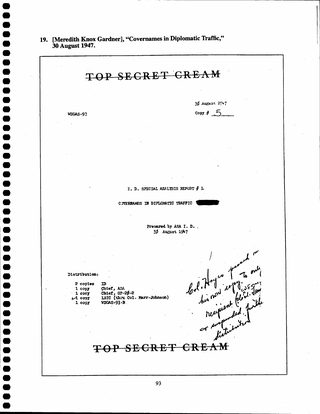 30 August 1947 · 11 p.Meredith Gardner's first Venona report: "Covernames in Diplomatic Traffic" (1947)Army Security Agency, Intelligence Division (I.D.); prepared by Meredith Knox GardnerThe Army codebreaker's August 1947 catalog of the cover names he could read in wartime Soviet cables, including an unidentified LIBERAL whose wife was called Ethel: the start of Venona's spy hunt.
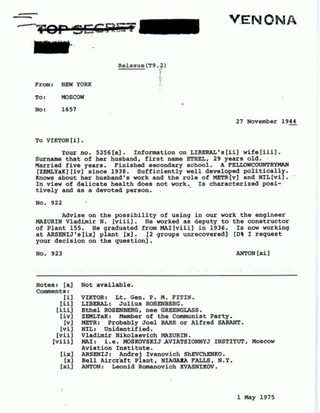 27 November 1944 · 1 p.A Venona decrypt: New York 1657, 27 November 1944KGB New York residency, signed ANTON (Leonid Kvasnikov)A short KGB cable from New York to Moscow describing LIBERAL's wife, "first name ETHEL." Broken by Army codebreakers years later, it became the most argued-over Venona message in the Rosenberg case.
Checking the record
Dates and outcome compared in two independent sources: they agree.
- CIA
- Program created 1 February 1943; Gardner broke the spell table late in 1946; effort formally closed in 1980; translations released July 1995 onward. More than 2,900 Soviet telegrams partly read; identifications of Fuchs, Gold, Greenglass, Rosenberg, Maclean, Coplon; Hall identified but not prosecuted.
- Wikipedia
- 1 February 1943 to 1 October 1980. Approximately 3,000 messages decrypted and translated; exposed Manhattan Project espionage and the Cambridge Five.
Dates agree. Counts differ slightly (CIA/NSA say 'some 2,900' messages; Wikipedia and NSA's later web page say about 3,000). This page uses the 1996 CIA/NSA figure.
Sources
- CIA Venona: Soviet Espionage and the American Response, 1939–1957 (Foreword, Preface, Introduction), Central Intelligence Agency and National Security Agency (eds. Robert L. Benson and Michael Warner) (1996).
- NSA Venona, Part II: Selected Messages, 1939–1957, Central Intelligence Agency and National Security Agency (1996).
- NSA VENONA (declassified documents overview), National Security Agency (archived copy).
- Official history The VENONA Intercepts, 1946–1980, US Department of Energy, Office of History and Heritage Resources.
- Congress Report of the Commission on Protecting and Reducing Government Secrecy, Appendix A, US Government Printing Office (1997).
- Wikipedia Venona project, Wikipedia.
- Wikipedia English Wikipedia article (used for cross-checking).
Elsewhere in the files
- Agency Federal Bureau of Investigation (FBI)
- Agency GC&CS and GCHQ
- Agency GRU (Soviet military intelligence)
- Agency National Security Agency (NSA)
- Agency Security Service (MI5)
- Document A Venona decrypt: New York 1657, 27 November 1944
- Document Hearings on American Aspects of the Richard Sorge Spy Case (HUAC, 1951)
- Document Hoover tells the White House about Gouzenko (September 1945)
- Document Meredith Gardner's first Venona report: "Covernames in Diplomatic Traffic" (1947)
- Document The Long Telegram (1946)
- Operation Soviet atomic espionage (Enormoz)
- Operation The Cambridge Five
- Operation The Gouzenko affair
- Person Alger Hiss
- Person Donald Maclean
- Person Elizabeth Bentley
- Person Ethel Rosenberg
- Person Guy Burgess
- Person Harry Gold
- Person Igor Gouzenko
- Person J. Edgar Hoover
- Person Julius Rosenberg
- Person Kim Philby
- Person Klaus Fuchs
- Person Melita Norwood
- Person Morris and Lona Cohen
- Person Theodore Hall
- Person Whittaker Chambers
- Tradecraft Cipher machines
- Tradecraft One-time pads
- Tradecraft Signals intelligence
Read next
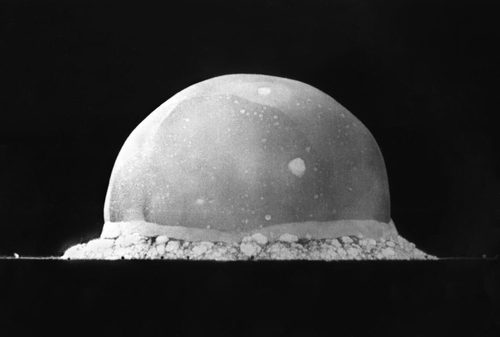 September 1941 – June 1950
Soviet atomic espionage (Enormoz)
How Soviet intelligence penetrated the Manhattan Project under the codename ENORMOZ, who its sources were, how Venona and confessions exposed them, and what the stolen secrets were worth.
 5 September 1945 – 27 June 1946
The Gouzenko affair
In September 1945 a GRU cipher clerk walked out of the Soviet embassy in Ottawa with over a hundred documents, exposing a Soviet spy network in Canada and a British atomic scientist.
1934 – 23 January 1963
The Cambridge Five
Five Cambridge graduates recruited by Soviet intelligence in the 1930s reached MI6, MI5, the Foreign Office and Bletchley Park, and were exposed one by one between 1951 and 1990.
 27 November 1944
A Venona decrypt: New York 1657, 27 November 1944
A short KGB cable from New York to Moscow describing LIBERAL's wife, "first name ETHEL." Broken by Army codebreakers years later, it became the most argued-over Venona message in the Rosenberg case.
 1917–1980s
One-time pads
The one cipher proven unbreakable if its key is random and never reused. Soviet intelligence relied on it, and a wartime printing shortcut that duplicated pages let US codebreakers read thousands of messages.
 1914–1990s
Signals intelligence
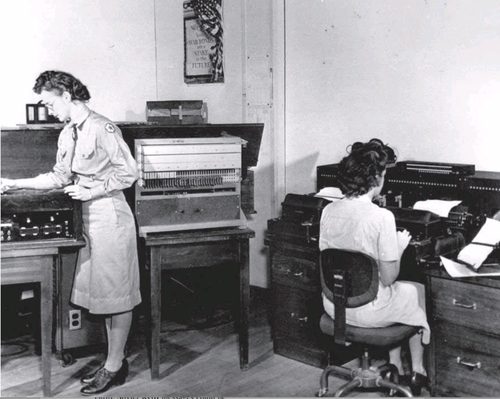
Intelligence from intercepted communications and electronic emissions, from Room 40 and the Zimmermann telegram to Ultra, Venona, the Berlin tunnel and NSA's domestic programs exposed by the Church Committee.