
Portrait: Donald Maclean, in a United Press International photograph. United Press International. Wikimedia Commons, Public domain.

Donald Maclean was the agent whose exposure broke the Cambridge network open. He was caught not by a defector or a confession but by codebreaking: Soviet telegrams from 1944–45, read years later in the joint Anglo-American The Venona project effort, described a source codenamed HOMER inside the British Embassy in Washington.2,5
A diplomat's career
Maclean was born in Marylebone on 25 May 1913, the son of Sir Donald Maclean, a Liberal politician and later Cabinet minister. He went to Gresham's School and Trinity Hall, Cambridge, where he joined the Communist Party, and was recruited by Soviet intelligence before entering the Diplomatic Service in August 1935. MI5 later assessed him as having been a Soviet agent since the 1930s.1,5
He was a capable official and rose quickly. He took up the post of Third Secretary in Paris on 24 September 1938, and in 1944 went to Washington, where he served until 1948 and was promoted to First Secretary.5 Toward the end of that posting he acted as secretary of the Combined Policy Committee, the Anglo-American-Canadian body on atomic energy.5 In 1948 he became Head of Chancery in Cairo. After what the Foreign Secretary later called "a breakdown in Cairo... due to overstrain," he returned to London and was made head of the Foreign Office's American Department.3
HOMER
MI5's 2015 release covers the search for HOMER. It says the Venona breakthrough identified Maclean, and that he had been passing information on the British negotiating position for the wartime talks between Churchill, Roosevelt and Stalin.2 The intercepted traffic included a description of a message from Churchill to Roosevelt.5 The catalogue entry for his file puts it plainly: in 1951 Maclean "was identified as the source of a leakage from the Washington Embassy some years earlier."1
Identification was not proof. Venona material could not be shown in court without revealing the programme, and in the spring of 1951 the security authorities were preparing to interview him.5
Escape
He did not wait. Kim Philby, who knew of the investigation in Washington, warned him through Guy Burgess, as the government acknowledged in 1963.4 On the evening of 25 May 1951, his 38th birthday, Maclean left his home at Tatsfield in Surrey with Burgess.5 Herbert Morrison told the Commons on 11 June that the two had left Southampton that night, disembarked at St. Malo on 26 May, and had not been traced since.3 MI5's surveillance had spotted Maclean meeting Burgess shortly beforehand.2
Anthony Blunt later admitted that he had used his old Soviet contact to help with the arrangements.5
In the Soviet Union
Maclean's American wife, Melinda, and their children later joined him in the Soviet Union.1,5 He and Burgess reappeared publicly at a short Moscow press conference in February 1956.5 Unlike Burgess, Maclean settled into Soviet working life, becoming a specialist on British foreign policy and on Soviet relations with NATO. He died in Moscow on 6 March 1983.5
The flight was the first public sign of what became known as the The Cambridge Five; the government's 1963 statement on Philby finally explained who had warned him.4
Key dates
- August 1935 Enters the Diplomatic Service.
- 24 September 1938 Takes up post as Third Secretary at the British Embassy in Paris.
- 1944 Posted to the British Embassy in Washington; later First Secretary.
- 1948 Appointed Head of Chancery at the British Embassy in Cairo.
- 1950 Appointed head of the Foreign Office's American Department.
- 25 May 1951 Flees with Guy Burgess via Southampton and St. Malo.
- February 1956 Appears with Burgess at a press conference in Moscow.
Sources
- Other KV 2/4140: Donald Duart MACLEAN (catalogue description), The National Archives (UK), Discovery catalogue (1949–1951).
- Official history October 2015 release of historical MI5 files, MI5 (Security Service), archived by the Internet Archive (2015-10).
- Other Foreign Service (Missing Officials), HC Deb 11 June 1951 vol 488 cc1668–75, UK Parliament, Hansard (1951-06-11).
- Other Mr. Harold Philby, HC Deb 1 July 1963 vol 680 cc33–5, UK Parliament, Hansard (1963-07-01).
- Wikipedia Donald Maclean (spy), Wikipedia.
- Wikipedia English Wikipedia article (used for cross-checking).
Elsewhere in the files
Read next
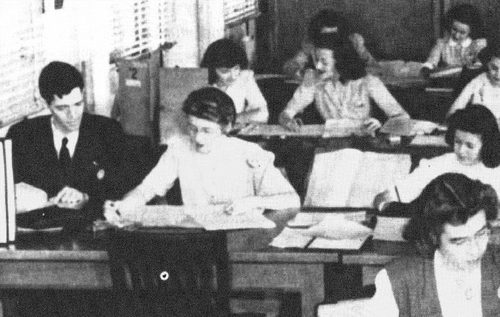 1 February 1943 – 1 October 1980
The Venona project
The US Army codebreaking program that, from 1943 to 1980, read parts of some 2,900 wartime Soviet intelligence cables and exposed Fuchs, the Rosenbergs and Donald Maclean.
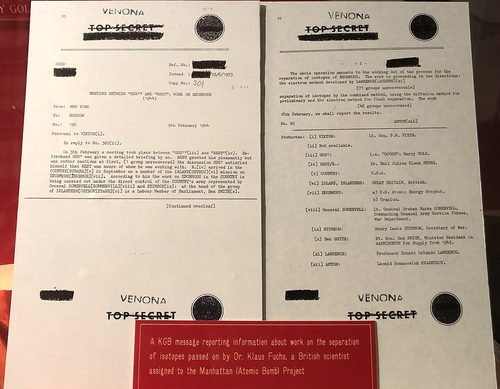 27 November 1944
A Venona decrypt: New York 1657, 27 November 1944
A short KGB cable from New York to Moscow describing LIBERAL's wife, "first name ETHEL." Broken by Army codebreakers years later, it became the most argued-over Venona message in the Rosenberg case.
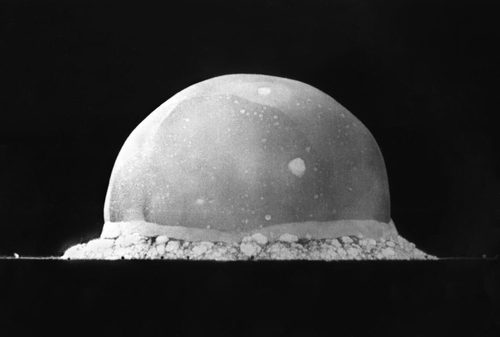 September 1941 – June 1950
Soviet atomic espionage (Enormoz)
How Soviet intelligence penetrated the Manhattan Project under the codename ENORMOZ, who its sources were, how Venona and confessions exposed them, and what the stolen secrets were worth.