
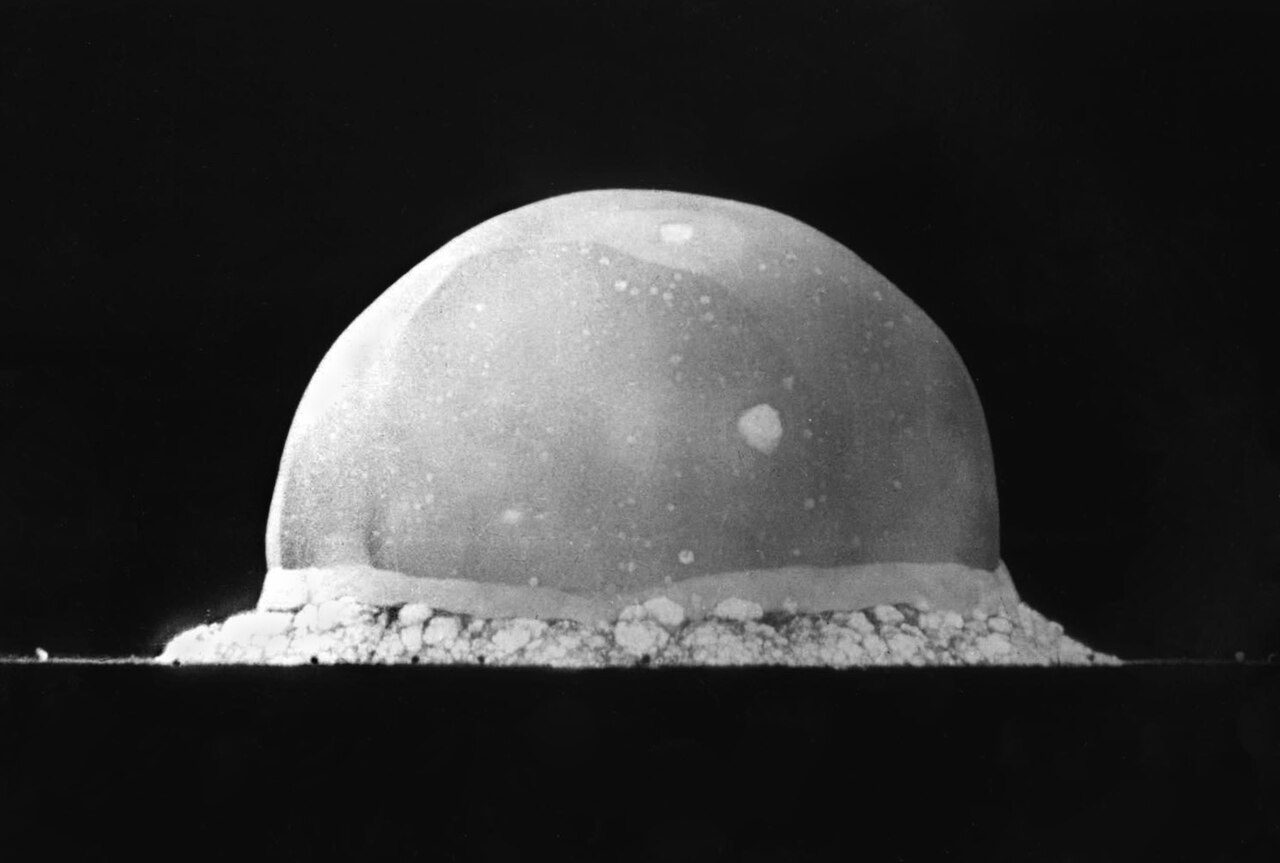

Soviet intelligence learned of Anglo-American work on an atomic bomb in September 1941, almost a year before the Manhattan Engineer District existed. The first word probably came from John Cairncross, then private secretary to a British minister who saw the MAUD Committee's findings; Donald Maclean reported on the subject at about the same time1. Moscow gave the target a fitting codename: ENORMOZ, "enormous"1.
What followed was the most consequential espionage effort of the Second World War. It ran in Britain, Canada and the United States, through two rival services, the military intelligence directorate (GRU) and the state security service (NKVD/NKGB, later the KGB), and it relied overwhelmingly on volunteers who believed the Soviet Union deserved to share the secret1,4.
The sources
The most valuable source was the German-born physicist Klaus Fuchs. He offered his services to the GRU in London in late 1941 and was passed in 1942 to the courier Ursula Kuczynski ("Sonya"), who met him in the Oxfordshire countryside near Banbury4. When Fuchs went to New York with the British mission in December 1943, control of him passed to the NKGB, whose courier Harry Gold met him in New York, Cambridge, Massachusetts, and Santa Fe4,5. From Los Alamos, where he worked in the Theoretical Division from August 1944, Fuchs passed the case for implosion, critical-mass data and, in June 1945, a dimensioned sketch of the plutonium bomb1,4.
The second scientist was Theodore Hall, a nineteen-year-old Harvard physicist at Los Alamos who walked into Soviet contact in New York in October 1944. A KGB cable of 12 November 1944 records his recruitment by name3. His couriers included Saville Sax and later Lona Cohen2.
The third Los Alamos source was a machinist, Army Sergeant David Greenglass, recruited through his wife Ruth at the urging of his brother-in-law Julius Rosenberg, an electrical engineer who ran a ring of engineers passing military electronics to the NKGB5. Benson and Warner, editing the declassified cables, count at least four agents at Los Alamos reporting through couriers to a KGB sub-residency at the New York consulate under Leonid Kvasnikov: Fuchs (covernames REST, then CHARLES), Greenglass (BUMBLEBEE, then CALIBRE), Hall (MLAD, "youngster") and an unidentified source called FOGEL or PERS2.
Canada supplied another route. The British physicist Alan Nunn May, working at the Montreal laboratory, passed GRU officers information from the Anglo-Canadian atomic project, a case exposed by the defector Igor Gouzenko in September 19452,7. Nunn May was sentenced in London to ten years' hard labor on 1 May 19467. Britain had other sources, including Melita Norwood, a secretary at a metals research association whose work for Moscow was revealed only in 19997.
How the ring came apart
Manhattan Project security caught several clumsy approaches during the war, at Berkeley's Radiation Laboratory and Chicago's Metallurgical Laboratory, and removed the scientists involved1. The important sources went undetected until the codebreakers of the Venona project began reading wartime KGB cables. In September 1949 the FBI concluded that REST and CHARLES were Fuchs, because one message quoted a paper he had written2. MI5 could not use the decrypts in court, so its interrogator William Skardon worked on Fuchs until he confessed in January 19504.
Fuchs's description of his American courier led the FBI to Gold, who confessed on 22 May 19505. Gold's account of a June 1945 errand in Albuquerque led to Greenglass, who confessed on 15 June 1950 and implicated Julius Rosenberg; Venona messages about LIBERAL and ANTENNA matched Rosenberg, and two of them mentioned his wife Ethel2,5. The Rosenbergs were convicted on 29 March 1951 and executed on 19 June 19535.
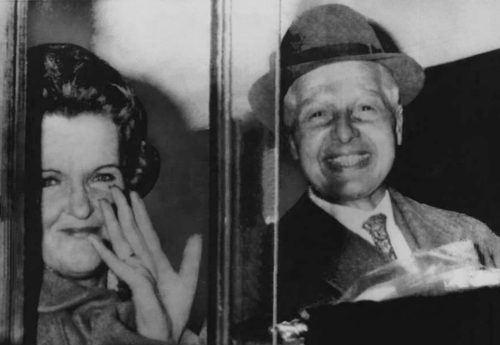
Hall was identified in 1949–50 and questioned in 1951 but never charged; prosecutors could not have built a case without exposing the codebreaking2,6. The Cohens left the United States in 1950 and resurfaced in London as "Peter and Helen Kroger"2.
What the secrets were worth
The Soviet Union tested its first bomb on 29 August 1949. Its design closely followed the American plutonium device described by Fuchs, and MI5's own summary is that his material, combined with other sources, "helped the Russians to make rapid progress in developing what was effectively a copy of the American atomic bomb design"4. The Department of Energy's history says Hall's data served as "an important supplement and confirmation" of Fuchs's1.
The exposures had political effects beyond the courtroom. The Department of Energy's history notes an irony: four days after Fuchs confessed, President Truman directed the Atomic Energy Commission to proceed with the hydrogen bomb1.
What the record does not show
The Venona decrypts cover only a fraction of Soviet traffic, mostly from 1944–45, and several covernames in the atomic messages were never identified2. The KGB and GRU archives remain closed except for what Russian authors have chosen to publish, so the full list of ENORMOZ sources, and exactly what each delivered, is still not known.
The documents
Declassified records of this operation, with the scans and their full text hosted here.
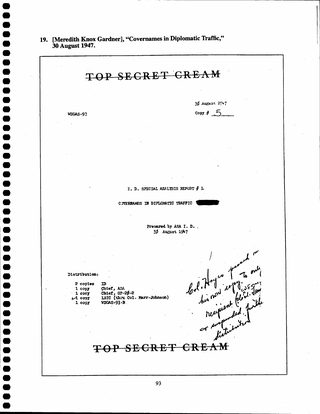 30 August 1947 · 11 p.Meredith Gardner's first Venona report: "Covernames in Diplomatic Traffic" (1947)Army Security Agency, Intelligence Division (I.D.); prepared by Meredith Knox GardnerThe Army codebreaker's August 1947 catalog of the cover names he could read in wartime Soviet cables, including an unidentified LIBERAL whose wife was called Ethel: the start of Venona's spy hunt.
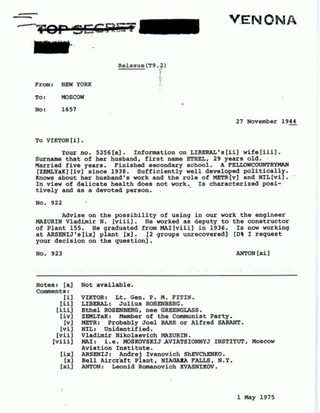 27 November 1944 · 1 p.A Venona decrypt: New York 1657, 27 November 1944KGB New York residency, signed ANTON (Leonid Kvasnikov)A short KGB cable from New York to Moscow describing LIBERAL's wife, "first name ETHEL." Broken by Army codebreakers years later, it became the most argued-over Venona message in the Rosenberg case.
Checking the record
Dates and outcome compared in two independent sources: they agree.
- Official history
- Soviet interest from September 1941; Fuchs confessed January 1950; Greenglass confessed 15 June 1950; Soviet test in 1949. Soviet spies penetrated Los Alamos and other sites and helped speed the Soviet bomb; Fuchs, Greenglass and the Rosenbergs were caught, Hall was not prosecuted.
- Wikipedia
- Wartime espionage 1942–1945, continuing to 1949; arrests 1950; Rosenberg executions 19 June 1953. Fuchs, Gold, Greenglass, Sobell and the Rosenbergs convicted; Hall and others identified later through Venona.
Both agree on the sequence and outcome. The DOE history dates Soviet awareness to September 1941 via John Cairncross; Wikipedia's article is organized by person rather than date, so this page takes its chronology from the DOE and court records.
Sources
- Official history Espionage and the Manhattan Project, 1940–1945, US Department of Energy, Office of History and Heritage Resources.
- CIA Venona: Soviet Espionage and the American Response, 1939–1957 (Introduction), Central Intelligence Agency and National Security Agency (eds. Robert L. Benson and Michael Warner) (1996).
- NSA Venona, Part II: Selected Messages, 1939–1957, Central Intelligence Agency and National Security Agency (1996).
- Official history Klaus Fuchs, MI5 (archived copy).
- FBI Atom Spy Case/Rosenbergs, Federal Bureau of Investigation (archived copy).
- Congress Report of the Commission on Protecting and Reducing Government Secrecy, Appendix A: Secrecy, A Brief Account of the American Experience, US Government Printing Office (1997).
- Wikipedia Atomic spies, Wikipedia.
- Wikipedia Julius and Ethel Rosenberg, Wikipedia.
- Wikipedia English Wikipedia article (used for cross-checking).
Elsewhere in the files
- Agency Cheka, OGPU and NKVD
- Document A Venona decrypt: New York 1657, 27 November 1944
- Document Hoover tells the White House about Gouzenko (September 1945)
- Document Meredith Gardner's first Venona report: "Covernames in Diplomatic Traffic" (1947)
- Operation Operation Paperclip
- Operation The Gouzenko affair
- Operation The Venona project
- Person Donald Maclean
- Person Elizabeth Bentley
- Person Ethel Rosenberg
- Person Harry Gold
- Person Igor Gouzenko
- Person John Cairncross
- Person Julius Rosenberg
- Person Klaus Fuchs
- Person Melita Norwood
- Person Morris and Lona Cohen
- Person Ruth Werner (SONYA)
- Person Theodore Hall
- Tradecraft One-time pads
Read next
 1 February 1943 – 1 October 1980
The Venona project
The US Army codebreaking program that, from 1943 to 1980, read parts of some 2,900 wartime Soviet intelligence cables and exposed Fuchs, the Rosenbergs and Donald Maclean.
 5 September 1945 – 27 June 1946
The Gouzenko affair
In September 1945 a GRU cipher clerk walked out of the Soviet embassy in Ottawa with over a hundred documents, exposing a Soviet spy network in Canada and a British atomic scientist.
 1910–1995
Morris and Lona Cohen
New York communists who worked for Soviet intelligence in the 1940s, vanished in 1950, and resurfaced in a London suburb as the booksellers Peter and Helen Kroger, radio hub of the Portland spy ring.
1912–2005
Melita Norwood
Secretary at a London metals research association who passed atomic-project papers to Soviet intelligence for decades, was exposed by the Mitrokhin archive in 1999 at the age of 87, and was never prosecuted.
1934 – 23 January 1963
The Cambridge Five
Five Cambridge graduates recruited by Soviet intelligence in the 1930s reached MI6, MI5, the Foreign Office and Bletchley Park, and were exposed one by one between 1951 and 1990.
1913–1995
John Cairncross
Scottish civil servant recruited at Cambridge who passed Soviet intelligence material from the Cabinet Office, Bletchley Park and SIS, confessed in part in 1964, and was publicly named only later.