
 Page 1 of 11
From the document
in the code book only about 15 per cent of the equivalences are identified, some only tentatively.
The most frequent New York signature is MAY, with an overall frequency of 164, only a handful of which occurrences are not signatures.
LIB?? (Lieb?) or possibly LIBERAL: was ANTENKO until Sept. 1944. ... Message of 27 November speaks of his wife ETHEL, 29 years old married (?) 5 years
BANK (the Bank): probably covername for the U.S. State Department
Excerpts are passages from a US government work (public domain), quoted exactly as they read in the scan, and checked against the full text on every rebuild.
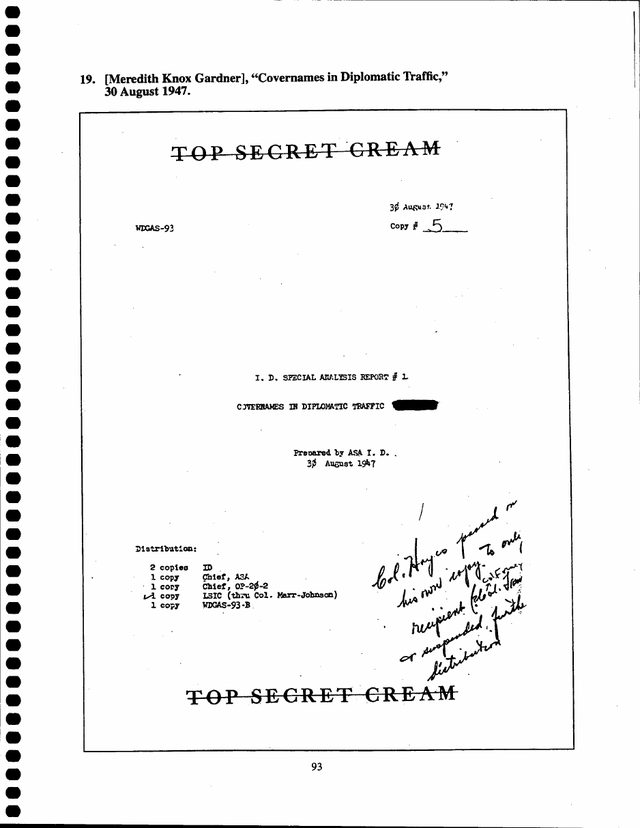
Late in 1946 Meredith Gardner, a linguist in the Army Security Agency's Russian section at Arlington Hall, broke the "spell table" that the KGB's codebook used for English words, and began reading fragments of Soviet cables sent from New York to Moscow in 1944 and 1945. By May 1947 he could see that they described espionage on a large scale. There was no channel for reporting it: the material could not be paraphrased for ordinary intelligence customers without giving away the source. So in the summer of 1947, the editors of the official Venona history write, Gardner "took matters into his own hands" and wrote this report2.
What it says
It is an eleven-page typed list, issued on 30 August 1947 as I.D. Special Analysis Report #1, in a handful of copies1. Gardner opens with warnings. Only about 15 percent of the code groups had been identified, the additive key had large gaps, and everything was "subject to correction in detail." He explains how he knew the words were cover names: some messages announced changes of names, and others used the formula "A (henceforth B)." For the practice itself he cites the Canadian Royal Commission's 1946 report on the Gouzenko defection1.
The rest is a catalog arranged like a philologist's word list: addresses and signatures (VIKTOR as the Moscow addressee, MAY as the usual New York signature), Russian Christian names, other first names, family relationships, mythological names, animals, plants, and places. TIR (Tyre) is New York, KARFAGEN (Carthage) Washington, SIDON London, DEREVNIA (the countryside) Mexico, and BANK probably the State Department1. Each entry gives dates and counts of occurrences, and often a guess. Gardner quotes Louis Budenz's 1947 memoir at length on the false first names used in the American Communist Party, and notes that Gerhard Eisler had been known to Budenz as "Edwards"1. KOMAR, the subject of "intense interest" in several 1944 messages, he takes to be the defector Victor Kravchenko1. A short conclusion stresses how provisional all of it is, and says the report folds in an earlier tentative report of 26 June 19471.
LIBERAL
The entry that mattered most is in the "miscellaneous" section. A source first called ANTENKO, then LIBERAL, appears in six messages between October and December 1944; one of 27 November mentions "his wife ETHEL, 29 years old"1. Gardner could not say who he was. The Venona editors single out this item as the one that "would later prove fateful": in late June 1950 the FBI matched LIBERAL to the New York engineer Julius Rosenberg, and two messages implicated Ethel Rosenberg2. See Soviet atomic espionage (Enormoz) for the case.
What happened next, and how to read it
The report circulated narrowly. The editors write that Deputy G-2 Carter Clarke read it and, in late August or early September 1948, asked the FBI for a list of KGB and GRU cover names; the Bureau sent about 200, and the long FBI–Arlington Hall partnership began2. They also note that British liaison officers learned of the break even before the FBI2.
This is a working paper, not a finding. Many readings are marked with question marks, some guesses proved wrong or were revised, and the name of the cryptographic system is still blacked out in the 1996 facsimile1. It shows how little was known in 1947: the cover names came first, the identities years later. Gardner, who died in 2002, saw his work made public only when the NSA and CIA released the Venona material in 1995–962,3.
Sources
- NSA [Meredith Knox Gardner], "Covernames in Diplomatic Traffic," 30 August 1947, in Venona: Soviet Espionage and the American Response, 1939–1957, Part I, document 19, National Security Agency and Central Intelligence Agency (ed. Robert Louis Benson and Michael Warner) (1996).
- CIA Venona: Soviet Espionage and the American Response, 1939–1957: Foreword, Preface, Introduction and Chronology, National Security Agency and Central Intelligence Agency (1996).
- Wikipedia Meredith Gardner, Wikipedia.