
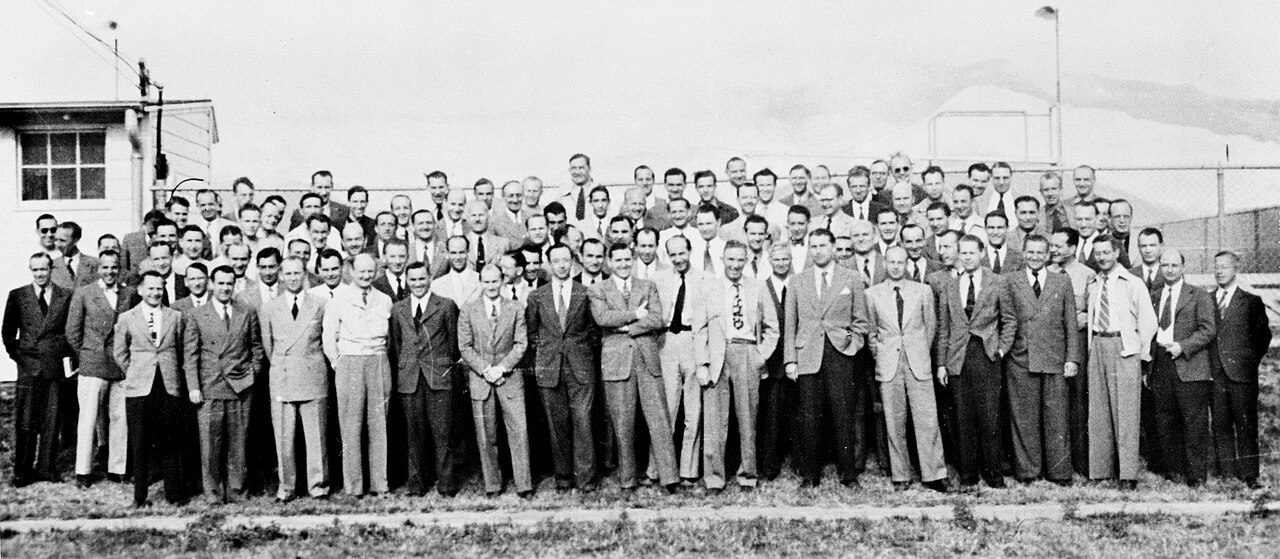

As Allied armies crossed Germany in spring 1945, specialist teams followed close behind with lists of laboratories, factories and people. The Supreme Headquarters' "T Force" examined some 3,000 planned targets and found 2,000 more, looking for jet and rocket aircraft, synthetic rubber and fuel, naval equipment, secret-writing chemicals, aviation medicine and what its lists called "scientific and industrial personalities"2. The grand prize was the Mittelwerk, the underground V-2 factory near Nordhausen2. Scientists picked up in the sweep were interrogated at a detention center codenamed DUSTBIN, first near Paris and later at Kransberg Castle outside Frankfurt2.
Overcast
The German rocket engineers formed a group of their own. Many had moved south to Bavaria late in the war and surrendered to American troops; Wernher von Braun, the technical director at Peenemünde, gave himself up in the Austrian Alps with other team leaders2,3. In July 1945 the Secretary of War approved Project OVERCAST, the shipment of up to 350 German specialists, mostly in rocketry, to the United States2.
The Army's own history is frank about the motives. Beyond any help the Germans might give in the war against Japan, "one of the most compelling arguments for bringing them to the United States seemed at the time to be simply to put them beyond the reach of Soviet recruiters"2. The Soviets had taken Peenemünde and the Mittelwerk but had missed most of the research staff2. Early recruiting went badly: the War Department insisted on volunteers, one-year contracts and families left behind, and few signed until the occupation authorities agreed in late 1945 to house and feed dependents in Germany2.
Paperclip and the JIOA
In 1945 the Joint Chiefs of Staff set up the Joint Intelligence Objectives Agency (JIOA), a subcommittee of their Joint Intelligence Committee, and gave it direct responsibility for the foreign scientist program, "initially code-named Overcast and subsequently code-named Paperclip"1. The JIOA administered the program's rules, compiled a dossier on each recruit and worked with British officers running a parallel scheme1. President Truman formally approved the program in a secret directive of 3 September 1946, expanding it to as many as 1,000 specialists held under "temporary, limited military custody"4.
The first rocket specialists, von Braun among them, reached the United States in September 19454. They worked for the Army at Fort Bliss, Texas, and fired captured V-2s at White Sands Proving Ground in New Mexico3,4. In 1950 the team moved to Redstone Arsenal in Huntsville, Alabama, where it built the Redstone and Jupiter missiles and the Jupiter C that launched Explorer I, the first American satellite, in 19583. In 1960 the group was transferred to NASA; von Braun became director of the Marshall Space Flight Center and chief architect of the Saturn V3.
Paperclip was not only about rockets. Recruits worked for the Air Force, Navy, Army Signal Corps and Bureau of Mines, on aerodynamics, jet engines, fuels, electronics and aviation medicine4. NARA's dossier series covers "over 1,500 German and other foreign scientists, technicians, and engineers" brought in under Paperclip and similar programs1. The Soviet Union ran its own version: on the night of 22 October 1946, in Operation Osoaviakhim, it deported more than 2,200 German specialists and their families to the USSR4.
The past that came with them
The program's central problem was that the expertise it wanted had been built in the service of the Nazi state. The V-2 was assembled at the Mittelwerk by prisoners of the Mittelbau-Dora concentration camp, as NASA's own biography of von Braun records3. Von Braun had joined the Nazi Party in 1937 and been made an SS officer in 19404.
The NARA dossiers include several men whose pasts caught up with them1:
- Georg Rickhey, an official at the Nordhausen factory, arrived in 1946 and was sent back in 1947 to be tried for war crimes by a US military tribunal; he was acquitted.
- Walter Schreiber, implicated in medical experiments on concentration-camp inmates, left for Argentina in 1952 after a newspaper column exposed him.
- Arthur Rudolph, a V-2 project engineer who in 1969 received NASA's Distinguished Service Medal, left the United States in 1984 after the Justice Department discovered his role in the persecution of prisoners at Nordhausen1,4.
Legacy
The JIOA was disbanded in 19621. Its files, opened under the Nazi War Crimes Disclosure Act, let historians weigh both sides of the ledger: Paperclip recruits helped build the missiles that carried American warheads and the rockets that took astronauts to the Moon, and the government that recruited them chose not to look closely at what some had done before 1945.
The documents
Declassified records of this operation.
Checking the record
Dates and outcome compared in two independent sources: they agree.
- Official history
- Secretary of War approved Project OVERCAST in July 1945; shipments began late 1945. German rocket specialists brought to the US largely to keep them from Soviet recruiters; von Braun and Dornberger held the group together.
- Wikipedia
- Overcast established by the Joint Chiefs on 20 July 1945; Truman approved Paperclip on 3 September 1946; arrivals 1945–1959. More than 1,600 specialists brought to the US; major role in the missile and space programs; controversy over Nazi affiliations.
Dates agree on July 1945 for Overcast. Totals differ: NARA counts dossiers on 'over 1,500' people, Wikipedia gives 'more than 1,600'; this page uses NARA's figure. Wikipedia gives two different dates for the renaming to Paperclip, so this page does not state one.
Sources
- National Archives Records of the Secretary of Defense (RG 330): Joint Intelligence Objectives Agency, National Archives and Records Administration, Interagency Working Group.
- Official history Earl F. Ziemke, The U.S. Army in the Occupation of Germany, 1944–1946, Chapter 17, US Army Center of Military History (archived copy) (1975).
- Official history Wernher von Braun, NASA.
- Wikipedia Operation Paperclip, Wikipedia.
- Wikipedia English Wikipedia article (used for cross-checking).
Elsewhere in the files
Read next
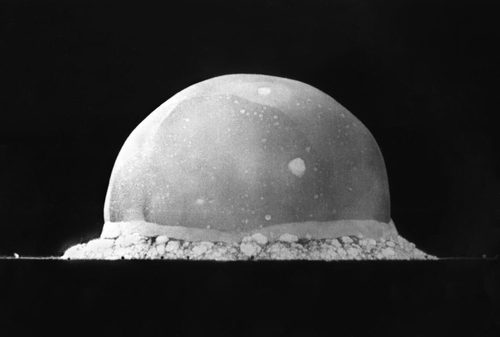 September 1941 – June 1950
Soviet atomic espionage (Enormoz)
How Soviet intelligence penetrated the Manhattan Project under the codename ENORMOZ, who its sources were, how Venona and confessions exposed them, and what the stolen secrets were worth.
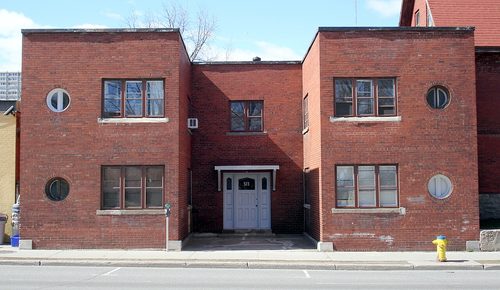 5 September 1945 – 27 June 1946
The Gouzenko affair
In September 1945 a GRU cipher clerk walked out of the Soviet embassy in Ottawa with over a hundred documents, exposing a Soviet spy network in Canada and a British atomic scientist.
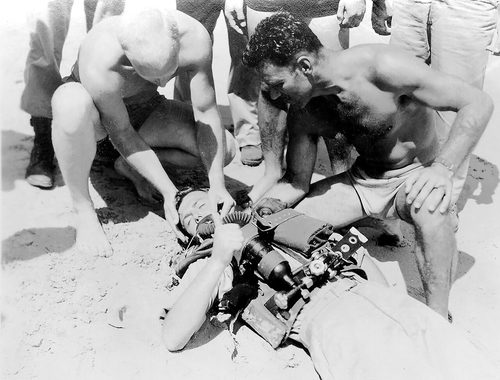 United States · 1942–1945
Office of Strategic Services (OSS)
America's wartime intelligence service, 1942–1945: William Donovan's mix of scholars, spies, saboteurs and propagandists, abolished by Truman and reborn in parts as the CIA.
 United States · 1947
Central Intelligence Agency (CIA)
The US civilian intelligence service, created by the National Security Act of 1947 to coordinate foreign intelligence, which within a year also became Washington's instrument for covert action.
 1920s–1980s
Illegals and legends
Soviet officers who lived abroad as private citizens under borrowed identities, with no diplomatic protection. The Abel and Portland court records show how their legends were built and how they came apart.