
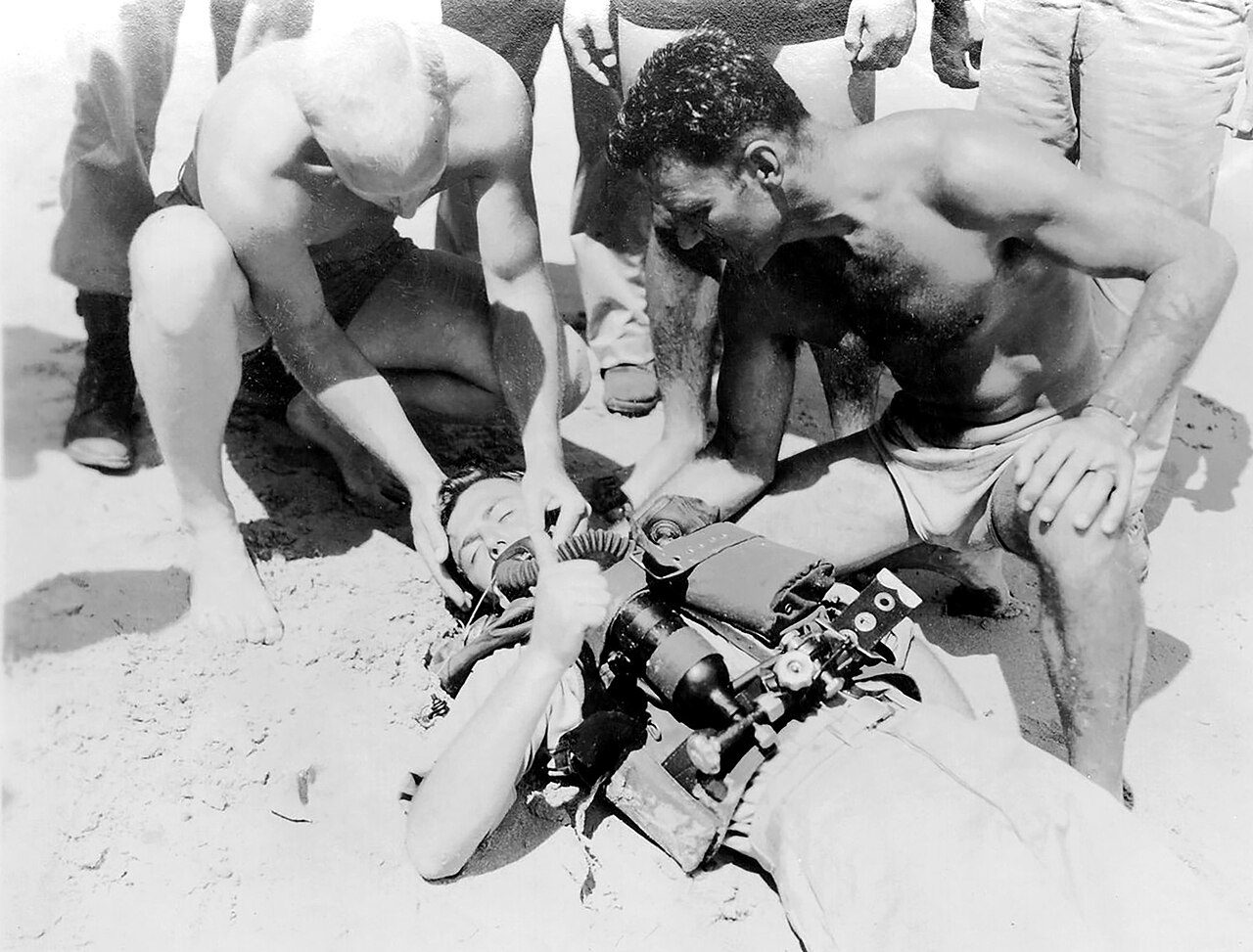

Before 1941 the United States had no central intelligence service. The State Department, the Office of Naval Intelligence and the Army's G-2 each collected what they could, and nobody below the President tried to put it together. The diplomat Robert Murphy later called the arrangement "primitive and inadequate." The Office of Strategic Services was the wartime answer to that gap. It lived for a little more than three years, and a good deal of what it built ended up in the Central Intelligence Agency.1
From COI to OSS
On 11 July 1941 Franklin Roosevelt named the New York lawyer and Medal of Honor winner William J. Donovan Coordinator of Information (COI). It was a civilian office attached to the White House. Its job was to collect and analyze information bearing on national security and to carry out "supplementary activities" when the President asked for them. Two British officers, Admiral John Godfrey and William Stephenson, had pushed for something of the kind.1
In September 1941 the armed services handed COI their small "undercover" intelligence sections, along with the right to spend unvouchered presidential funds. Donovan had not planned to run spies, but these two changes put him in the business.1
After Pearl Harbor the Joint Chiefs of Staff wanted COI under their control, and Donovan agreed. Roosevelt kept COI's radio propaganda service out of military hands and moved it to the new Office of War Information. On 13 June 1942 he signed the order that turned what was left into the Office of Strategic Services. The CIA Museum now holds that letter.1,5
What OSS did
Rival agencies fenced OSS in from the start. A presidential directive in mid-1942 cut it off from most intercepted Axis communications: it never received MAGIC and saw only some ULTRA. The FBI kept Latin America for itself, and MacArthur and Nimitz kept OSS out of the main Pacific campaigns. Inside those limits the agency grew fast. At its peak in late 1944 it had almost 13,000 people. About two-thirds were Army personnel, about 4,500 were women, and some 7,500 served overseas. It spent around $135 million over its life.1
Its branches give a sense of its range:
- Research and Analysis (R&A), under the Harvard historian William Langer, employed about 900 scholars. Its Enemy Objectives Unit in London helped steer Allied bombers toward German fighter plants and then toward synthetic-oil production.1
- Special Operations (SO) was the American partner of the British Special Operations Executive. Together they ran the Jedburgh teams into France in 1944, 93 three-man teams in all. Virginia Hall worked in central France for SO and became the only civilian woman awarded the Distinguished Service Cross in the war. In Burma, Detachment 101 led about 11,000 Kachin irregulars against the Japanese.1
- Secret Intelligence (SI) ran agents abroad. Its best-known station chief, Allen Dulles, opened the Bern office in November 1942. His sources included the German Foreign Office official Fritz Kolbe, whose material helped the British identify the spy in the Cicero affair. In the last months of the war SI's London office, under William J. Casey, sent nearly 200 agents into Germany, most of them recruited from prisoners of war.1
- X-2, the counterintelligence branch created in 1943, was the channel through which British services shared ULTRA-derived material on German agents. That work was tied to the Double-Cross System. James Jesus Angleton ran X-2 in Rome in the final year of the war.1
- Morale Operations produced "black" propaganda meant to look as if it came from inside the Axis. Research and Development, under the chemist Stanley Lovell, built weapons, forged papers and concealment devices.1
Dulles's contacts with SS General Karl Wolff in 1945, known as Operation Sunrise, ended with the surrender of German forces in Italy. They also caused one of the sharpest Allied quarrels of the war.1
Weaknesses
CIA's own history is blunt about Donovan as an administrator: inspiring, but bored by detail. OSS also had a poor security record. No Axis service is known to have penetrated its headquarters. Soviet intelligence did. The CIA historian Michael Warner names Donovan's aide Duncan C. Lee, the R&A economist Donald Wheeler, Jane Foster Zlatowski of Morale Operations and Maurice Halperin of R&A as people who passed information to Moscow. OSS operations in China were also penetrated by Communist agents.1
Abolition
Rivals worked to keep OSS from outliving the war. On 6 September 1945 J. Edgar Hoover sent the Attorney General a memo, now printed in FRUS. It reported, from "two independent outside sources", Donovan's plans for the "perpetuation of his dynasty" under another name.4 On 13 September Donovan asked Truman not to split up secret intelligence, counterespionage and analysis, arguing that whatever agency held intelligence "should have it as a complete whole."3
Truman did not agree. Executive Order 9621 of 20 September 1945 ended OSS as of 1 October. Research and Analysis went to the State Department as an interim service. Everything else went to the War Department to be wound up.2 Assistant Secretary of War John J. McCloy kept the SI and X-2 branches together as a Strategic Services Unit. These later passed to the Central Intelligence Group and then to the CIA, created by the National Security Act of 1947. Four later Directors of Central Intelligence had served in OSS: Allen Dulles, Richard Helms, William Colby and William Casey.1
The records
OSS is unusual among intelligence services because most of its archive was opened voluntarily. Over several decades the CIA transferred almost all the OSS records it held to the National Archives, where they form Record Group 226.1 On 14 August 2008 the National Archives opened more than 35,000 OSS personnel files. They covered staff from Julia Child to Arthur Goldberg and Ralph Bunche.6
Key dates
- 11 July 1941 Roosevelt appoints William J. Donovan Coordinator of Information, the forerunner of OSS.
- 13 June 1942 COI is split; its intelligence and operations side becomes the Office of Strategic Services under the Joint Chiefs of Staff.
- November 1942 Allen Dulles opens the OSS station in Bern, Switzerland; OSS officers in North Africa support the Torch landings.
- 1943 Counterintelligence Branch X-2 is created to share ULTRA-derived material with British services.
- June 1944 Jedburgh teams, run jointly with SOE, begin parachuting into France.
- 29 April 1945 Surrender of German forces in Italy is signed at Caserta after Dulles's Sunrise contacts with SS General Karl Wolff.
- 20 September 1945 Executive Order 9621 dissolves OSS effective 1 October 1945.
- 18 September 1947 The National Security Act creates the CIA, which inherits OSS personnel and methods.
- 14 August 2008 The National Archives opens more than 35,000 OSS personnel files.
Operations in these files
 5 June 1944 – April 1945
Operation Jedburgh
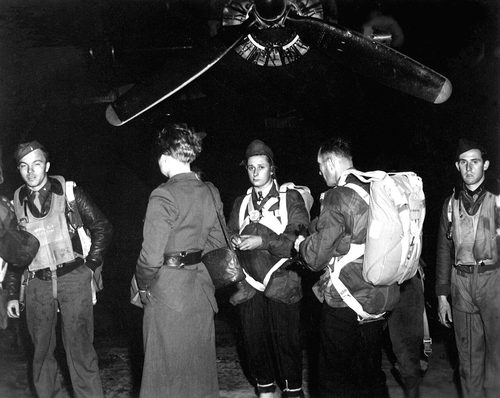
From June 1944 Allied three-man teams in uniform, drawn from SOE, the OSS and the Free French, parachuted into France and the Low Countries to arm and lead resistance fighters behind German lines.
 February – 2 May 1945
Operation Sunrise
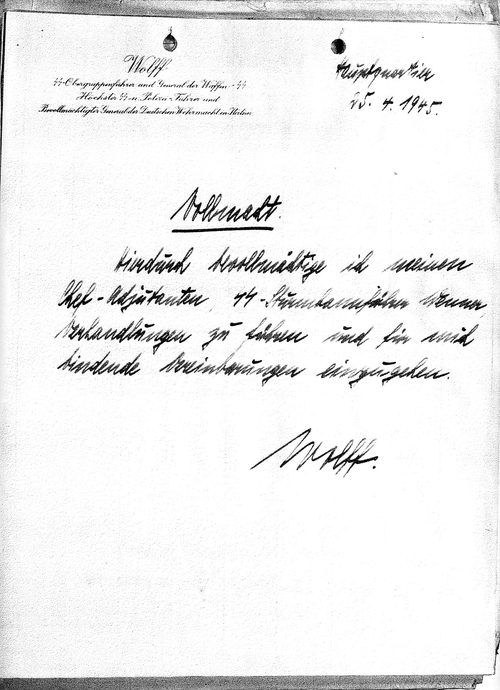
Allen Dulles's secret 1945 talks in Switzerland with SS General Karl Wolff, which ended in the German surrender in Italy and sparked an angry exchange between Stalin and Roosevelt.
People
Sources
- CIA The Office of Strategic Services: America's First Intelligence Agency, Central Intelligence Agency, Center for the Study of Intelligence (Michael Warner) (2000-05).
- FRUS Foreign Relations of the United States, 1945–1950, Emergence of the Intelligence Establishment, Document 14 (Executive Order 9621), US Department of State, Office of the Historian (1945-09-20).
- FRUS Foreign Relations of the United States, 1945–1950, Emergence of the Intelligence Establishment, Document 9 (Donovan to Truman, 13 September 1945), US Department of State, Office of the Historian (1945-09-13).
- FRUS Foreign Relations of the United States, 1945–1950, Emergence of the Intelligence Establishment, Document 8 (Hoover to Attorney General Clark, 6 September 1945), US Department of State, Office of the Historian (1945-09-06).
- CIA Letter on White House Stationery Establishing the OSS, Central Intelligence Agency, CIA Museum.
- National Archives Media Alert: National Archives to open OSS personnel files, National Archives and Records Administration (2008-08-07).
- Wikipedia Office of Strategic Services, Wikipedia.
- Wikipedia English Wikipedia article (used for cross-checking).
Elsewhere in the files
- Agency Central Intelligence Agency (CIA)
- Agency Federal Bureau of Investigation (FBI)
- Agency Special Operations Executive (SOE)
- Document Alias George Wood: CIA's case history of Fritz Kolbe (1966)
- Document Dulles and Gaevernitz's report on SUNRISE-CROSSWORD: 'The First German Surrender' (1945)
- Document On the Trail of Nazi Counterfeiters: a CIA historian on Operation Bernhard (2002)
- Document Team Frederick in Brittany: the OSS London war diary, 1944
- Document The Doolittle Report (1954)
- Document The National Security Act of 1947
- Document The OSS interrogation of Richard Kauder, alias Klatt (August 1945)
- Operation Operation Gladio
- Operation Operation Jedburgh
- Operation Operation Paperclip
- Operation Operation Sunrise
- Operation The Cicero affair
- Person Allen Dulles
- Person Elizabeth Bentley
- Person James Jesus Angleton
- Person Richard Helms
- Person Virginia Hall
- Person William Colby
- Person William J. Donovan