
Portrait: Allen Dulles, Director of Central Intelligence 1953–1961. US Government. Wikimedia Commons, Public domain.

Allen Welsh Dulles came from a family of American diplomats. His grandfather John W. Foster and his uncle Robert Lansing had both been Secretary of State, and his elder brother, John Foster Dulles, would hold the office under Eisenhower while Allen ran the CIA. Born in Watertown, New York, on 7 April 1893, he graduated from Princeton and joined the diplomatic service in 1916, serving in Vienna and then Bern during the First World War. Between the wars he practiced law at Sullivan & Cromwell in New York and was active in the Council on Foreign Relations7.
Bern
William Donovan recruited him to the new intelligence service in October 1941, and on 12 November 1942 Dulles reached Bern to run the OSS mission in neutral Switzerland. From there he built contacts with German opponents of Hitler and with officials inside the Reich. His most valuable source was Fritz Kolbe, a German diplomat who supplied secret documents, including material on German agents and on the Me 262 jet fighter; Dulles called him the best spy of the war7. In March 1945 he opened the secret talks with SS General Karl Wolff that led to the surrender of German forces in northern Italy (Operation Sunrise), negotiations that strained relations with the Soviet Union and that historians have criticized for what they offered Wolff7.
Building the CIA
After the war Dulles returned to law but stayed close to intelligence policy. In 1948 he chaired a National Security Council survey committee on the new CIA, whose report, written with William Jackson and Mathias Correa, criticized the agency sharply2,7. Walter Bedell Smith brought him into the CIA as Deputy Director for Plans, in charge of covert operations, on 4 January 1951, and made him his deputy that August. Eisenhower appointed him Director of Central Intelligence on 26 February 1953, the first civilian to hold the post1,7.
Director, 1953–1961
Dulles's directorship is remembered for covert action. His memorandum of 1 March 1953 warned the President that Iran's disintegration made a Communist takeover "more and more of a possibility," and that summer the agency helped overthrow Mohammad Mosaddeq (Operation Ajax (TPAJAX))3. The next year it organized the campaign that drove Guatemala's Jacobo Árbenz from office (Operation PBSuccess); in the FRUS volume on that operation Dulles appears under the pseudonym "Robert A. Ascham"1. He backed the development of the U-2 reconnaissance aircraft (The U-2 program and the 1960 shoot-down), and the agency's research into drugs and interrogation, later exposed as MKUltra (Project MKUltra)7.
In August 1960, after an NSC meeting on the Congo, he cabled the CIA station in Léopoldville that Patrice Lumumba's "removal must be an urgent and prime objective" (The CIA and the Congo crisis, 1960–61)5. Whether he told Eisenhower about the CIA's parallel plots against Fidel Castro remained uncertain; the Church Committee could not establish it (The plots against Fidel Castro).
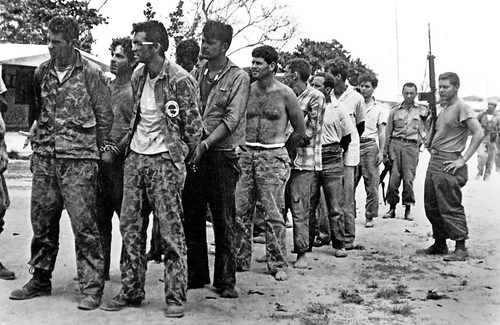
On 17 March 1960 Dulles presented the plan for covert action against Castro that grew into the Bay of Pigs landing. Eisenhower told him "he knows of no better plan"4. The defeat of April 1961 ended his career. Kennedy eased him out, and he served as Director of Central Intelligence until November 1961, when John McCone succeeded him6,7.
Afterward
In retirement Dulles published The Craft of Intelligence (1963), largely ghost-written. After President Kennedy's assassination, Lyndon Johnson appointed him one of the seven members of the Warren Commission, a choice later criticized because Kennedy had dismissed him7. He died of influenza complicated by pneumonia in Washington on 29 January 19697.
Key dates
- 12 November 1942 Arrives in Bern to run the OSS mission in Switzerland.
- March 1945 Opens secret talks on a German surrender in northern Italy.
- 4 January 1951 Joins the CIA as Deputy Director for Plans.
- 26 February 1953 Becomes Director of Central Intelligence.
- 19 August 1953 Coup in Iran overthrows Mosaddeq.
- 17 April 1961 Bay of Pigs landing fails.
- November 1961 Leaves the CIA; succeeded by John McCone.
- November 1963 Appointed to the Warren Commission on the Kennedy assassination.
Sources
- FRUS FRUS, 1952–1954, Guatemala: Persons and Pseudonyms, US Department of State, Office of the Historian (2003).
- FRUS FRUS, 1945–1950, Emergence of the Intelligence Establishment: List of Persons, US Department of State, Office of the Historian (1996).
- FRUS FRUS, 1951–1954, Iran, Document 169: Memorandum from DCI Dulles to President Eisenhower, 1 March 1953, US Department of State, Office of the Historian (1953-03-01).
- FRUS FRUS, 1958–1960, volume VI, Cuba, Document 486: Memorandum of a Conference with the President, 17 March 1960, US Department of State, Office of the Historian (1960-03-17).
- Congress Alleged Assassination Plots Involving Foreign Leaders, Part III.A: Congo (chapter scan), Church Committee; copy hosted by the Assassination Archives and Research Center (1975-11-20).
- FRUS FRUS, 1961–1963, volume X, Cuba: List of Persons, US Department of State, Office of the Historian (1997).
- Wikipedia Allen Dulles, Wikipedia.
- Wikipedia English Wikipedia article (used for cross-checking).
Elsewhere in the files
- Agency Central Intelligence Agency (CIA)
- Agency National Reconnaissance Office (NRO)
- Agency Office of Strategic Services (OSS)
- Document After the U-2: the President and his advisers (May 1960)
- Document Alias George Wood: CIA's case history of Fritz Kolbe (1966)
- Document Alleged Assassination Plots Involving Foreign Leaders (1975)
- Document Allen Dulles's cable on Lumumba: 'an urgent and prime objective' (August 1960)
- Document CORONA: the CIA's 1995 documentary history of its first spy satellite
- Document Dulles and Gaevernitz's report on SUNRISE-CROSSWORD: 'The First German Surrender' (1945)
- Document Iran 1953: Kermit Roosevelt's debriefing at CIA headquarters
- Document Operation PBSUCCESS: the CIA's own history of the Guatemala coup (Cullather, 1994)
- Document The CIA Inspector General's inspection of MKULTRA (1963)
- Document The CIA Inspector General's report on plots to kill Castro (1967)
- Document The CIA historian's case against the Taylor Committee (1984)
- Document The CIA's history of OXCART: 'The U-2's Intended Successor' (1992)
- Document The CIA's history of the Berlin Tunnel (1968)
- Document The Doolittle Report (1954)
- Document The Inspector General's survey of the Cuban operation (1961)
- Document Undercover Armies: the CIA's secret history of its war in Laos (2006)
- Operation CORONA
- Operation Operation Ajax (TPAJAX)
- Operation Operation Gold (the Berlin Tunnel)
- Operation Operation PBSuccess
- Operation Operation Sunrise
- Operation Project MKUltra
- Operation ST CIRCUS: the CIA in Tibet
- Operation The Bay of Pigs invasion
- Operation The CIA and the Congo crisis, 1960–61
- Operation The Cicero affair
- Operation The U-2 program and the 1960 shoot-down
- Operation The plots against Fidel Castro
- Person Francis Gary Powers
- Person James Jesus Angleton
- Person Reinhard Gehlen
- Person Richard Helms
- Person Wilhelm Canaris
- Person William J. Donovan
- Tradecraft Overhead reconnaissance
- Tradecraft Signals intelligence
Read next
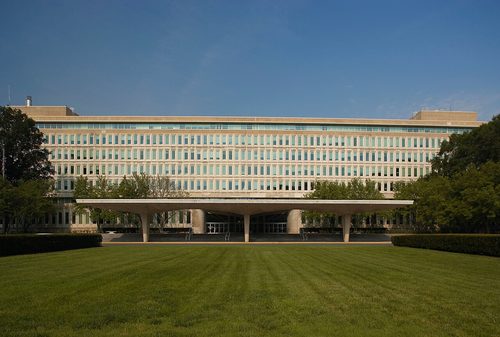 United States · 1947
Central Intelligence Agency (CIA)
The US civilian intelligence service, created by the National Security Act of 1947 to coordinate foreign intelligence, which within a year also became Washington's instrument for covert action.
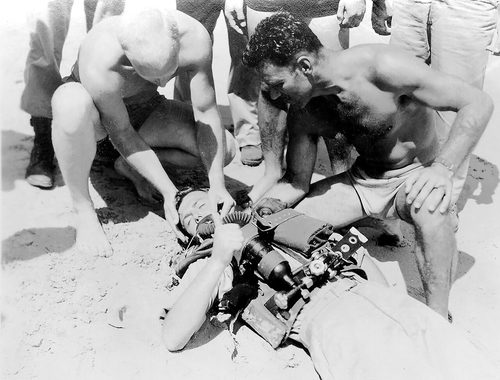 United States · 1942–1945
Office of Strategic Services (OSS)
America's wartime intelligence service, 1942–1945: William Donovan's mix of scholars, spies, saboteurs and propagandists, abolished by Truman and reborn in parts as the CIA.
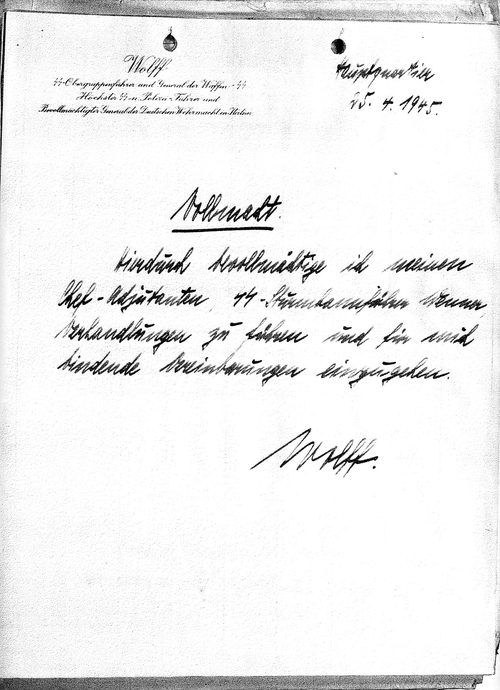 February – 2 May 1945
Operation Sunrise
Allen Dulles's secret 1945 talks in Switzerland with SS General Karl Wolff, which ended in the German surrender in Italy and sparked an angry exchange between Stalin and Roosevelt.
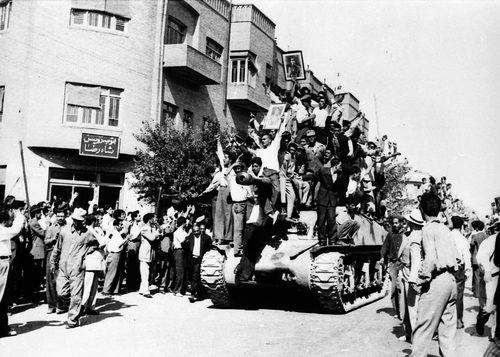 March – 19 August 1953
Operation Ajax (TPAJAX)
The 1953 Anglo-American covert operation that removed Iran's prime minister Mohammad Mosaddeq, as reconstructed from the CIA and State Department records published in 2017.
 17 March 1960 – 19 April 1961
The Bay of Pigs invasion
In April 1961 a CIA-trained brigade of Cuban exiles landed at the Bay of Pigs to topple Fidel Castro and was defeated within three days. The records show how a covert plan outgrew its cover.
 1913–2002
Richard Helms
A career clandestine officer who rose from OSS to Director of Central Intelligence (1966–73), Richard Helms ran the CIA through Vietnam and Chile and later became the only DCI convicted over testimony to Congress.