
 Page 1 of 158
From the document
This is the Inspector General's report on the Central Intelligence Agency's ill-fated attempt to implement national policy by overthrowing the Fidel Castro regime in Cuba by means of a covert paramilitary operation.
The Agency failed to recognize that when the project advanced beyond the stage of plausible denial it was going beyond the area of Agency responsibility as well as Agency capability.
As the project grew, the Agency reduced the exiled leaders to the status of puppets, thereby losing the advantages of their active participation.
The project was badly organized. Command lines and management controls were ineffective and unclear.
Excerpts are passages from a US government work (public domain), quoted exactly as they read in the scan, and checked against the full text on every rebuild.
Few agencies have described their own failure as plainly as the CIA did in this report. Its first sentence calls the Bay of Pigs operation the agency's "ill-fated attempt" to overthrow Fidel Castro by a covert paramilitary operation1. The author was Lyman B. Kirkpatrick Jr., the CIA's Inspector General and a career officer who had been tipped as a future director until polio left him paralyzed in 19524. Allen Dulles asked him to examine the operation after the defeat of April 19614.
Scope and method
Kirkpatrick set clear limits. The survey would judge the agency's own performance: the organization, staffing and planning of the project, and the covert paramilitary phase, including intelligence support, training and security1. It would not analyze the purely military phase of the landing. It would mention the roles CIA officials played in meetings with the President and other departments, but would offer "no evaluation of or judgment" on anyone outside the agency1. He and his staff interviewed about 125 CIA employees at every level and went through a large body of documents1.
What it says
The body of the survey, about 150 typed pages, follows the project from the policy paper Eisenhower approved on 17 March 1960 to the landings1. That paper and four later planning papers, including the briefing prepared for President Kennedy in February 1961, are attached as annexes A to E1. Sections cover the organization and command structure, staffing, planning, the large forward base in Miami, intelligence support, the exiles' political front, and air, maritime and training operations. Another section deals with Americans who took part in the fighting1.
The verdict comes in the conclusions on pages 143 and following. Kirkpatrick wrote that the agency had begun by building up resistance inside Cuba and then turned the project into what was really an overt military operation, going beyond what it was responsible for or capable of doing1. It had not appraised the chances of success realistically and had not kept policymakers informed of the conditions needed to win. It had reduced the exile leaders to "puppets." It had failed to build a resistance organization, collected too little information on Castro's strength and the opposition, and evaluated what it had poorly1. The project was "badly organized," not always staffed with "top-quality people," and launched without the boats, bases, agent networks and Spanish-speakers it needed. Even the landing plan had "no disaster plan"1. Ten recommendations followed. They included full-time, high-level control of any large covert project and a more orderly way of assigning staff within the clandestine service1.
Twenty copies
The survey was explosive inside the agency. Kirkpatrick's memorandum of 16 February 1962 records that 20 copies were made but only a few were handed out. The first went to the new Director, John McCone, on 21 November 1961. Dulles, his deputy General Charles Cabell, and Richard Bissell, the Deputy Director for Plans who had run the operation, received theirs on 24 November1. A copy went to the President's Foreign Intelligence Advisory Board in January 19621. The clandestine service prepared a formal rebuttal, "An Analysis of the Cuban Operation," dated 18 January 1962, which is bound with the released survey1.
Release
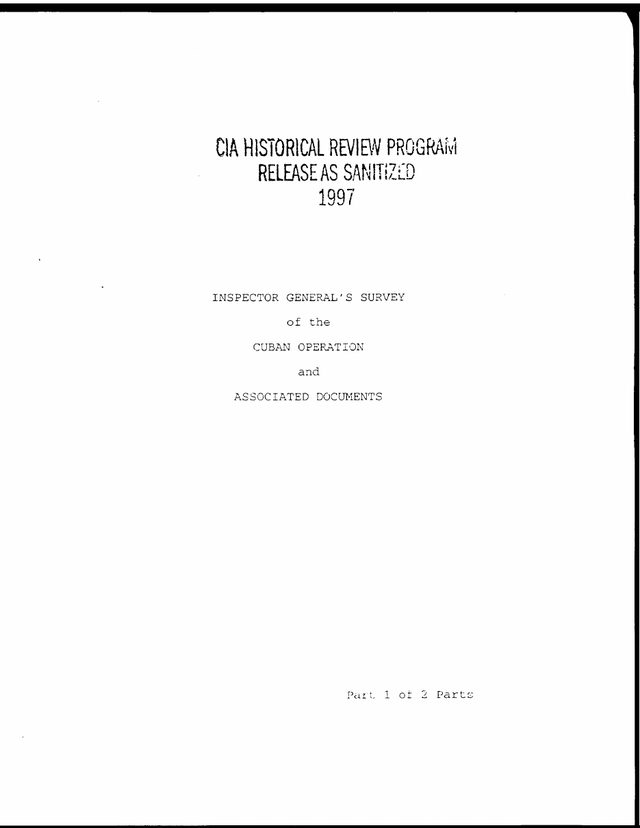
The survey stayed secret for more than 35 years. The CIA released it in sanitized form in 1998. The cover of the released copy is stamped "CIA Historical Review Program, Release as Sanitized, 1997"1,3. The National Security Archive, which had pressed for it, published it with the CIA rebuttal. Kirkpatrick did not see it made public; he died in 19953,4.
Historians read it alongside the Cuba Study Group report that General Maxwell Taylor gave Kennedy in June 1961, which also concluded that an operation of this size could not be kept deniable (see The Bay of Pigs invasion). Kirkpatrick's survey is the harsher of the two, because he was judging his own service.
Sources
- CIA Inspector General's Survey of the Cuban Operation and Associated Documents (October 1961; part 1 of 2), Central Intelligence Agency, via the National Security Archive (1961-10).
- Other Exhibit F: Inspector General's Survey of the Cuban Operation and Associated Documents (PDF), Wikimedia Commons (public-domain copy).
- National Security Archive CIA Sued for 'Holding History Hostage' on Bay of Pigs Invasion (Electronic Briefing Book No. 341), National Security Archive (2011-04-14).
- Wikipedia Lyman Kirkpatrick, Wikipedia.
- Wikipedia Bay of Pigs Invasion, Wikipedia.
Elsewhere in the files
- Document 'CIA Agents Imprisoned in the Soviet Union': a retiring officer's memo on captured REDSOX agents (1978)
- Document Alleged Assassination Plots Involving Foreign Leaders (1975)
- Document The CIA historian's case against the Taylor Committee (1984)
- Document The Doolittle Report (1954)
- Operation The Bay of Pigs invasion