
 Page 1 of 84
From the document
More than twenty years after the event, CIA personnel who were closely involved in the Bay of Pigs (BOP) operation continue to speak bitterly about the outcome.
In short, the Taylor Committee failed to place blame where it really belonged--on a principal member of the President's cabinet.
illustrates that the investigation had political as well as fact finding objectives. An impartial observer might question which took precedence with Taylor.
the major causes for the failure--contrary to the image which has been and continues to be popularized--were directly attributable to actions, or inactions, of the Kennedy Administration, specifically including the President, Secretary Rusk, and Secretary McNamara.
Excerpts are passages from a US government work (public domain), quoted exactly as they read in the scan, and checked against the full text on every rebuild.
Jack Pfeiffer spent a decade as a CIA historian writing the agency's official history of the Bay of Pigs. This fourth volume, dated 9 November 1984, is the most argumentative. Its subject is the Cuba Study Group that President Kennedy set up on 22 April 1961 under General Maxwell Taylor, with Robert Kennedy, Admiral Arleigh Burke and Allen Dulles as members, and its purpose is to take that inquiry apart1.
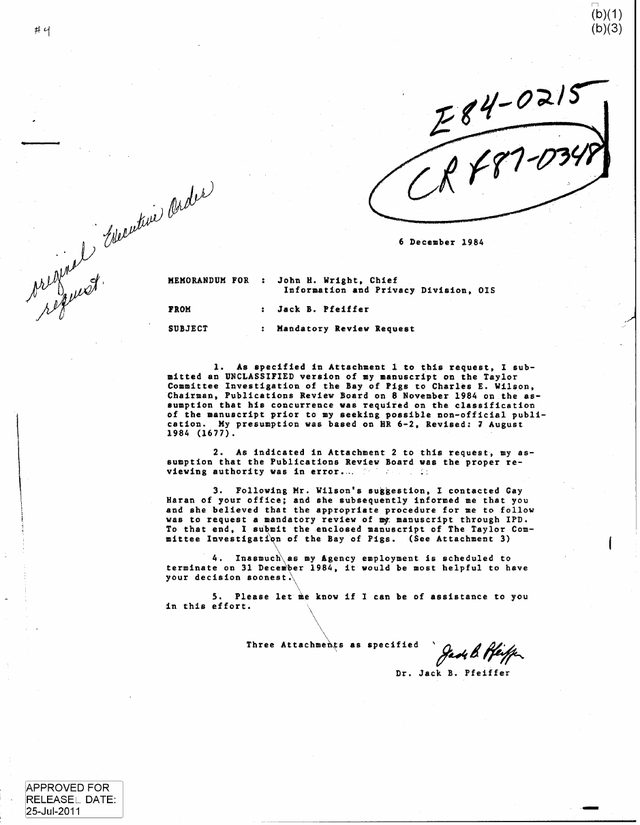
The hosted copy opens with a memo of 6 December 1984 in which Pfeiffer asks the CIA's information office for a declassification review. He had written the volume in unclassified form, hoping for "non-official publication," and his employment was to end on 31 December1.
What it argues
Pfeiffer's introduction sets the tone: two decades on, CIA veterans still felt they had taken "a 'bum rap' for a political decision." He presents Taylor as having leaned toward shielding the White House, and Robert Kennedy as having belittled military and CIA witnesses1.
Chapter 4, which the hosted pages pick up near its start, reads the Taylor report's four memoranda of 13 June 1961 against the record. Pfeiffer argues that the committee had largely reached its conclusions by an 11 May study, before Burke, General Lyman Lemnitzer, Dulles and the CIA project chief Jacob Esterline had testified. He stresses that Robert McNamara never acted on two Joint Chiefs papers, JCSM-44-61 and JCSM-166-61, which preferred the Trinidad landing site to Zapata. And he treats Kennedy's cancellation of the D-Day air strikes on the evening of 16 April as decisive1. The report itself found that the operation's leaders had not pressed their case on that cancellation "with sufficient force and clarity"; Pfeiffer reads this finding as cover for the President and Dean Rusk1,3. He quotes in full the one recorded dissent, in which Burke and Dulles argued that with ammunition and air cover the Brigade might have held its beachhead and set off wider revolt1,2.
Chapter 5 compares the report with Taylor's later memoir and a 1980 newspaper article, and finds his views hardened rather than revised. Chapter 6 lists witnesses the committee never called, among them Tracy Barnes, Richard Drain and Robert Amory of the CIA and Thomas Mann, Roger Hilsman and Adlai Stevenson of the State Department, and faults the committee for keeping no verbatim transcript. Pfeiffer's verdict is that the main causes of failure lay with Kennedy, Rusk and McNamara1.
Release
The National Security Archive, which sued for the history in April 2011, says the CIA had cleared this volume for Pfeiffer before, but he never circulated it. The copy now public carries a release date of 25 July 2011 and was published with three other volumes in August 2011. Volume V, his critique of the Inspector General's survey, was still being withheld1,4.
How to read it
This is an advocate's brief from inside the agency, written after the CIA's own Inspector General's survey had also blamed its planners. Pfeiffer cites his own volumes and interviews, writes in sharp language about Robert Kennedy and the "Camelot entourage," and closes with a quotation from Raúl Castro that Kennedy "vacillated"1,4. It is useful for the record it assembles on the air strikes and the JCS papers. On blame, it is one side of a dispute that the Taylor report, printed in Foreign Relations, lets readers check2,3.
Sources
- CIA Official History of the Bay of Pigs Operation, Volume IV: The Taylor Committee Investigation of the Bay of Pigs (Jack B. Pfeiffer, 9 November 1984), Central Intelligence Agency, FOIA Electronic Reading Room (1984-11-09).
- FRUS Foreign Relations of the United States, 1961–1963, Volume X, Cuba, 1961–1962, Document 231 (Memorandum No. 1 From the Cuba Study Group to President Kennedy, 13 June 1961), US Department of State, Office of the Historian.
- FRUS Foreign Relations of the United States, 1961–1963, Volume X, Cuba, 1961–1962, Document 233 (Memorandum No. 3: Conclusions of the Cuban Study Group, 13 June 1961), US Department of State, Office of the Historian.
- National Security Archive Top Secret CIA 'Official History' of the Bay of Pigs: Revelations (Electronic Briefing Book No. 355, ed. Peter Kornbluh), National Security Archive (2011-08-15).
- Wikipedia Bay of Pigs Invasion, Wikipedia.