
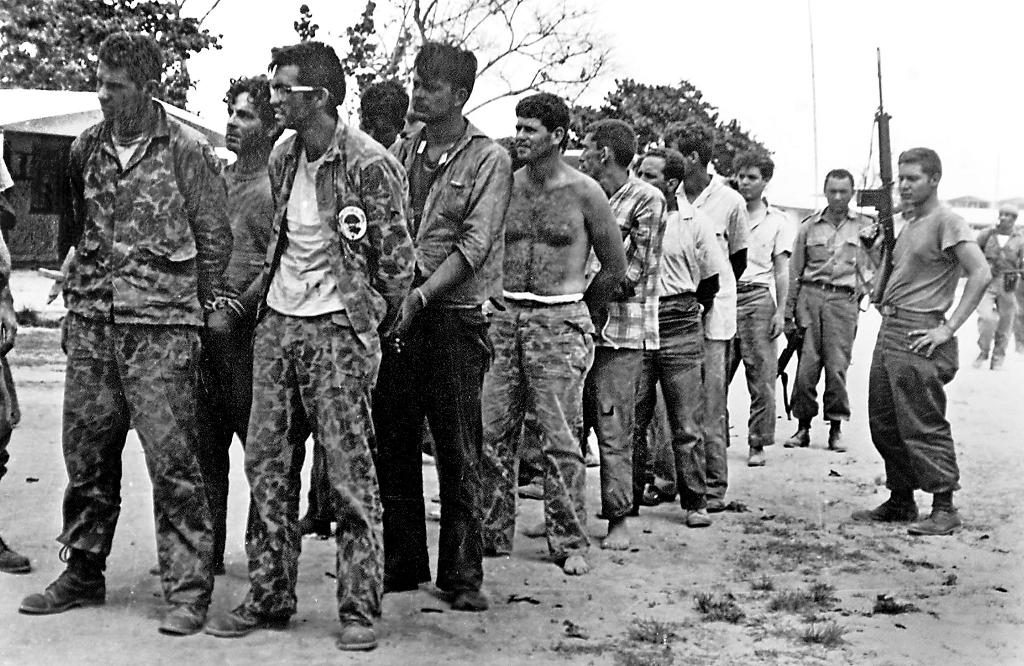

The invasion began as something much smaller. On 16 March 1960 the National Security Council's covert-action panel, the 5412 Committee, produced a paper titled "A Program of Covert Action Against the Castro Regime." Its aim was to replace Fidel Castro's government "in such a manner as to avoid any appearance of U.S. intervention," chiefly by organizing Cuban exiles to act as if on their own initiative1. The program had four parts: a unified Cuban opposition in exile, a propaganda radio, a clandestine network inside Cuba, and a small paramilitary force trained outside the island1,2.
President Eisenhower approved it the next day. At the meeting, Director of Central Intelligence Allen Dulles estimated that building the force might take eight months. Eisenhower said he knew "of no better plan," warned that the great problem was "leakage and breach of security," and said that "everyone must be prepared to swear that he has not heard of it"2.
From guerrillas to an amphibious landing
Over 1960 the plan grew. The CIA's Deputy Director for Plans, Richard Bissell, oversaw the project; recruits trained at a base on a coffee plantation in western Guatemala, and an airstrip was built near Retalhuleu. The exiles named their unit Brigade 2506. A guerrilla-infiltration scheme turned into a conventional landing, with its own B-26 bombers based at Puerto Cabezas in Nicaragua4,8.
John F. Kennedy inherited the project in January 1961. In mid-March 1961 the White House rejected a daylight assault plan as too much like a Second World War landing and set new ground rules: a quiet night landing and the seizure of an airfield to which air strikes could be attributed8. On 16 March CIA officials presented the revised plan, code-named Zapata, for a night landing at the Bay of Pigs. Kennedy let planning continue and "reserved the right to call off the plan even up to 24 hours prior to the landing." The Chief of Naval Operations, Admiral Arleigh Burke, put its chance of success at about 50 percent3. Asked what would happen if the brigade were pinned down on the beach, Burke recorded the answer: "they would not be re-embarked because there was no place to go"3.
15–19 April 1961
On 15 April eight exile B-26s attacked Cuban airfields. One pilot flew on to Miami, and the raids were presented as the work of Cuban air force defectors. At the United Nations the US ambassador, Adlai Stevenson, repeated that story and displayed a wire photo of the plane in Cuban markings, unaware that the CIA had misled him. His objections to further strikes weighed heavily in the decision of the following night4,8.
At about 9:30 on the evening of 16 April, the night before the landing, McGeorge Bundy told Deputy Director Charles Cabell that the planned dawn strikes on Cuban airfields would not be permitted until they could be flown from a strip inside the beachhead. Cabell and Bissell appealed to Secretary of State Dean Rusk, who cited the position at the UN and would not reverse the decision; the order to cancel "caught the crews in their cockpits"4.
The landings began at 1 a.m. on 17 April. Paratroopers seized the road junction of San Blas. But Castro's remaining aircraft were flying, and by mid-morning two of the brigade's ships, the Rio Escondido and the Houston, had been sunk; the supply ships withdrew to sea with much of the ammunition5. US Navy ships stood offshore with orders not to become involved except in self-defense5. By the morning of 19 April the brigade commander was radioing that he could not hold without help, and the CIA was preparing to recommend evacuation6. The beachhead collapsed later that day8.
Inquiries and consequences
Kennedy appointed a Cuba Study Group under General Maxwell Taylor to find out what had gone wrong. Its conclusions, delivered on 13 June 1961, were blunt: an operation "of the magnitude of Zapata could not be prepared and conducted in such a way that all U.S. support of it and connection with it could be plausibly disclaimed," and by about November 1960 that should have been recognized and the project reviewed or "abandoned"7. The CIA's inspector general, Lyman Kirkpatrick, wrote a harsher internal survey later in 1961, faulting the agency's planning, intelligence and organization; it was kept secret until 1998 (see The Inspector General's survey of the Cuban operation (1961))8.
About 1,100 members of the brigade were taken prisoner. After long negotiations, the lawyer James B. Donovan signed an agreement with Castro on 21 December 1962 exchanging 1,113 prisoners for $53 million in food and medicine, paid for by private donations8. Dulles was eased out in November 1961, and Bissell and Cabell were also made to leave8.
Inside Washington the defeat did not end the effort against Castro; it moved it to the White House and toward sabotage, under Operation Mongoose, while the CIA continued separate efforts to kill him (The plots against Fidel Castro). Eighteen months after the landing, Soviet missiles in Cuba brought on the crisis of October 1962 (Intelligence in the Cuban Missile Crisis).
The documents
Declassified records of this operation, with the scans and their full text hosted here.
 9 November 1984 · 84 p.The CIA historian's case against the Taylor Committee (1984)Jack B. Pfeiffer, CIA History StaffVolume IV of the CIA's official Bay of Pigs history: Jack Pfeiffer's attack on the 1961 White House inquiry led by Maxwell Taylor, arguing that the Kennedy administration, not the CIA, caused the defeat.
 20 November 1975 · 85 p.Alleged Assassination Plots Involving Foreign Leaders (1975)Senate Select Committee to Study Governmental Operations with Respect to Intelligence Activities (Frank Church, chairman)The Church Committee's interim report of 20 November 1975 found that US officials plotted to kill Castro and Lumumba and backed plotters in three other countries where leaders died. Ford opposed publication.
 October 1961 · 158 p.The Inspector General's survey of the Cuban operation (1961)Lyman B. Kirkpatrick Jr., Inspector General, Central Intelligence AgencyCIA Inspector General Lyman Kirkpatrick's October 1961 post-mortem on the Bay of Pigs blamed the agency's own planning, intelligence and organization. Twenty copies were made; it was released in 1998.
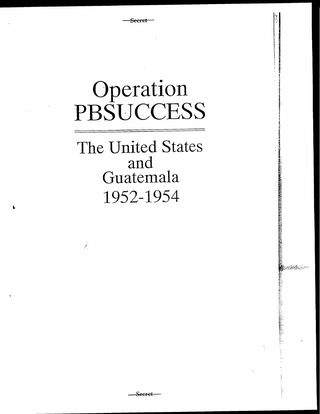 1994 · 105 p.Operation PBSUCCESS: the CIA's own history of the Guatemala coup (Cullather, 1994)Nicholas Cullather, History Staff, Center for the Study of Intelligence, Central Intelligence Agency (foreword by J. Kenneth McDonald, Chief Historian)The CIA History Staff's account of the 1954 operation against Jacobo Arbenz, written from the agency's files by Nicholas Cullather. It concludes that Arbenz fell to an army coup, not to CIA radio and bombing.
Checking the record
Dates and outcome compared in two independent sources: they agree.
- FRUS
- Landings began at 1 a.m. on 17 April 1961; by the morning of 19 April the situation was desperate and evacuation was being considered (FRUS Documents 112 and 142) Cuban Expeditionary Force defeated; Navy rescue operations ended 26 April.
- Wikipedia
- 17–20 April 1961 Invading force defeated within three days and surrendered; 1,113 prisoners later exchanged for $53 million in food and medicine.
Outcome agrees. Wikipedia dates the surrender to 20 April; most accounts and the FRUS record put the collapse of the beachhead on the afternoon of 19 April. This page uses 19 April.
Sources
- FRUS FRUS, 1958–1960, volume VI, Cuba, Document 481: A Program of Covert Action Against the Castro Regime, 16 March 1960, US Department of State, Office of the Historian (1960-03-16).
- FRUS FRUS, 1958–1960, volume VI, Cuba, Document 486: Memorandum of a Conference with the President, 17 March 1960, US Department of State, Office of the Historian (1960-03-17).
- FRUS FRUS, 1961–1963, volume X, Cuba, Document 66: Editorial Note on the meeting of 16 March 1961, US Department of State, Office of the Historian (1997).
- FRUS FRUS, 1961–1963, volume X, Cuba, Document 108: Memorandum from Cabell to Taylor on the cancelled air strikes, 9 May 1961, US Department of State, Office of the Historian (1961-05-09).
- FRUS FRUS, 1961–1963, volume X, Cuba, Document 112: Editorial Note on the landings of 17 April 1961, US Department of State, Office of the Historian (1997).
- FRUS FRUS, 1961–1963, volume X, Cuba, Document 142: Editorial Note on the situation on 19 April 1961, US Department of State, Office of the Historian (1997).
- FRUS FRUS, 1961–1963, volume X, Cuba, Document 233: Memorandum No. 3 from the Cuba Study Group to President Kennedy, 13 June 1961, US Department of State, Office of the Historian (1961-06-13).
- Wikipedia Bay of Pigs Invasion, Wikipedia.
- Wikipedia English Wikipedia article (used for cross-checking).
Elsewhere in the files
- Agency Central Intelligence Agency (CIA)
- Document Alleged Assassination Plots Involving Foreign Leaders (1975)
- Document Lansdale's "The Cuba Project" (1962)
- Document Lansdale's first Cuba Project program review (18 January 1962)
- Document Operation PBSUCCESS: the CIA's own history of the Guatemala coup (Cullather, 1994)
- Document The CIA Inspector General's report on plots to kill Castro (1967)
- Document The CIA historian's case against the Taylor Committee (1984)
- Document The Inspector General's survey of the Cuban operation (1961)
- Document The Northwoods memorandum (1962)
- Document Undercover Armies: the CIA's secret history of its war in Laos (2006)
- Operation Operation Mongoose
- Operation Operation Northwoods
- Operation Operation PBSuccess
- Operation The plots against Fidel Castro
- Person Allen Dulles
- Person Richard Helms
Read next
 30 November 1961 – October 1962
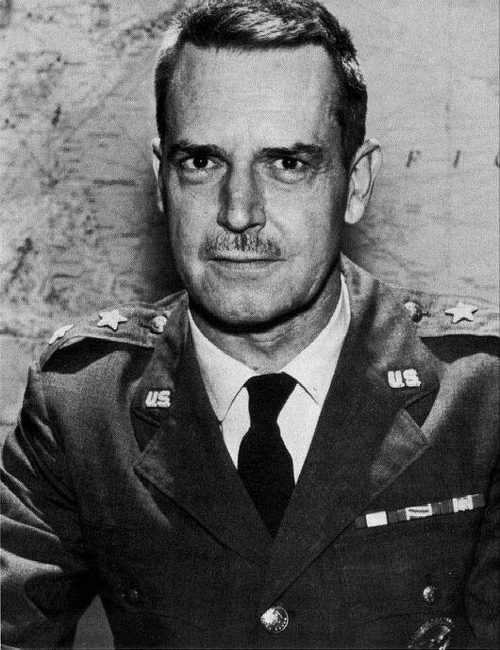
Operation Mongoose
The Kennedy administration's 1961–62 covert program to overthrow Fidel Castro, run by Edward Lansdale under Robert Kennedy's eye, which aimed at a revolt in Cuba by October 1962.
October 1961
The Inspector General's survey of the Cuban operation (1961)
CIA Inspector General Lyman Kirkpatrick's October 1961 post-mortem on the Bay of Pigs blamed the agency's own planning, intelligence and organization. Twenty copies were made; it was released in 1998.
 12 August 1953 – 27 June 1954
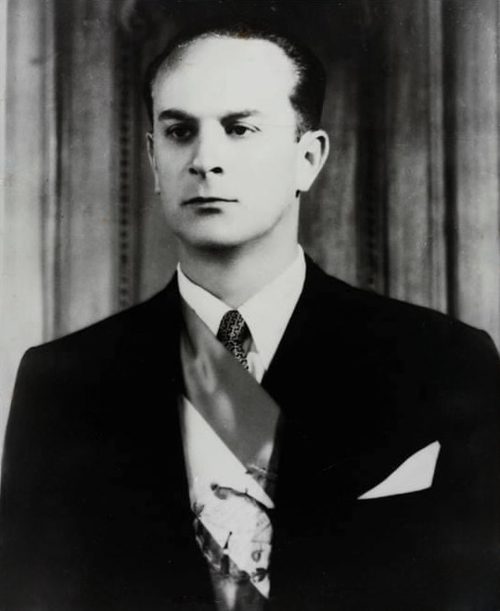
Operation PBSuccess
The CIA's 1953–54 campaign of propaganda, pressure and a small proxy invasion that forced Guatemala's elected president Jacobo Árbenz to resign on 27 June 1954.
 August 1960 – 1965
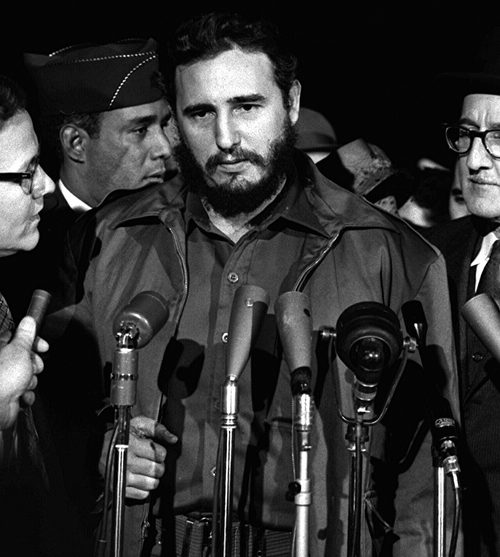
The plots against Fidel Castro
Between 1960 and 1965 the CIA pursued at least eight plots to kill Fidel Castro, using poison pills, gangsters and a Cuban insider. None succeeded, and who authorized them was never settled.
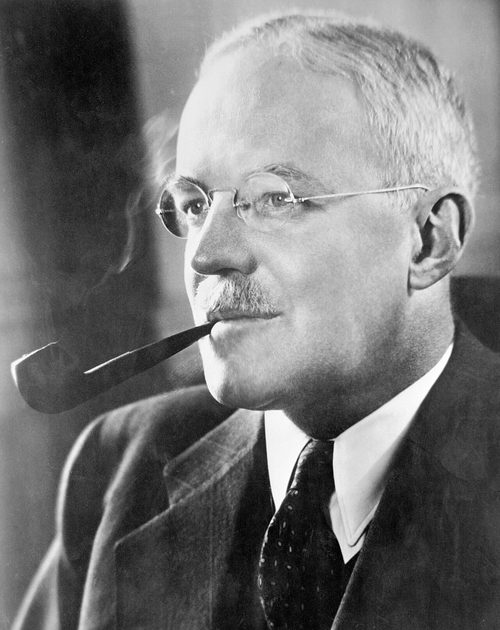 1893–1969
Allen Dulles
OSS spymaster in wartime Switzerland and Director of Central Intelligence from 1953 to 1961, Allen Dulles presided over the CIA's era of coups and covert wars until the Bay of Pigs ended his tenure.