
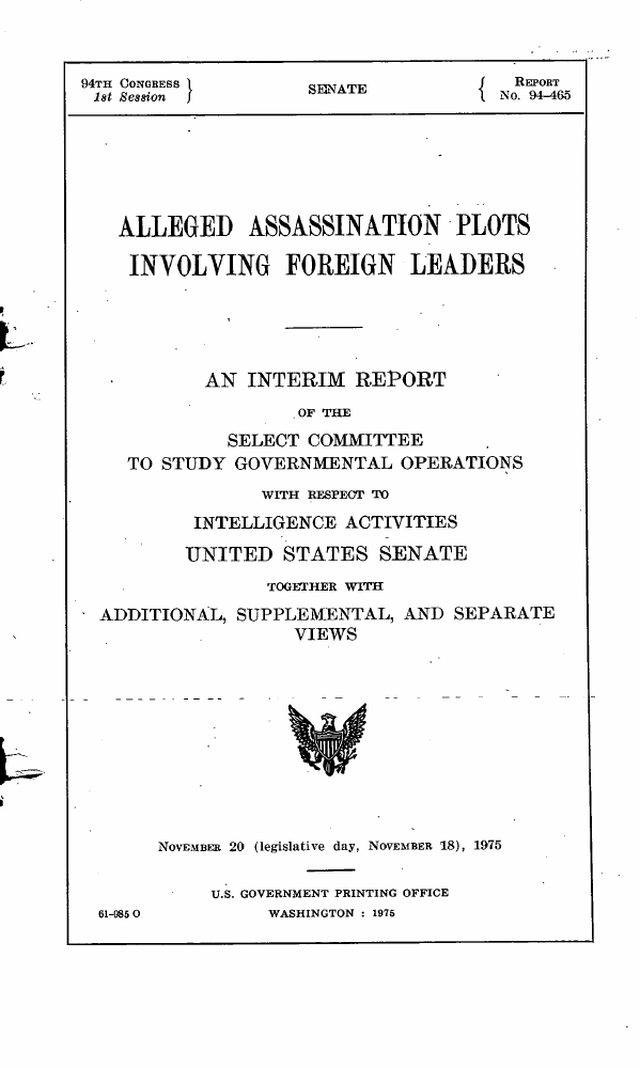
 Page 1 of 85
From the document
The Committee believes that, short of war, assassination is incompatible with American principles, international order, and morality. It should be rejected as a tool of foreign policy.
We believe that the public is entitled to know what instrumentalities of their Government have done.
The Castro and Lumumba cases are examples of plots conceived by United States officials to kill foreign leaders.
The Committee finds that the system of executive command and control was so ambiguous that it is difficult to be certain at what levels assassination activity was known and authorized.
Excerpts are passages from a US government work (public domain), quoted exactly as they read in the scan, and checked against the full text on every rebuild.
This report was the first time a branch of the US government said in public that American officials had planned to kill foreign leaders. It is an interim report: the Senate's select committee on intelligence, chaired by Frank Church of Idaho, published it on 20 November 1975, months before its final report of April 19761,4.
The committee had been created in January 1975 after press revelations of CIA domestic spying4. A presidential commission under Vice President Rockefeller had started looking into assassination allegations, said it could not finish, and at the President's direction handed its work to the Senate1. The committee took more than 8,000 pages of sworn testimony from over 75 witnesses on 60 hearing days, and drew on agency files and the papers of the Eisenhower, Kennedy and Johnson presidential libraries1.
Five countries
The report examines five cases1:
- Congo. In the autumn of 1960 two CIA officials were asked by superiors to assassinate Patrice Lumumba. Poisons were sent to the Congo and "exploratory steps" taken. Lumumba was killed by Congolese rivals in early 1961, and the committee found no evidence that the United States was involved in his death. See The CIA and the Congo crisis, 1960–61.
- Cuba. US government personnel plotted to kill Fidel Castro from 1960 to 1965, using American underworld figures and anti-Castro Cubans. See The plots against Fidel Castro.
- Dominican Republic. Dissidents shot Rafael Trujillo on 31 May 1961. US officials had supported them and supplied three pistols and three carbines, and some knew that the dissidents meant to kill him.
- South Vietnam. Ngo Dinh Diem and his brother were killed on 2 November 1963 during a generals' coup that the United States backed. The committee found no evidence that American officials wanted Diem dead.
- Chile. General René Schneider was shot on 22 October 1970 during a kidnap attempt by officers who wanted to block Salvador Allende, and died three days later. The CIA had backed coup plotters but had withdrawn active support from this group, and the committee found no plan to kill him. See Track II and Chile, 1970.
The report sets these apart. Only the Castro and Lumumba plots were conceived by American officials as killings1. It also reports evidence that senior officials discussed, and may have authorized, a general CIA assassination capability, called "executive action"1.
Who authorized it
Much of the report deals with authority and control. The committee traced the plots through the CIA's Directorate of Plans and the National Security Council's Special Group. It found the paper trail deliberately thin. Covert action was designed so that the US role could be "plausibly denied," and the same habit, applied inside the government, made communications between the agency and the White House "convoluted and imprecise"1. It could not find that any President had authorized a plot. It said a successful "plausible denial" might have hidden an authorization, and that each President still bore final responsibility for his subordinates1.
The committee also noted a gap in the record. The CIA's 1967 internal study of the Castro, Trujillo and Diem allegations, made to answer questions from President Johnson, survived. Its working papers had been destroyed on the instructions of Director Richard Helms, who had also ordered the study and kept it1.
Recommendations and consequences
The committee proposed a federal statute that would make it a crime to conspire, attempt or succeed in killing a foreign official abroad1. Congress did not pass it. On 18 February 1976 President Ford signed Executive Order 11905, which barred US government employees from engaging or conspiring in political assassination5,6. The Ford administration had asked the Senate not to publish the report. The committee released it anyway, explaining its decision on the second page1,6.
Reading it now
The report is still the main published source for these plots, and much of the CIA material it quoted has since been declassified under the Kennedy assassination records program6. Its limits are its own: it used aliases for some participants, depended on testimony fifteen years after the events, and covered only the cases the committee chose. The CIA's internal catalogue of the same period is The "Family Jewels" (1973).
Sources
- Congress Alleged Assassination Plots Involving Foreign Leaders: An Interim Report (GPO print, Boston Public Library copy), US Senate Select Committee on Intelligence Activities, via Internet Archive (1975-11-20).
- Congress Alleged Assassination Plots Involving Foreign Leaders (PDF), US Senate Select Committee on Intelligence (1975-11-20).
- Congress Intelligence-related commissions, reports and documents, US Senate Select Committee on Intelligence.
- Congress Select Committee to Study Governmental Operations with Respect to Intelligence Activities (Church Committee), United States Senate.
- National Archives Executive Orders Disposition Tables, 1976 (Executive Order 11905), National Archives, Office of the Federal Register.
- Wikipedia Church Committee, Wikipedia.
Elsewhere in the files
- Document "Make the economy scream": Helms's notes of 15 September 1970
- Document Allen Dulles's cable on Lumumba: 'an urgent and prime objective' (August 1960)
- Document Lansdale's "The Cuba Project" (1962)
- Document The "Family Jewels" (1973)
- Document The CIA Inspector General's report on plots to kill Castro (1967)
- Document The Church Committee's report on the NSA: 'National Security Agency Surveillance Affecting Americans' (1976)
- Document The Doolittle Report (1954)
- Document The Inspector General's survey of the Cuban operation (1961)
- Document The National Security Act of 1947
- Document The congressional Iran-Contra report (1987)
- Operation The CIA and the Congo crisis, 1960–61
- Operation The plots against Fidel Castro
- Operation Track II and Chile, 1970
- Person Frank Church