
 Page 1 of 2
From the document
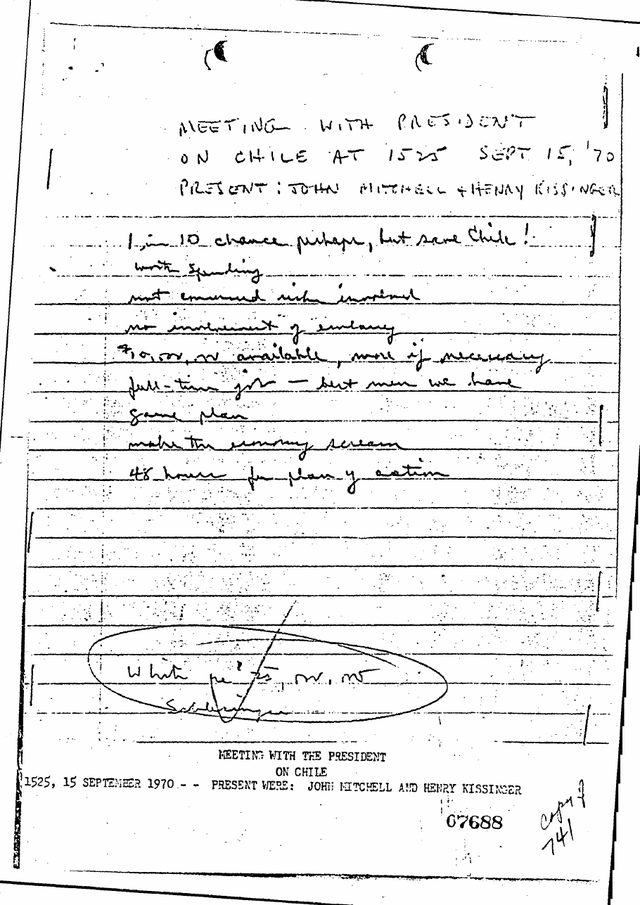
1 in 10 chance perhaps, but save Chile!
$10,000,000 available, more if necessary
make the economy scream
48 hours for plan of action
Excerpts are passages from a US government work (public domain), quoted exactly as they read in the scan, and checked against the full text on every rebuild.
Salvador Allende won a plurality, not a majority, in Chile's presidential election of 4 September 1970, which left the final choice to the Chilean Congress5. Eleven days later, at 3:24 in the afternoon of 15 September, President Nixon met Henry Kissinger, Attorney General John Mitchell and CIA Director Richard Helms in the White House to talk about Chile. The meeting lasted twenty minutes. Helms kept the only known notes2.
What the notes say
The first hosted page is Helms's handwritten sheet; the second is a typed transcription of it, marked Secret. Under the heading "Meeting with President on Chile at 1525 Sept 15, '70" and the names of Mitchell and Kissinger come ten short lines1.
They are fragments, but the order is clear. Nixon gave the effort a one-in-ten chance and wanted it tried anyway. It was "worth spending"; he was "not concerned" by the risks; the US embassy was not to be involved. Ten million dollars was available, "more if necessary." It was to be a "full-time job" with the "best men we have." Then came "game plan," "make the economy scream," and a deadline of 48 hours for a plan of action1.
Below a gap, both versions carry two more lines, "White re $25,000,000" and "Schlesinger," circled on the handwritten page. They are left out of the transcriptions printed by the Church Committee and by Foreign Relations, and those sources do not explain them1,2,3.
What happened next
The notes became the charter for what the CIA and the White House called Track II, the effort to provoke a military coup before the Chilean Congress voted, run alongside the 40 Committee's approved covert program, Track I, and known only to the CIA and the White House3. The next day Helms told his staff that Nixon had found an Allende regime unacceptable and had authorized $10 million, and that the agency was to act without coordinating with State or Defense. On 21 September headquarters cabled the Santiago station that a "military solution" was the objective3. On 16 October, after a review at the White House the afternoon before, headquarters told the station that it remained "firm and continuing policy that Allende be overthrown by a coup"4.
No coup came. Army commander General René Schneider, who opposed military intervention, was shot in a kidnap attempt by one group of plotters on 22 October and died on 25 October; Congress confirmed Allende on 24 October, by 153 votes to 355. The story is told on the Track II page.
How to read it
These are a listener's notes, not the President's words, and the Church Committee's interim report of November 1975 showed how differently two of the men in the room read them3.
The notes were given to the Church Committee in 1975 and a facsimile was printed in its published hearings; they are held among Helms's files in the CIA's records2. The committee also quoted them in full in its assassination report3.
Sources
- CIA CIA, Helms notes, 'Meeting with President on Chile at 1525 Sept 15, '70, Present: John Mitchell + Henry Kissinger', as posted by the National Security Archive, Central Intelligence Agency, via the National Security Archive (1970-09-15).
- FRUS Foreign Relations of the United States, 1969–1976, Volume XXI, Chile, 1969–1973, Document 93: Editorial Note, US Department of State, Office of the Historian (2014).
- Congress Alleged Assassination Plots Involving Foreign Leaders: An Interim Report (S. Rep. 94-465), pp. 227–231, US Senate Select Committee to Study Governmental Operations with Respect to Intelligence Activities, via Internet Archive (1975-11-20).
- FRUS Foreign Relations of the United States, 1969–1976, Volume XXI, Document 154: Telegram From the CIA to the Station in Chile, 16 October 1970, US Department of State, Office of the Historian (2014).
- CIA CIA Activities in Chile (the Hinchey Report), Office of the Director of Central Intelligence, via the Federation of American Scientists (2000-09).