
 Page 1 of 50
From the document
NSA has intercepted and disseminated international communications of American citizens whose privacy ought to be protected under our Constitution.
Codenamed Operation SHAMROCK, this was the largest governmental interception program affecting Americans, dwarfing CIA's mail opening program by comparison.
The initial interception of a stream of communications is analogous to a vacuum cleaner: NSA picks up all communications carried over a specific link that it is monitoring.
The watch list activities and the sophisticated technological capabilities that they highlight present some of the most crucial privacy issues facing this nation. Space age technology has outpaced the law.
Excerpts are passages from a US government work (public domain), quoted exactly as they read in the scan, and checked against the full text on every rebuild.
This is the Church Committee's considered verdict on the National Security Agency, written after the public hearings and published in April 1976 in Book III of the final report. Where the October and November 1975 hearings (Church Committee Hearings, Volume 5: The NSA and Fourth Amendment Rights (1975)) put the NSA director and the Attorney General on the record, this 50-page chapter is the staff's narrative, footnoted to depositions, agency letters and the hearing exhibits1,2. Its opening sentence states the problem: the NSA had intercepted and passed around Americans' international messages without warrants1.
Four programmes
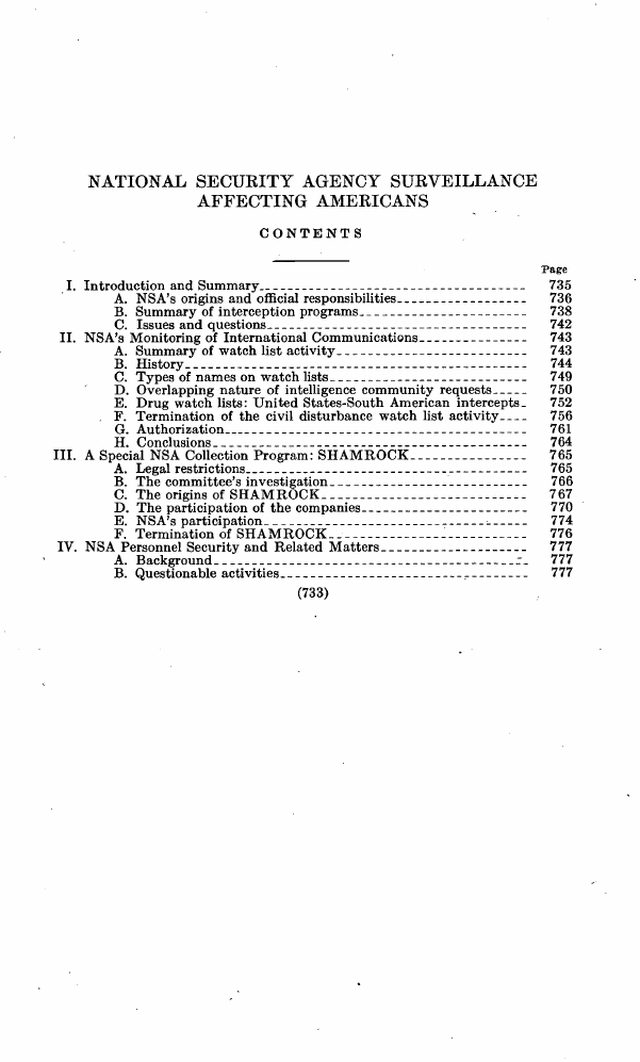
The report begins with the law, or its absence. The NSA had no statute; it rested on a Top Secret directive of 1952 and on National Security Council directives, and its general counsel told the committee that no law limited its signals work and that the Fourth Amendment did not apply to foreign-intelligence interception1. It then describes four programmes1:
- Watch lists. From the early 1960s to 1973 the NSA selected international messages using names of Americans supplied by the FBI, CIA, Secret Service, the drug bureau and the Pentagon. After 1967 the lists took in antiwar and civil rights activists; in 1969 they were formalized as MINARET, with orders to hide NSA's role. General Lew Allen suspended dissemination in 1973, and the Attorney General then judged the lists of "questionable legality".
- SHAMROCK. From August 1945 to May 1975 RCA Global and ITT World Communications handed over almost all their international telegrams, and Western Union International some foreign traffic. By the program's last years NSA analysts reviewed about 150,000 messages a month.
- Drug intercepts. From 1970 to 1973 the NSA monitored telephone links between the United States and South America for the Bureau of Narcotics and Dangerous Drugs, with 450 American names on a drug list.
- "Incidental" intercepts, which continued: the NSA's "vacuum cleaner" still swept up Americans' messages, though names were now usually deleted before reports went out.
SHAMROCK in detail
The longest section reconstructs SHAMROCK from Army and NSA files. In August 1945 two Army Signal Security Agency officers went to New York; ITT first refused, then reconsidered once Western Union had agreed, and RCA followed, all on condition of the Attorney General's protection. Secretary of Defense Forrestal renewed the assurances in December 1947, his successor Louis Johnson in 1949; a 1948 bill to legalize the arrangement died in the Senate Judiciary Committee. From 1966 to 1973 the CIA rented the NSA a cover office in lower Manhattan, project LPMEDLEY, to copy the companies' magnetic tapes. The companies were never told that Americans' telegrams were being read. Secretary Schlesinger ended the programme on 15 May 19751.
The report also shows how the story kept moving: an NSA file "discovered" in March 1976, and nine more documents found in the National Archives in April, while the report was at the printer1.
The Office of Security
A final section, not aired at the public hearings, covers the NSA's own security office: files on about 75,000 Americans destroyed in 1974, which CIA staff searched unsupervised for at least 13 years; watch-listing of two authors who wrote about the agency, and talk of a break-in at one author's home; four warrantless buggings in the late 1950s and four surreptitious entries in the early 1960s1. It names only the defectors Martin and Mitchell; everyone else is anonymous.
Reading it
The report keeps the NSA's secrets: it names no watch-listed citizen and no foreign target country1. Its policy questions, whether the NSA should be allowed to target Americans and whether a warrant should be needed, were taken up in the Foreign Intelligence Surveillance Act of 19781,5. For the 1975 hearings, Allen's testimony and the MINARET charter itself, see Church Committee Hearings, Volume 5: The NSA and Fourth Amendment Rights (1975); for the committee's work generally, Alleged Assassination Plots Involving Foreign Leaders (1975)3,4.
Sources
- Congress Final Report of the Select Committee to Study Governmental Operations with Respect to Intelligence Activities, Book III: Supplementary Detailed Staff Reports on Intelligence Activities and the Rights of Americans (S. Rep. 94-755), 'National Security Agency Surveillance Affecting Americans', US Senate Select Committee on Intelligence (1976-04-23).
- Congress Intelligence Activities: Senate Resolution 21, Hearings, Volume 5: The National Security Agency and Fourth Amendment Rights, US Senate Select Committee on Intelligence (1976).
- Congress Select Committee to Study Governmental Operations with Respect to Intelligence Activities (Church Committee), United States Senate.
- Wikipedia Project SHAMROCK, Wikipedia.
- Wikipedia Foreign Intelligence Surveillance Act, Wikipedia.