
 Page 1 of 166
From the document
Since its establishment in 1952 as a part of the Defense Department, representatives of the NSA have never appeared before the Senate in a public hearing. Today we will bring the Agency from behind closed doors.
Between 1967 and 1973 there was a cumulative total of about 450 U.S. names on the narcotics list, and about 1,200 U.S. names on all other lists combined.
For almost 30 years, copies of most international telegrams originating in or forwarded through the United States were turned over to the National Security Agency and its predecessor agencies.
An equally important aspect of MINARET will be to restrict the knowledge that such information is being collected and processed by the National Security Agency.
Excerpts are passages from a US government work (public domain), quoted exactly as they read in the scan, and checked against the full text on every rebuild.
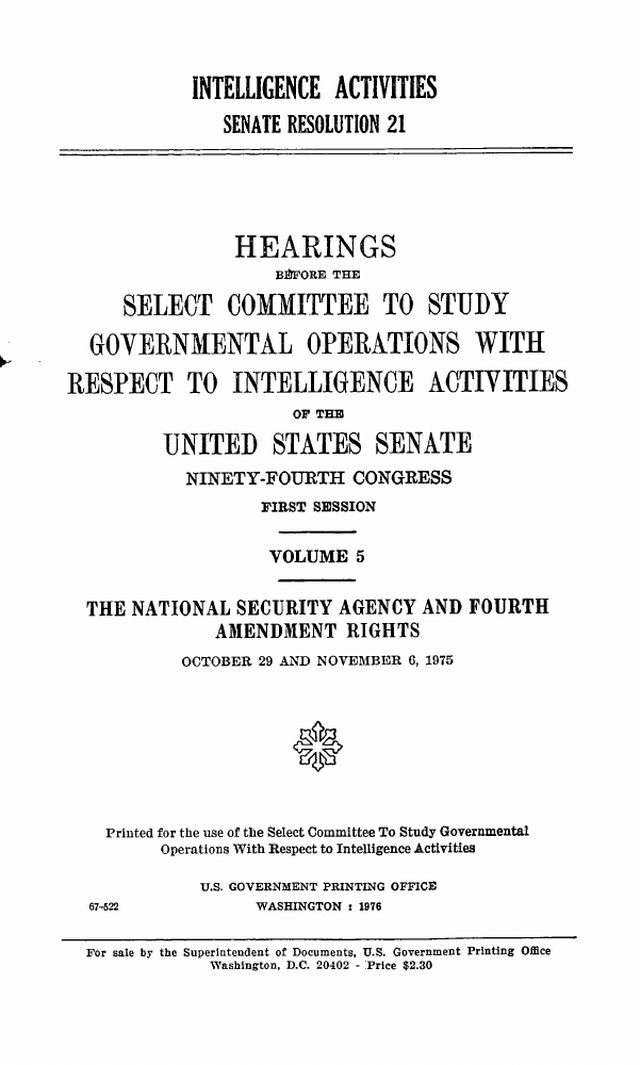
On the morning of 29 October 1975 Frank Church opened a hearing on an agency, he said, whose name most Americans did not know. Twenty-three years after its founding, the director of the National Security Agency, Lt. Gen. Lew Allen, Jr., sat before a congressional committee in public for the first time1. This volume is the record of that day and of a second session on 6 November, with the documents the committee forced into print. The committee's written verdict came later, in Book III of its final report; this is the testimony and the paper trail1,2.
29 October: the director testifies
Allen's prepared statement is the NSA's own account of the "watch list activity" of 1967 to 1973. Agencies supplied names: the Secret Service about 180 Americans, the FBI up to about 1,000 American persons and groups, the Defense Intelligence Agency about 20 people who had travelled to North Vietnam, the narcotics bureau about 450. At its height the list held about 800 American names. The NSA issued some 2,000 reports on drug trafficking and 1,900 on terrorism, presidential protection and foreign influence on protest groups. He said the information was a by-product of foreign collection, with one exception: telephone links to South America tapped for the drug bureau1.
The questioning is sharper. Senator Mondale read out an intercepted message about a peace concert to show how ordinary the swept-up material was; the committee withheld the musicians' names to protect their privacy. Barry Goldwater, opposed to public hearings, got Allen to agree that by his own reading of the law he was "violating the law in being here"1. Church then argued for disclosing a second, still secret programme over Senator Tower's objection1.
6 November: SHAMROCK and the Attorney General
The committee voted 7 to 3 on 3 November to release it. On 6 November Church read a committee statement into the record because the executive branch would supply no witnesses: for almost 30 years three telegraph companies had handed most international telegrams to the NSA and its predecessors, under assurances given by Secretary of Defense Forrestal on behalf of President Truman1. SHAMROCK was public. The rest of the day belongs to Attorney General Edward Levi, who put on the record annual figures for FBI wiretaps and microphones since 1940 and a long argument about the Fourth Amendment and foreign-intelligence surveillance, and to Professor Philip Heymann of Harvard, who argued that disseminating Americans' intercepted messages should require a warrant1.
The exhibits
The appendix prints eight declassified documents, with deletions to protect sources and the privacy of individuals1. Among them: the Army cable of 20 October 1967 that started the civil-disturbance list; the NSA director's same-day cable to the Intelligence Board; the 1 July 1969 charter of MINARET, which says the product would be marked "Background Use Only" and would "not be identified with the National Security Agency"; the drug bureau's 1970 request; Admiral Noel Gayler's ground rules of 26 January 1971 to the Secretary of Defense and the Attorney General; and the 1973 exchange in which Attorney General Elliot Richardson told the NSA to stop passing such material to the FBI and Secret Service1.
Reading it
The volume shows what the committee knew in late 1975, not the final record. Its SHAMROCK statement dates the company assurances to 1947; documents found in 1976 took the programme back to August 1945, as Book III reports1,2. No watch-listed name appears, and the MINARET scan is cropped at the margin. Names surfaced only decades later, from a declassified NSA history4. For the committee's background and other reports, see the Senate's history of the committee3.
Sources
- Congress Intelligence Activities: Senate Resolution 21, Hearings before the Select Committee, Volume 5: The National Security Agency and Fourth Amendment Rights (94th Congress, 1st session), US Senate Select Committee on Intelligence (1976).
- Congress Final Report, Book III (S. Rep. 94-755): 'National Security Agency Surveillance Affecting Americans', US Senate Select Committee on Intelligence (1976-04-23).
- Congress Select Committee to Study Governmental Operations with Respect to Intelligence Activities (Church Committee), United States Senate.
- Wikipedia Project MINARET, Wikipedia.