
In August 1945, with the war against Japan just over, two officers of the Army Signal Security Agency went to New York to ask three telegraph companies for something wartime censorship had given them for free: copies of the foreign government cables passing through their offices. The arrangement they struck lasted almost thirty years and outlived everyone who had approved it. When the Senate finally learned of it in 1975, it had a codename, Shamrock, and the Church Committee called it "probably the largest governmental interception program affecting Americans ever undertaken"1.
A wartime habit continued
During the Second World War, censorship law put all international message traffic in front of military censors, who passed the useful foreign material to intelligence. That access was due to end with the war. On 18 August 1945 the Army sent its two representatives to secure, in the words of their orders, "approval of the interception of all Governmental traffic entering the United States, leaving the United States, or transiting the United States"1.
The companies' lawyers advised against it. ITT at first "very definitely and finally refused." Western Union agreed unless the Attorney General ruled the intercepts illegal; ITT then reconsidered after being told it "would not desire to be the only non-cooperative company"; RCA's president agreed in principle. The executives' worries, the Army officers reported, were two: that the arrangement broke Federal Communications Commission rules, and that their own telegraph union might find out and expose it1.
The Committee found no evidence that Attorney General Tom C. Clark ever gave the written assurance the companies wanted. The program began anyway: ITT and Western Union by 1 September 1945, RCA by 9 October1.
Assurances that could not bind
In December 1947 Defense Secretary James Forrestal met RCA and ITT representatives in Washington, told them the work was "in the highest interests of national security," and said, speaking for President Truman, that they would not be prosecuted. He warned that he could not bind his successors. In June 1948 the Pentagon tried quietly to amend section 605 of the Communications Act of 1934, which forbade divulging the contents of wire messages, so that Shamrock would become legal. The Senate Judiciary Committee approved the change in executive session, but a Defense official told its chairman that "we did not desire an airing of the whole matter on the Floor," and the bill was never reported out. Louis Johnson renewed the assurances in 1949. Nobody asked again1.
Control passed from the Army to the Armed Forces Security Agency in 1949 and to the National Security Agency when it was created in 1952. Louis Tordella, NSA's deputy director from 1958 to 1974 and the official chiefly responsible, testified that to his knowledge no president after Truman knew of the program1.
From microfilm to magnetic tape
RCA Global and ITT World Communications handed over virtually all their international traffic; Western Union International supplied only certain foreign traffic and had dropped out by 1972. At first NSA couriers carried microfilm and paper tape from New York to Fort Meade, Maryland, several times a week, where it was sorted by hand. A former official remembered "literally miles and miles and miles of punched tape"1.
The change came with computers. RCA Global moved to magnetic tape in the early 1960s, and by 1964 NSA could sort its telegrams electronically against selection lists. That meant a name could be searched for. From 1967 the names of American protest leaders were on those lists, the watch-list program later formalized as Project Minaret1.
In 1966, to save the daily round trips, Tordella asked the CIA for a place in New York where the tapes could be copied. The Agency rented an office in lower Manhattan under cover of a television tape processing company and called its part LPMEDLEY. The CIA's general counsel later told it to "get out of it," and CIA support ended in August 1973; NSA moved the copying to another Manhattan office. In the program's last two or three years, NSA analysts reviewed about 150,000 telegrams a month1.
The company officials interviewed by the Committee said they never asked what NSA took from the tapes, and NSA never told them. Both sides said the companies received nothing in return1.
Found out
Shamrock surfaced sideways. In May 1975 documents passed to the Church Committee by the Rockefeller Commission mentioned CIA "cover" for an NSA copying operation in New York. NSA declined to confirm it, then offered to brief only the chairman and vice chairman. Press reports in July and August revealed fragments. In September NSA gave the Committee its first detailed account1.
By then the program was over. Defense Secretary James Schlesinger ordered it terminated effective 15 May 1975; NSA said it had lost its value as a source of foreign intelligence and the risk of exposure had grown. On 6 November 1975 Frank Church read the Committee's report into the public record, because the executive branch would not supply witnesses for an open session. In March 1976, as Book III went to press, NSA announced that a lower-level employee had turned up a further file on Shamrock, which the Committee folded into its final text1,2.
What it led to
The Committee's legal analysis was blunt. NSA never obtained a warrant for any telegram. Its own governing directive defined communications intelligence as excluding "unencrypted written communications," and the watch-list use of the tapes, it judged, appeared to violate section 605 outright1. Together with Minaret, Shamrock was one of the programs the Senate Historical Office lists as unknown to the public before the investigation, and the case helped produce the Senate Intelligence Committee in 1976 and the Foreign Intelligence Surveillance Act of 1978, which required warrants from a new court3,4.
No court ever ruled on Shamrock itself. A 1977 Justice Department review, as quoted by the historian Stephen Budiansky, concluded that the wiretap laws had been broken but placed the blame on "a 35-year failing of Presidents and the Congress rather than the agencies or their personnel"5.
The documents
Declassified records of this operation, with the scans and their full text hosted here.
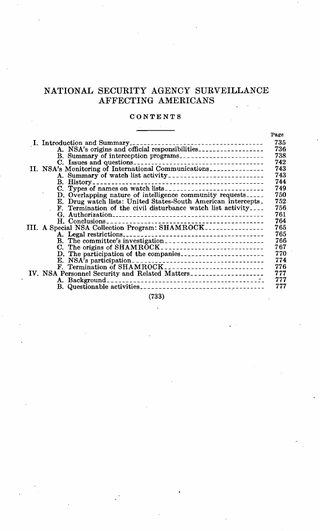 23 April 1976 · 50 p.The Church Committee's report on the NSA: 'National Security Agency Surveillance Affecting Americans' (1976)Senate Select Committee to Study Governmental Operations with Respect to Intelligence Activities (Frank Church, chairman)The Church Committee's 1976 staff report on the NSA: the MINARET watch lists, the drug intercepts, thirty years of telegram copying under SHAMROCK, and the NSA Office of Security's own files and break-ins.
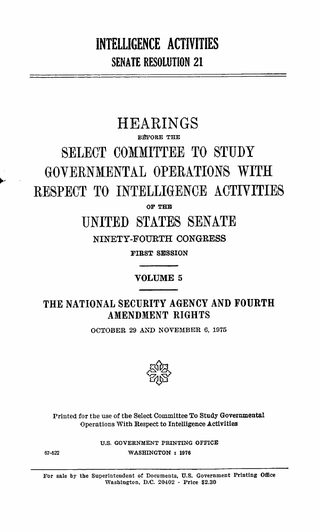 29 October 1975 · 166 p.Church Committee Hearings, Volume 5: The NSA and Fourth Amendment Rights (1975)Senate Select Committee to Study Governmental Operations with Respect to Intelligence Activities (Frank Church, chairman)The first public Senate testimony by an NSA director, Lew Allen's account of the watch lists, the committee's disputed vote to reveal SHAMROCK, and the 1969 MINARET charter and other NSA papers printed as exhibits.
Checking the record
Dates and outcome compared in two independent sources: they agree.
- Congress
- Army representatives approach the companies 18–21 August 1945; ITT and Western Union begin by 1 September, RCA by 9 October 1945; terminated 15 May 1975. Terminated by order of Secretary of Defense James Schlesinger; NSA said the program had lost its value and the risk of exposure had grown.
- Wikipedia
- August 1945 to May 1975 (with a 1940 RCA precursor). Terminated in May 1975 by NSA Director Lew Allen as congressional critics began to investigate.
Dates agree. Wikipedia credits Lew Allen with ending the program on his own authority; the Church Committee cites Allen's own handwritten memorandum of 12 May 1975 recording that the Secretary of Defense had decided to end it, and this page follows the committee. The Wikipedia article also muddles Shamrock with its sister program Minaret in places.
Sources
- Congress Final Report of the Select Committee to Study Governmental Operations with Respect to Intelligence Activities, Book III: Supplementary Detailed Staff Reports on Intelligence Activities and the Rights of Americans (S. Rep. 94-755), 'National Security Agency Surveillance Affecting Americans', US Senate, digitized by the Internet Archive (1976-04).
- Congress Church Committee Final Report, Book III (PDF), US Senate Select Committee on Intelligence (1976-04).
- Official history Senate Select Committee to Study Governmental Operations with Respect to Intelligence Activities, United States Senate, Historical Office.
- National Security Archive 'Disreputable if Not Outright Illegal': The National Security Agency versus Martin Luther King, Muhammad Ali, Art Buchwald, Frank Church, et al. (Electronic Briefing Book 441), National Security Archive (2013-09-25).
- Wikipedia Project SHAMROCK, Wikipedia.
- Wikipedia English Wikipedia article (used for cross-checking).
Elsewhere in the files
- Agency National Security Agency (NSA)
- Document Church Committee Hearings, Volume 5: The NSA and Fourth Amendment Rights (1975)
- Document The Church Committee's report on the NSA: 'National Security Agency Surveillance Affecting Americans' (1976)
- Operation Project Minaret
- Person Frank Church
- Tradecraft Signals intelligence
- Tradecraft Surveillance and countersurveillance
Read next
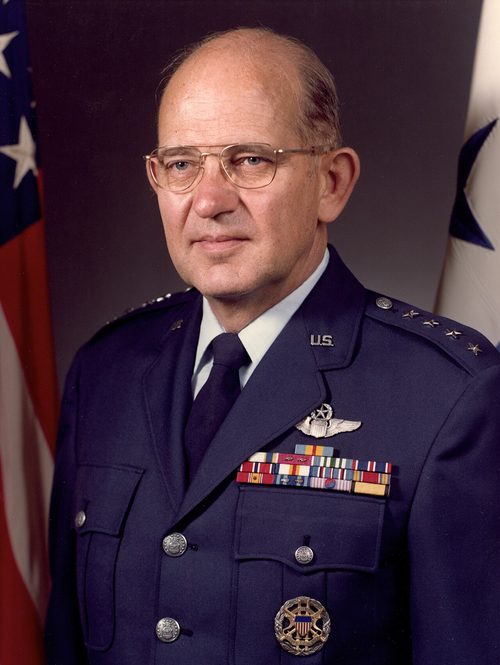 20 October 1967 – October 1973
Project Minaret
From 1967 to 1973 the NSA searched international communications for the names of Americans supplied by the FBI, CIA and Secret Service, among them Martin Luther King Jr., Muhammad Ali and two sitting senators.
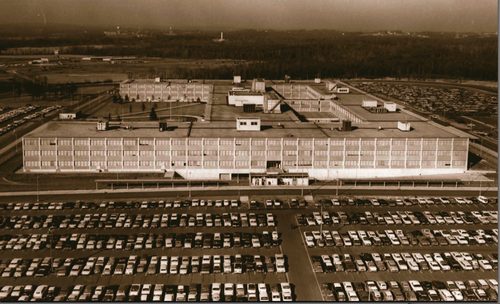 United States · 1952
National Security Agency (NSA)
America's signals intelligence and communications security agency, created by a secret Truman directive in 1952 out of the Armed Forces Security Agency, and exposed to public scrutiny by the Church Committee in 1975.
 15 August 1967 – 5 March 1974
Operation CHAOS
Pressed by two presidents to prove that foreign communists were behind the antiwar movement, the CIA built files on 7,200 Americans from 1967 to 1974 and kept finding no such proof.
 August 1956 – 28 April 1971
COINTELPRO
From 1956 to 1971 the FBI ran secret programs to 'disrupt' and 'neutralize' American political groups, from the Communist Party and the Klan to civil rights and antiwar organizations. A burglary in 1971 exposed them.
 1924–1984
Frank Church
Idaho senator who chaired the 1975–76 Senate investigation of the CIA, FBI and NSA. His committee exposed assassination plots, COINTELPRO and Shamrock, and led to permanent intelligence oversight.
 1914–1990s
Signals intelligence
Intelligence from intercepted communications and electronic emissions, from Room 40 and the Zimmermann telegram to Ultra, Venona, the Berlin tunnel and NSA's domestic programs exposed by the Church Committee.