


Counterintelligence is mostly patience. A tip from a defector or a decrypted message might point to a suspect, but courts and governments wanted proof, and proof usually came from watching: following a suspect on foot and by car, photographing meetings, staking out a dead drop, listening to a telephone. The other side's answer, countersurveillance, was the discipline of noticing that one was being watched and choosing when to act.
Watchers in London and New York
MI5's surveillance section, known inside the service as the watchers, did much of the work in the Portland case. From mid-1960 they followed the Admiralty clerks Harry Houghton and Ethel Gee on their monthly trips to London, saw Houghton hand a carrier bag to a man, and traced the man's car to Gordon Lonsdale (Konon Molody (Gordon Lonsdale)).2 Following Lonsdale led to his bank and, in November 1960, to the Ruislip bungalow of the Krogers, where MI5 set up an observation post in the house opposite.2 Watchers and Special Branch officers made the arrests on 7 January 1961.2
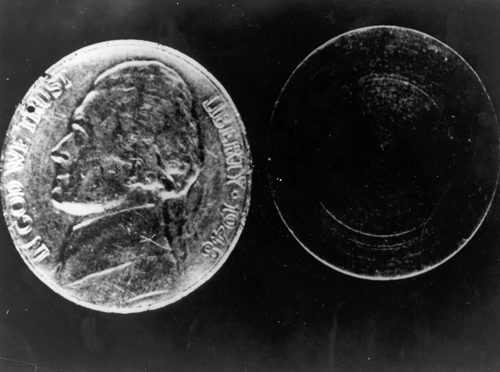
The FBI's pursuit of Rudolf Abel in 1957 shows the same method and its caution. Agents staked out the building at 252 Fulton Street in Brooklyn where the defector Reino Häyhänen had placed his superior's storeroom. On 28 May 1957 they saw a man matching the description sitting nervously on a park bench opposite, and chose not to follow him for fear of being spotted: "If that's 'Mark,' he'll return." He did, on 13 June, and was tailed to a hotel, photographed with a hidden camera, identified by Häyhänen and kept under watch until his arrest on 21 June.1
Moscow: the hardest street in the world
For Western intelligence officers in the Soviet capital, the roles were reversed. The KGB's internal counterintelligence directorate watched foreign diplomats as a matter of course. The CIA's account of Oleg Penkovsky's fall in 1962 says KGB officers were posted in apartments above and across the river from his home, and that he was arrested "after an extended period of surveillance."3,4
The CIA's history of the The Tolkachev case (1979–85) is the most detailed released description of how its officers worked under that pressure. The KGB, it explains, "could not maintain surveillance on all foreigners all the time," so officers built dull, predictable routines of shopping, sightseeing and walking the dog, hoping to bore their followers onto other targets. Before any operational act an officer made a long, apparently aimless route through the city to establish that he was alone; if he was not, the meeting was aborted, and an alternate date was always built into the plan.4 When surveillance grew heavy, the station turned to disguise and other deceptions, accepting that the KGB, aware that an officer had slipped away, would respond with harassment and tighter coverage for a time.4 (See The "Moscow Rules".)
None of this saved Tolkachev. In June 1985 the case officer going to meet him had seen nothing unusual on his way; at the meeting site more than a dozen KGB men rushed him from the bushes. The agent had already been betrayed.4
Surveillance as evidence
In the United States, physical surveillance provided the decisive evidence in the great espionage prosecutions of the late Cold War. During a ten-month investigation of Aldrich Ames, FBI teams watched him continuously; on 13 October 1993 they saw him make a chalk mark on a mailbox signaling a meeting in Bogotá, and on 1 November they observed him and, separately, his Russian handler there.5
The Hanssen affidavit shows the routine side of the work. FBI surveillance personnel had watched the KGB officer Viktor Degtyar arrive at the Soviet embassy on 16 October 1985 carrying an unusual large black bag, a day after he had received a package of classified documents from the spy then known only as "B." The significance of that sighting was understood only fifteen years later.6 In February 2001 FBI teams recorded Hanssen driving past the Foxstone Park signal site three times in one evening, and searched his car to find chalk and colored thumbtacks of the kind used to mark signal sites.6 (See Dead drops and The Hanssen case.)
Surveillance turned inward
The same tools could be aimed at a state's own citizens. In East Germany the Ministry for State Security, the Stasi, relied on tens of thousands of informants alongside its full-time staff; after reunification its files on millions of East Germans were opened, and from 1992 individuals could read their own.8
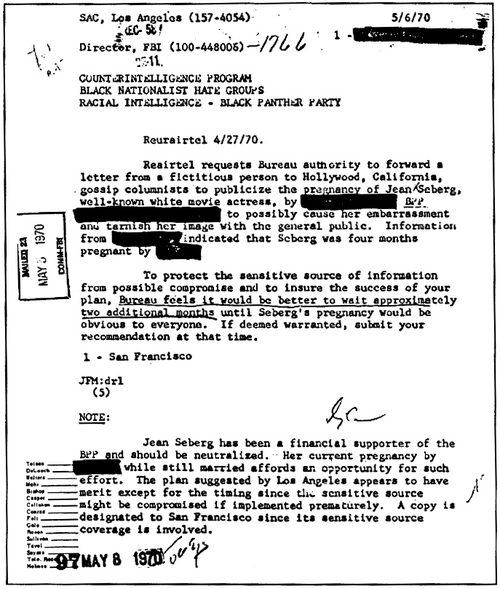
In the United States, the Senate's Church Committee, chaired by Frank Church, reported on 29 April 1976 after investigating domestic intelligence activities from Franklin Roosevelt's administration onward. It documented the FBI's COINTELPRO, whose targets included the Southern Christian Leadership Conference, the antiwar movement and Martin Luther King Jr., and NSA's SHAMROCK and MINARET programs, which monitored communications to and from the United States. The committee concluded that "intelligence agencies have undermined the constitutional rights of citizens," and its work led to the Senate intelligence committee in 1976 and the Foreign Intelligence Surveillance Act of 1978, which required warrants for national-security wiretaps.7
Sources
- FBI Hollow Nickel/Rudolf Abel, Federal Bureau of Investigation, History (archived by the Internet Archive).
- Wikipedia Portland spy ring, Wikipedia.
- CIA The Capture and Execution of Colonel Penkovsky, 1963, Central Intelligence Agency, Featured Story Archive (archived by the Internet Archive) (2010-03-05).
- CIA Tolkachev, A Worthy Successor to Penkovsky (Barry G. Royden), Studies in Intelligence 47, no. 3, Central Intelligence Agency, Center for the Study of Intelligence (archived by the Internet Archive) (2003).
- FBI Aldrich Ames, Federal Bureau of Investigation, History (archived by the Internet Archive).
- Court record USA v. Robert Philip Hanssen: Affidavit in Support of Criminal Complaint, Arrest Warrant and Search Warrants, US District Court, Eastern District of Virginia (text hosted by the Federation of American Scientists) (2001-02).
- Congress Senate Select Committee to Study Governmental Operations with Respect to Intelligence Activities (Church Committee), United States Senate, Historical Office.
- Wikipedia Stasi, Wikipedia.
- Wikipedia English Wikipedia article (used for cross-checking).
Elsewhere in the files
- Document The CIA's trained-cats memo (1967)
- Document The FBI letter that opened COINTELPRO against black nationalist groups (1967)
- Operation Acoustic Kitty
- Operation COINTELPRO
- Operation Project Mockingbird (1963)
- Operation The Portland spy ring
- Tradecraft Brush passes
- Tradecraft Dead drops
- Tradecraft Signals intelligence
- Tradecraft The "Moscow Rules"
Read next
 1940s–2001
Dead drops
A hiding place where one spy leaves material for another to collect later, so the two never meet. The Abel, Ames and Hanssen cases show how it worked and how the FBI turned it against its users.
1950s–1980s
Brush passes
The brief hand-to-hand exchange, made in passing in a public place. Declassified CIA accounts of the Penkovsky and Tolkachev cases in Moscow show how much of the Cold War's best intelligence moved this way.
 August 1956 – 28 April 1971
COINTELPRO
From 1956 to 1971 the FBI ran secret programs to 'disrupt' and 'neutralize' American political groups, from the Communist Party and the Klan to civil rights and antiwar organizations. A burglary in 1971 exposed them.
 1951 – 22 March 1961
The Portland spy ring
A Soviet network that took naval secrets from the Admiralty's underwater research establishment at Portland, run by the KGB illegal 'Gordon Lonsdale' and broken up by MI5 in January 1961.
 22 June 1953 – 15 November 1957
The Hollow Nickel case
A Brooklyn newsboy's trick nickel held a coded message the FBI could not read for four years, until a drunken KGB defector explained it and led agents to the illegal known as Rudolf Abel.