
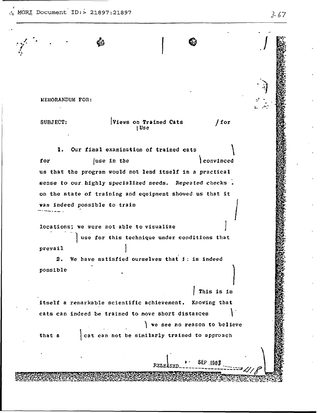
The CIA's official word on its spy cat runs to two pages. The memorandum, dated March 1967 by a handwritten "3-67" in its corner, is titled "Views on Trained Cats," with words blacked out on either side of that phrase. Its addressee, its author and most of its operational detail are deleted. What survives is enough to show that the CIA spent years trying to make a cat into a mobile listening post, and then decided against using it1.
What the memo says
The first paragraph gives the verdict. A "final examination of trained cats" for an unspecified use had "convinced us that the program would not lend itself in a practical sense to our highly specialized needs." Repeated checks on the training and the equipment had shown that it was possible to train the animals to reach certain locations, but the authors could not picture using the technique under the conditions that would prevail in the field1.
The second paragraph is almost admiring:
This is in itself a remarkable scientific achievement. Knowing that cats can indeed be trained to move short distances ...
The sentence runs into a redaction, and the paragraph closes with the decisive judgment1:
the environmental and security factors in using this technique in a real foreign situation force us to conclude that, for our [deleted] purposes, it would not be practical.
The third paragraph credits the staff, singling out a person whose name is deleted, "whose energy and imagination could be models for scientific pioneers"1.
The memo never uses the name "Acoustic Kitty," never mentions surgery, microphones or radio transmitters, gives no cost and names no target. Those details all come from later accounts1,2.
Where the work sat
The National Security Archive, which obtained the memo for Jeffrey Richelson's history of the CIA's Directorate of Science and Technology, places the project in that directorate. Its summary describes a surgically altered cat wired with transmitting and control devices to become a mobile eavesdropping platform2. Other heavily redacted CIA papers released under FOIA and posted by the Black Vault, a private document archive, show a broader "animal studies" program planned for fiscal 1968. They propose shifting the main effort to dogs while continuing "some small amount of work with felines to use them as testbeds," because cats were much cheaper laboratory subjects3.
How the story became public
The surviving copy carries a release stamp dated September 1983, but it drew little notice until September 2001, when the National Security Archive posted it among 43 documents on CIA science and technology1,2. The Guardian's report that week described the trained-cat memo as part of a fresh batch of declassified files and repeated the story of the cat's death5.
That story comes from Victor Marchetti, a former senior CIA official, as quoted by Richelson. In Marchetti's telling, the technicians "slit the cat open, put batteries in him, wired him up," used the tail as an antenna, and added another wire to override the cat's habit of wandering off when hungry. On its first field test, near a park bench where two men were talking, the cat was let out of a van and run over by a taxi2.
The figures and the targets
Many retellings say the project cost about $20 million, a figure Wikipedia attributes to Marchetti; a National Security Archive blog post in 2013 gave $15 million7,6. Neither figure appears in any released document.
What the record leaves out
When Smithsonian's writer asked the CIA in 2013 for documents on animal training for intelligence work, the Agency refused to confirm or deny that any existed, even though it had already released the 1967 memo. The National Security Archive criticized that response as an improper use of the Glomar formula4,6.
The result is an odd imbalance. A short memo establishes that the work was real, that it lasted "over the years," and that the CIA judged it impractical in 1967. Almost everything that made Acoustic Kitty famous rests on recollections that contradict one another. The project belongs with other Cold War experiments at the edge of science, such as MKUltra and the Stargate remote-viewing program, and with the long history of concealed listening devices2.
The documents
Declassified records of this operation, with the scans and their full text hosted here.
Checking the record
Dates and outcome compared in two independent sources: they agree.
- CIA
- Memo dated March 1967 (handwritten '3-67'); copy stamped released September 1983. Cats could be trained to move short distances, but the technique 'would not be practical' for the Agency's purposes.
- Wikipedia
- Project of the 1960s, cancelled in 1967; disclosed in 2001. Abandoned as impractical; cites the closing memorandum.
Both put the end in 1967 with the same conclusion. Wikipedia dates disclosure to 2001, when the National Security Archive published the memo; the copy itself carries a September 1983 release stamp, so this page treats 2001 as the date it became widely known.
Sources
- CIA Memorandum, Subject: [deleted] Views on Trained Cats [deleted] for [deleted] Use (March 1967), Document 27, Central Intelligence Agency, via National Security Archive (1967-03).
- National Security Archive Science, Technology and the CIA (Electronic Briefing Book No. 54, ed. Jeffrey T. Richelson), National Security Archive (2001-09-10).
- CIA CIA Acoustic Kitty and animal studies documents (FOIA release), Central Intelligence Agency, via The Black Vault.
- Other The CIA's Most Highly-Trained Spies Weren't Even Human (Tom Vanderbilt), archived copy, Smithsonian Magazine (2013-10).
- Other Project: Acoustic Kitty (Julian Borger, World dispatch), The Guardian (2001-09-11).
- National Security Archive The Cat's out of the Bag, So Declassify it Already, UNREDACTED, National Security Archive blog (2013-10-11).
- Wikipedia Acoustic Kitty, Wikipedia.
- Wikipedia English Wikipedia article (used for cross-checking).
Elsewhere in the files
Read next
 1940s–1980s
Concealment devices
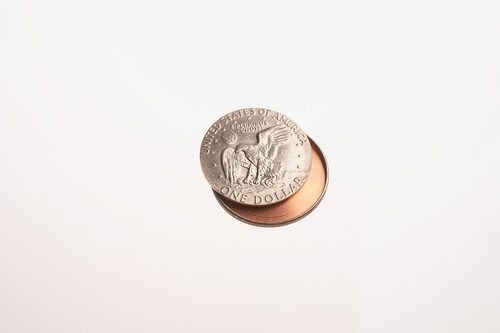
Hollow coins, bolts, batteries and books: the everyday objects spies used to carry film and messages. Many now sit in FBI and CIA collections, and nearly all were found the same way, through an informant or an arrest.
 1940s–1990s
Surveillance and countersurveillance
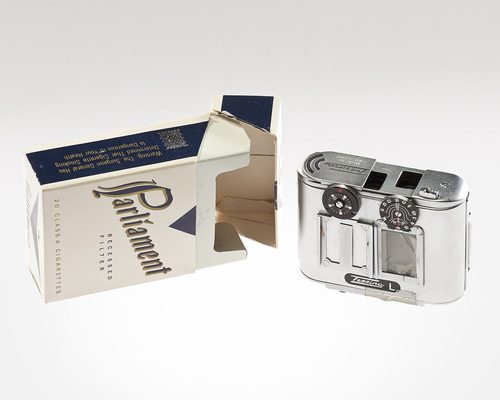
Watching people was the core of Cold War counterintelligence, from MI5's watchers in the Portland case to KGB teams trailing CIA officers in Moscow, and the Church Committee exposed its abuse at home.
 United States · 1947
Central Intelligence Agency (CIA)
The US civilian intelligence service, created by the National Security Act of 1947 to coordinate foreign intelligence, which within a year also became Washington's instrument for covert action.
 13 April 1953 – 1964
Project MKUltra
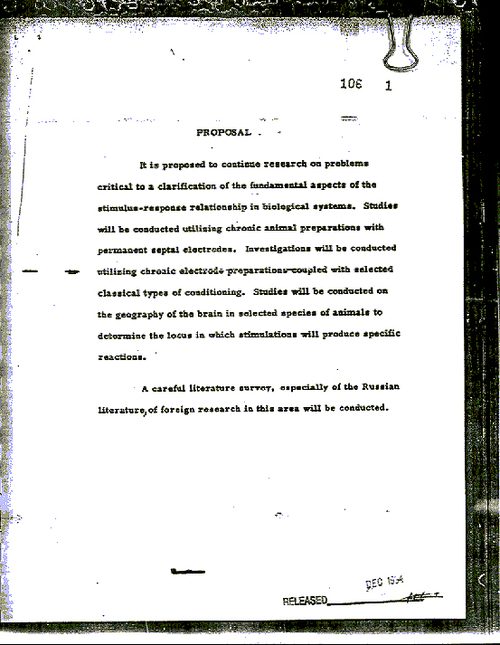
The CIA's umbrella program, approved in 1953, for secret research on drugs and behavior control. It included LSD tests on unwitting Americans; most records were destroyed in 1973, and a surviving cache surfaced in 1977.
1972 – 1995
The Stargate Project
For two decades the CIA, the Army and the DIA funded research into 'remote viewing', the claimed psychic ability to describe distant places. A 1995 review found it never produced usable intelligence.