
 Page 1 of 2
From the document
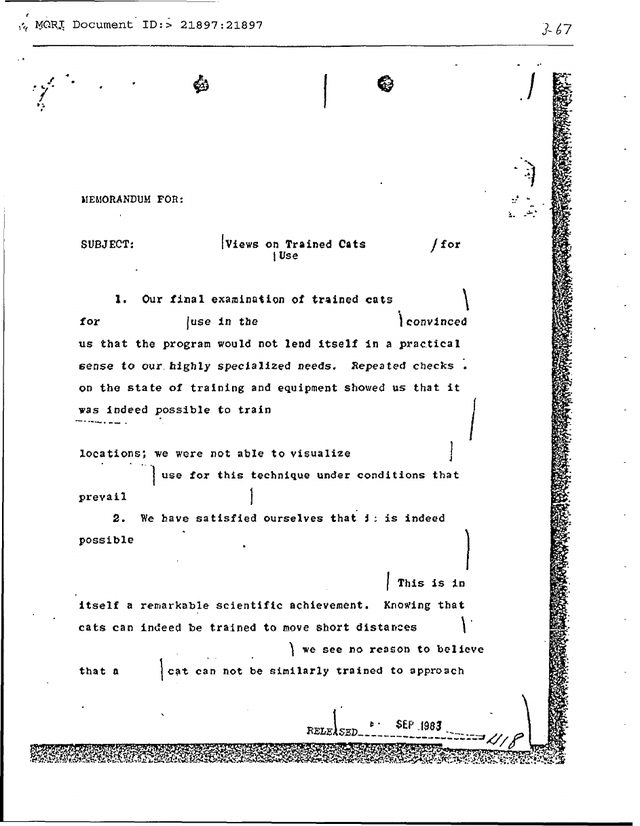
convinced us that the program would not lend itself in a practical sense to our highly specialized needs.
This is in itself a remarkable scientific achievement. Knowing that cats can indeed be trained to move short distances
the environmental and security factors in using this technique in a real foreign situation force us to conclude that, for our ... purposes, it would not be practical.
The work done on this problem over the years reflects great credit on the personnel who guided it
Excerpts are passages from a US government work (public domain), quoted exactly as they read in the scan, and checked against the full text on every rebuild.
Two typed pages are all the CIA has released about its attempt to send a cat to eavesdrop. A handwritten "3-67" in the top corner dates the memorandum to March 1967; the "MORI Document ID" header and a release stamp of September 1983 show it came out of the Agency's own declassification system. The addressee, the author, the office and most nouns that would say where and against whom the cat was to be used are cut out1.
What survives
The subject line reads "Views on Trained Cats," with deletions on either side. Paragraph 1 is the verdict. A "final examination" of trained cats had convinced the authors that the program could not serve the Agency's "highly specialized needs." Repeated checks of training and equipment showed that a cat could be trained to reach given locations, but they could not picture using the technique in the conditions that would prevail in the field1.
Paragraph 2 calls the training "a remarkable scientific achievement" and says there was no reason to think a cat could not be trained to approach a further target, which is redacted. Even so, "environmental and security factors" in a real foreign operation made it impractical. Paragraph 3 credits the staff "over the years" and singles out one person, name deleted, as a model for "scientific pioneers"1.
That is all. The memo never says "Acoustic Kitty." It mentions no surgery, microphone, transmitter, cost or target1.
Where it came from
The National Security Archive published the memo on 10 September 2001 as Document 27 of a briefing book edited by Jeffrey Richelson for his history of the CIA's Directorate of Science and Technology. The Archive lists the copy as a donation, not a FOIA release. Its note gives the project's popular name and the account of the surgically wired cat2.
How to read it
The memo establishes three things: the work was real, it went on for years, and in 1967 the Agency judged it impractical. Everything else in the Acoustic Kitty story comes from later recollection1,2.
When Smithsonian's writer asked the CIA in 2013 for records on animal training, the Agency would neither confirm nor deny that any existed. The National Security Archive's blog called that an incorrect use of the Glomar response, since this memo had already been declassified3,4. The project belongs with the CIA's other experiments at the edge of science, such as MKUltra, and with the longer history of concealed listening devices2.
Sources
- CIA Memorandum, Subject: [deleted] Views on Trained Cats [deleted] for [deleted] Use (March 1967), Document 27, Central Intelligence Agency, via National Security Archive (1967-03).
- National Security Archive Science, Technology and the CIA (Electronic Briefing Book No. 54, ed. Jeffrey T. Richelson), National Security Archive (2001-09-10).
- Other The CIA's Most Highly-Trained Spies Weren't Even Human (Tom Vanderbilt), archived copy, Smithsonian Magazine (2013-10).
- National Security Archive The Cat's out of the Bag, So Declassify it Already, UNREDACTED, National Security Archive blog (2013-10-11).
- Wikipedia Acoustic Kitty, Wikipedia.