
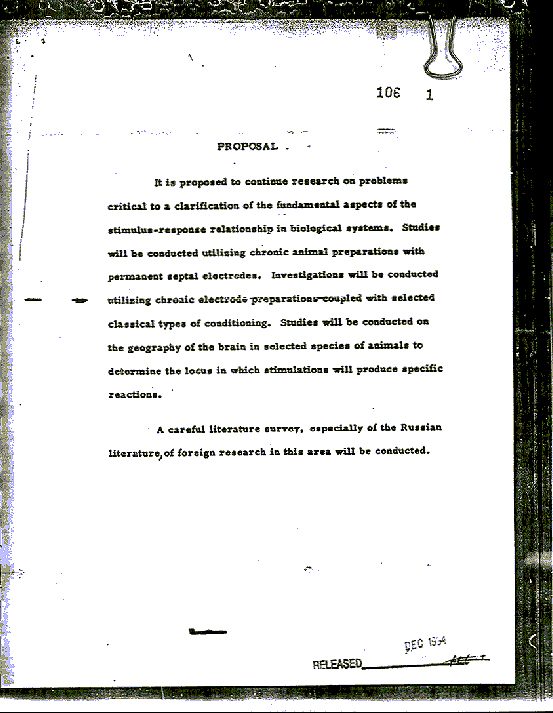

The paper trail for MKUltra was supposed to have been burned. In January 1973, on the eve of Richard Helms's departure as Director of Central Intelligence, the chief of the CIA's Technical Services Division had the program's records destroyed. He testified, and Helms confirmed, that he was carrying out Helms's verbal order. The Rockefeller Commission counted 152 files gone3,4.
Four years later an employee answering Freedom of Information Act requests went through the listings at the CIA's Retired Records Center and found seven boxes nobody had searched. They were the program's finance folders, retired in 1970 by a budget office instead of the branch that ran the work, and so missed both by the shredders and by the Senate's investigators in 1975. Admiral Stansfield Turner, the new Director, reported the find to the Senate on 15 July 1977 and testified about it on 3 August1.
An umbrella for sensitive research
MKUltra began with a proposal from Helms, then Assistant Deputy Director for Plans, to Director Allen Dulles. It was a funding mechanism for research into "the covert use of biological and chemical materials." Helms wrote that the work aimed at a chemical causing "a reversible non-toxic aberrant mental state" that might aid "in discrediting individuals, eliciting information, and implanting suggestions and other forms of mental control." Dulles approved it on 13 April 19533.
The background was fear of what the Soviet bloc might already have. The Rockefeller Commission traced the interest to the late 1940s, when show-trial confessions in Eastern Europe raised the possibility of drugs or hypnosis, and to anxiety over "brainwashing" in the Korean War4. An earlier project, BLUEBIRD, approved in 1950 and renamed ARTICHOKE in 1951, had studied special interrogation techniques3.
Grants went to outside specialists through foundations that hid the CIA's interest. The 1963 Inspector General's report, quoted by the Church Committee, explained the secrecy plainly: many authorities considered research in "the manipulation of human behavior" unethical; some activities raised "questions of legality"; and a final phase of testing "places the rights and interests of U.S. citizens in jeopardy"3.
What the recovered files showed
Turner's staff sorted 149 MKUltra subprojects by subject. Drug research was the largest group; others covered hypnosis, sleep and psychotherapy, polygraph research, and in a few cases electroshock, harassment substances and crop sabotage. The files named 185 non-government researchers and 80 institutions: 44 colleges or universities, 15 research foundations or drug companies, 12 hospitals or clinics and 3 prisons. Many of the people and places never knew the CIA was paying1.
Turner reported one case of "possibly improper" funding: $375,000 passed through an intermediary to the building fund of a private medical institution, which then received matching federal money as though for a private gift1. A separate procedure, MKDELTA, governed use of the materials abroad; because of the 1973 destruction the Church Committee could not reconstruct how often they were used3.
Unwitting subjects
The best-known part of the program was its third phase: testing in "normal life settings." From about 1955, officers of the Federal Bureau of Narcotics working for the CIA gave LSD to people who did not know they were being drugged, first on the West Coast and from 1961 in New York. The 1977 hearing heard that the work used safehouses in San Francisco and New York. At the federal addiction research center in Lexington, Kentucky, volunteer prisoners were rewarded for taking hallucinogens with doses of the drug they were addicted to1,3,4.
The program's first known casualty came before those tests. On 19 November 1953 a CIA officer put LSD into a bottle of Cointreau at a meeting of Army and CIA scientists. One of them, Frank Olson, an Army biological warfare scientist from Fort Detrick, became paranoid in the following days. While in New York for psychiatric treatment he fell from a tenth-floor window of the Statler Hotel; the Church Committee gave the date as 27 November 1953. In February 1954 the Director wrote to the officers involved criticizing their "poor judgment," but the Church Committee found that the letters were explicitly not reprimands and had no effect on their careers3.
The Inspector General learned of the unwitting tests in 1963 and recommended ending them. They were suspended, though Helms argued in December 1963 and again in 1964 for resuming them, warning that without realistic testing the Agency was living "with the illusion of a capability." No formal decision to resume them was ever taken3.
Canada, the courts and the record
Some of the money went to Canada. One subproject funded work at the Allan Memorial Institute in Montreal under the psychiatrist Donald Ewen Cameron, whose patients were subjected to drug-induced sleep and intensive electroshock; former patients sued the CIA in the 1980s6.
Researchers' identities stayed secret. A request for the names filed in 1977 ended in CIA v. Sims, decided on 16 April 1985, in which the Supreme Court held that the National Security Act let the Director withhold the names of the researchers and their institutions as "intelligence sources." The Court summarized MKULTRA as a project to "counter Soviet and Chinese advances in brainwashing and interrogation techniques"5.
The documents
Declassified records of this operation, with the scans and their full text hosted here.
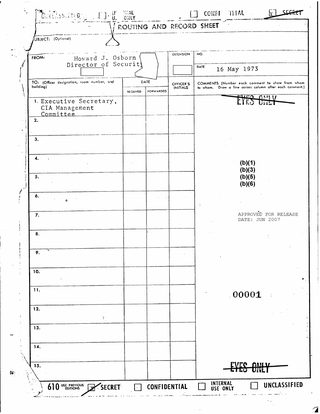 May 1973 · 148 p.The "Family Jewels" (1973)CIA offices and senior officials, reporting to the Director of Central Intelligence under James R. Schlesinger's directive of 9 May 1973The CIA's own 1973 inventory of activities that might have broken its charter, from mail opening and wiretaps on reporters to plots against Castro. Kept secret for 34 years, it was released in June 2007.
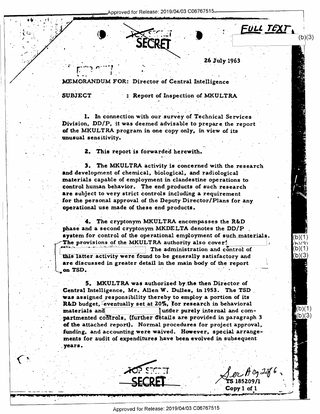 26 July 1963 · 46 p.The CIA Inspector General's inspection of MKULTRA (1963)J. S. Earman, Inspector General, Central Intelligence AgencyThe 1963 report, prepared in a single copy, in which the CIA's Inspector General described the MKULTRA behavior-control program, its drug tests on unwitting Americans, and recommended ending those tests.
Checking the record
Dates and outcome compared in two independent sources: they differ.
- Congress
- Program conducted 1953–1964; records destroyed January 1973; surviving financial files found in 1977. 149 subprojects; 185 non-government researchers and 80 institutions named; unwitting testing discontinued after the 1963 Inspector General report.
- Wikipedia
- 1953 to 1973 (the article treats the follow-on work as part of the program). Revealed by the Church Committee and Rockefeller Commission in 1975; records largely destroyed on Helms's order in 1973; about 20,000 pages surfaced in 1977.
The end date differs. The 1977 hearing and the Church Committee treat MKULTRA as ending in 1964, with related work under MKSEARCH until 1972; Wikipedia runs the program to 1973, and the Supreme Court in CIA v. Sims gave 1953–1966. This page follows the 1977 hearing, which drew on the recovered files.
Sources
- Congress Project MKULTRA, the CIA's Program of Research in Behavioral Modification: Joint Hearing before the Select Committee on Intelligence and the Subcommittee on Health and Scientific Research, US Senate, 95th Congress, 3 August 1977, US Senate, digitized by the Internet Archive (1977-08-03).
- Congress Project MKULTRA joint hearing, 1977 (PDF), US Senate Select Committee on Intelligence (1977-08-03).
- Congress Final Report of the Select Committee to Study Governmental Operations with Respect to Intelligence Activities, Book I: Foreign and Military Intelligence (S. Rep. 94-755), 'Testing and Use of Chemical and Biological Agents by the Intelligence Community', US Senate, digitized by the Internet Archive (1976-04).
- Official history Report to the President by the Commission on CIA Activities Within the United States, chapter 16, Rockefeller Commission, digitized by the Internet Archive (1975-06).
- Court record CIA v. Sims, 471 U.S. 159 (1985), US Supreme Court, United States Reports (Library of Congress) (1985-04-16).
- Wikipedia MKUltra, Wikipedia.
- Wikipedia English Wikipedia article (used for cross-checking).
Elsewhere in the files
Read next
 15 August 1967 – 5 March 1974
Operation CHAOS
Pressed by two presidents to prove that foreign communists were behind the antiwar movement, the CIA built files on 7,200 Americans from 1967 to 1974 and kept finding no such proof.
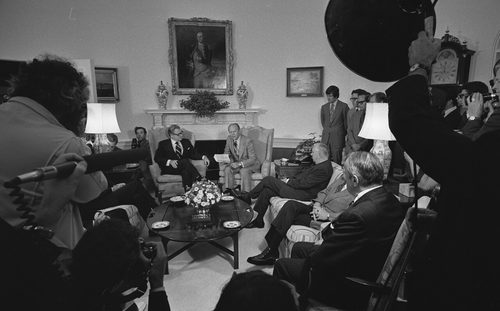 May 1973
The "Family Jewels" (1973)
The CIA's own 1973 inventory of activities that might have broken its charter, from mail opening and wiretaps on reporters to plots against Castro. Kept secret for 34 years, it was released in June 2007.
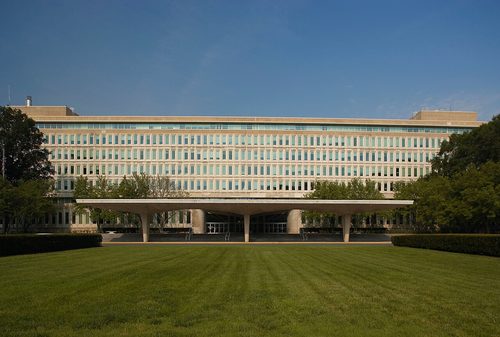 United States · 1947
Central Intelligence Agency (CIA)
The US civilian intelligence service, created by the National Security Act of 1947 to coordinate foreign intelligence, which within a year also became Washington's instrument for covert action.
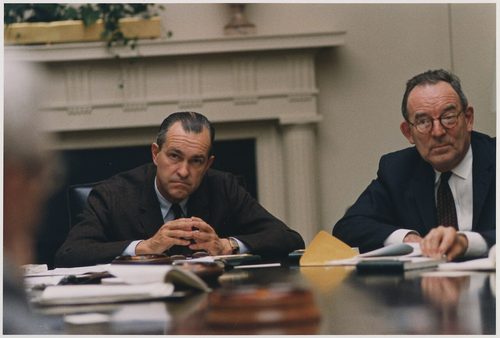 1913–2002
Richard Helms
A career clandestine officer who rose from OSS to Director of Central Intelligence (1966–73), Richard Helms ran the CIA through Vietnam and Chile and later became the only DCI convicted over testimony to Congress.
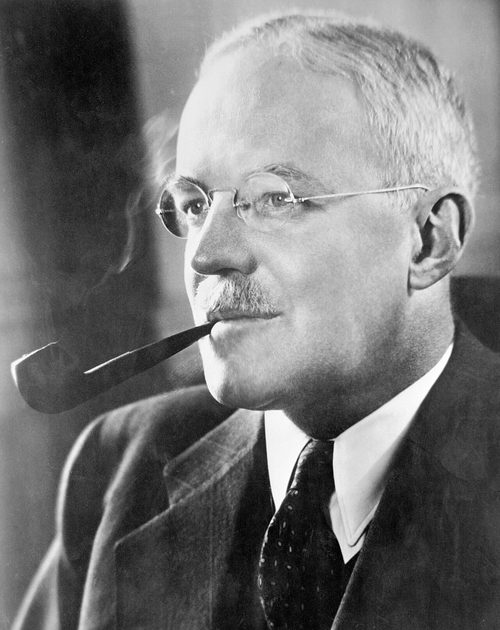 1893–1969
Allen Dulles
OSS spymaster in wartime Switzerland and Director of Central Intelligence from 1953 to 1961, Allen Dulles presided over the CIA's era of coups and covert wars until the Bay of Pigs ended his tenure.
 1924–1984
Frank Church
Idaho senator who chaired the 1975–76 Senate investigation of the CIA, FBI and NSA. His committee exposed assassination plots, COINTELPRO and Shamrock, and led to permanent intelligence oversight.