
In September 1995 three researchers at the American Institutes for Research in Washington sent the CIA a 200-page report on a program the Agency was being asked to take over. It concerned "remote viewing, or the ability to describe locations one has not visited," and it ended with a sentence that closed a twenty-year experiment: "we conclude that continued use of remote viewing in intelligence gathering operations is not warranted"1.
The Soviet worry
The program began as a response to reports from the other side. Between 1969 and 1971 American intelligence concluded that the Soviet Union was funding research into what it called "psychotronics," with estimates of about 60 million rubles a year by 1970. The amount of money suggested to some analysts that the Soviets had found something4.
The CIA's own effort began in 1972, with contracts to the Stanford Research Institute in Menlo Park, California, under the name SCANATE, "scan by coordinate." Its physicists worked with a small group of gifted subjects, among them the New York artist Ingo Swann and a former Burbank police officer, Pat Price. In the basic experiment a "sender" travelled to a site and the viewer, elsewhere, tried to draw and describe it; a judge then ranked the description against a set of possible targets. The AIR report later noted that early studies were "plagued by a number of statistical and methodological flaws," such as cues from the time it took to drive to each site1,4.
The CIA dropped its program in 19771.
From Grill Flame to Star Gate
The Army picked up the idea the same year. Its intelligence staff began GONDOLA WISH in 1977 to judge what an adversary might do with remote viewing, and in mid-1978 turned it into an operational unit, GRILL FLAME, housed in two wooden buildings at Fort Meade, Maryland. The research at SRI was folded in during 1979. In 1983 the unit became the INSCOM CENTER LANE Project4,5.
It was never secret from everyone. The columnist Jack Anderson reported the program in April 1984. That year the National Research Council, reviewing techniques for improving human performance at the request of the Army Research Institute, found little or no support for remote viewing; its report was published in 19883,4. Army funding ended in late 1985, and the Defense Intelligence Agency took the unit over as SUN STREAK. In the early 1990s, with the research contract moved to Science Applications International Corporation, it received its final name, STAR GATE1,4.
Over more than two decades about $20 million was spent. Some 40 people served in the program, about 23 of them as viewers; at the peak in the mid-1980s there were as many as seven full-time viewers. By the 1990s a few remained, working at Fort Meade on tasks set by other agencies4.
The 1995 review
In 1995 Congress directed that the program pass from DIA to the CIA. Before accepting it, the CIA declassified its own past parapsychology work and in June 1995 hired AIR to evaluate the research since the National Research Council's report and the program's operational record1.
The research review used a panel built to argue with itself. AIR chose two outside experts, a statistician who had published work favorable to paranormal interpretations and a psychologist known as a skeptic, together with two of its own senior scientists without any background in parapsychology. They reviewed about 80 publications. Their joint findings were that "a statistically significant laboratory effort has been demonstrated in the sense that hits occur more often than chance," but that the same viewers, judge and target photographs had been used so often that the cause could not be separated, and that nothing showed the hits were "due to the operation of paranormal phenomena"1.
What the users said
The operational half of the review asked the people who had set the targets. Their verdict was blunt. Some reports caught "broad background characteristics," but they did not give "the concrete, specific information valued in intelligence gathering"; they were "inconsistent, inaccurate with regard to specifics," and needed heavy interpretation. The decisive finding was a single line:
In no case had the information provided ever been used to guide intelligence operations.
That passage is from1. The report added that the laboratory conditions in which hits appeared, with feedback and photographs chosen as targets, could not exist in real intelligence work1.
The CIA ended the program in 1995 and released its records. In January 2017 the Agency put the Stargate files online in its CREST database2,5.
Checking the record
Dates and outcome compared in two independent sources: they agree.
- CIA
- CIA program 1972–1977; DIA involvement from about 1985; program named Star Gate in the early 1990s; AIR contracted June 1995, reported 29 September 1995. Remote viewing 'failed to produce actionable intelligence'; continued use 'not warranted'.
- Wikipedia
- Army unit established 1977 at Fort Meade; SRI research from 1972; renamed Stargate 1991; terminated 1995. Terminated and declassified after a CIA-commissioned review found it was never useful in any intelligence operation.
Dates and outcome agree in substance. Wikipedia dates the unit from the Army's 1977 GONDOLA WISH effort and the Stargate name from 1991; the AIR report gives the CIA's own program as 1972–1977 and the Star Gate name as early 1990s. This page uses 1972 for the start of government-funded research.
Sources
- CIA An Evaluation of Remote Viewing: Research and Applications (Mumford, Rose and Goslin, American Institutes for Research), CIA-RDP96-00791R000200180006-4, Central Intelligence Agency release, copy hosted by The Black Vault (1995-09-29).
- CIA Stargate collection, CIA FOIA Reading Room, Central Intelligence Agency.
- Other Enhancing Human Performance: Issues, Theories, and Techniques, National Research Council, National Academies Press (1988).
- Other STAR GATE [Controlled Remote Viewing], Federation of American Scientists, Intelligence Resource Program.
- Wikipedia Stargate Project (U.S. Army unit), Wikipedia.
- Wikipedia English Wikipedia article (used for cross-checking).
Elsewhere in the files
Read next
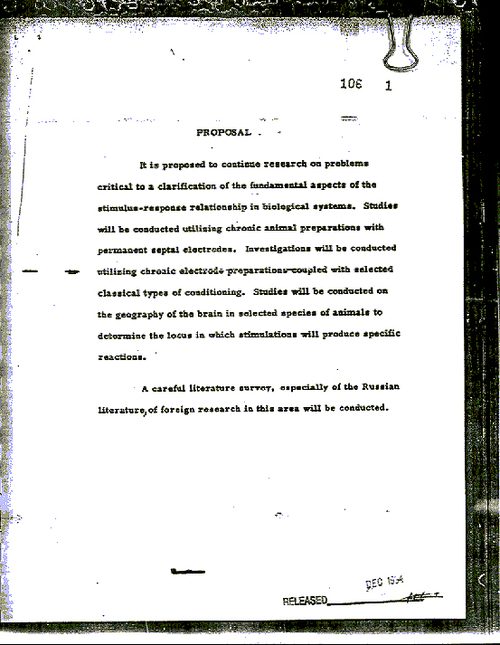 13 April 1953 – 1964
Project MKUltra
The CIA's umbrella program, approved in 1953, for secret research on drugs and behavior control. It included LSD tests on unwitting Americans; most records were destroyed in 1973, and a surviving cache surfaced in 1977.
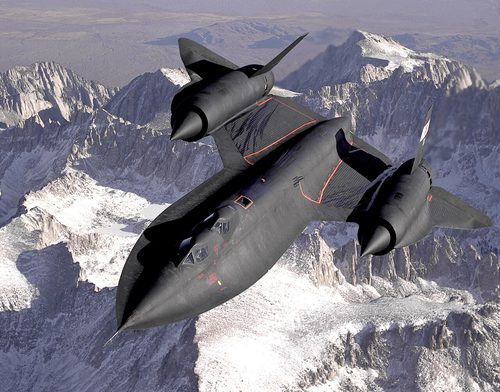 1956–1990s
Overhead reconnaissance
Balloons, the U-2, the A-12 and the CORONA satellites gave the United States its first reliable picture of Soviet military power. The programs were secret for decades; the NRO itself was not acknowledged until 1992.
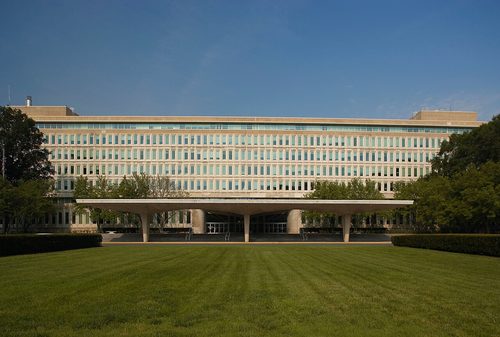 United States · 1947
Central Intelligence Agency (CIA)
The US civilian intelligence service, created by the National Security Act of 1947 to coordinate foreign intelligence, which within a year also became Washington's instrument for covert action.
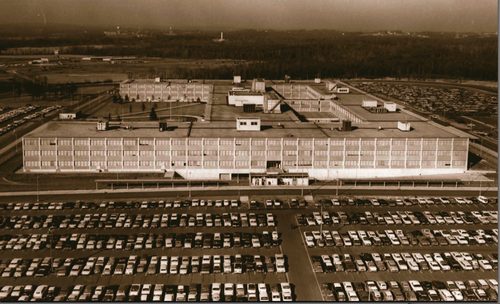 United States · 1952
National Security Agency (NSA)
America's signals intelligence and communications security agency, created by a secret Truman directive in 1952 out of the Armed Forces Security Agency, and exposed to public scrutiny by the Church Committee in 1975.