
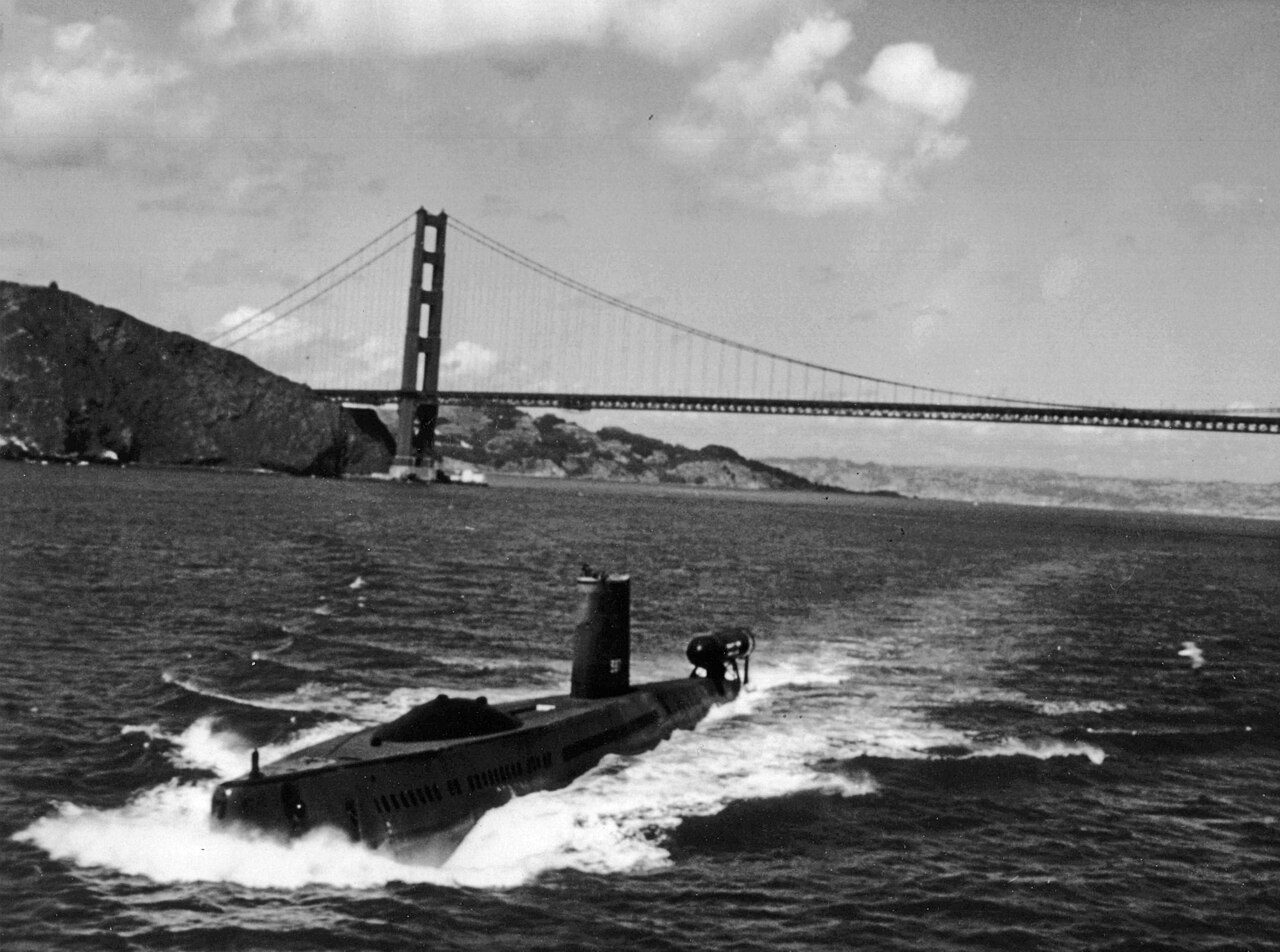
The Sea of Okhotsk is nearly enclosed by Soviet territory, and in the early 1970s Moscow treated it as its own water. Across its floor ran a communications cable linking the Pacific Fleet's submarine base at Petropavlovsk on the Kamchatka Peninsula with the mainland. Operation Ivy Bells was the American effort to listen to that cable from the seabed. For about a decade it worked. It ended because a former NSA analyst sold its existence to the KGB5,2.
The submarine and the "rescue vehicle"
The platform was USS Halibut, a former missile submarine rebuilt in 1968–1970 at Mare Island with side thrusters, seabed anchors, a saturation-diving chamber, search sonars, a towed camera vehicle and equipment for induction tapping and recording7. The diving chamber on its after deck was described publicly as a deep-submergence rescue vehicle. According to Duncan Campbell's 1999 report for the European Parliament, it was welded to the hull and could not leave it2,5.
In October 1971 Halibut went into the Sea of Okhotsk. Divers locked out of the submarine, found the cable in roughly 400 feet of water, and wrapped tapping coils around it. Induction tapping read the signals through the cable's casing without cutting into it, which made the tap hard to detect. In 1972 Halibut returned and laid a recording pod beside the cable2,5.
A decade of tapes
Submarines returned periodically to collect full recorders and leave new ones, and the tapes went to the NSA for processing. Accounts based on participants say much of the traffic was unenciphered, because Soviet officers assumed nobody could reach a cable on the floor of their own sea. Later pods were larger and could record for longer, and the method was extended elsewhere: Campbell reports that USS Parche laid a tap near Murmansk in the Barents Sea in 19792,5. Wikipedia credits Parche, Seawolf and Richard B. Russell with later cable missions5.
Ivy Bells belonged to a long line of American efforts to tap Soviet lines at the source, from the Vienna tunnels and the Berlin Tunnel in the 1950s, and it ran alongside the Navy's broader program of close-in submarine reconnaissance, best known by the code name Holystone. Halibut itself had photographed the wreck of the Soviet submarine K-129 in 1968, the first step toward Project Azorian7.
The man who sold it
Ronald William Pelton served in the Air Force from 1960 to 1964, where he learned Russian, and worked for the NSA from 1965 to 1979 on communications intelligence about Soviet transmissions. He left after financial trouble and bankruptcy1,6. In January 1980 he decided to sell what he knew. He telephoned Soviet officials and arranged to visit the embassy in Washington. The FBI was wiretapping the line under the Foreign Intelligence Surveillance Act, but nobody recognized his voice at the time1.
He took no documents. Between 1980 and 1983 he met Soviet officers in Washington and Vienna and answered their questions from memory, compromising several classified NSA operations, for which he was paid more than $35,0001. Secrecy News, the FAS newsletter, later noted that this reliance on memory rather than stolen papers made the case unusual for its time3. Ivy Bells was the most damaging of what he gave away. Wikipedia, drawing on published accounts, says American satellites saw Soviet ships, including a salvage vessel, over the tap site in 1981, and that a submarine sent to service the tap could not find it5,4.
Caught by a defector's memory
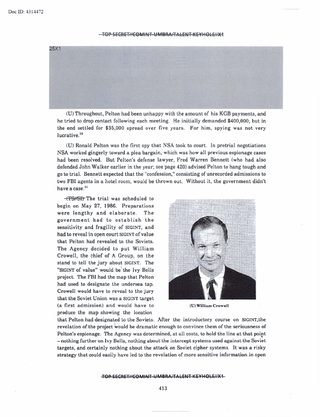
In 1985 the KGB officer Vitaly Yurchenko defected to the United States and described a former NSA man he had met in 1980. NSA officials recognized Pelton's voice on the 1980 intercepts1,6. On 24 November 1985 FBI agents interviewed Pelton at a hotel in Annapolis, laid out a "hypothetical" story that matched his own, and drew him into admissions about payments, meetings and a program the court records call "Project A." He was arrested at the end of a second session late that night. Yurchenko had by then gone back to the Soviet Union, so Pelton's own statements were central to the prosecution1.
Pelton was convicted in 1986 of conspiracy to commit espionage, espionage, attempted espionage and unauthorized disclosure of communications intelligence, and sentenced to three concurrent life terms plus ten years. The Fourth Circuit upheld the convictions on 18 December 1987, rejecting his claims that his statements were involuntary and that the surveillance law was unconstitutional1,3. His arrest was one of the cluster that made 1985 the Year of the Spy, along with the Walker ring4. He was released on 24 November 2015 and died in 20223,6.
What remains classified
The NSA and the Navy have never released an official history of Ivy Bells. The public account rests on Pelton's trial, on interviews with submariners gathered by journalists, chiefly Sherry Sontag and Christopher Drew in Blind Man's Bluff (1998), and on later secondary works. Specific figures that often circulate, such as the depth of the cable, the exact dates of each pod run and what the tapes revealed, come from those accounts rather than from released documents5,2.
The documents
Declassified records of this operation, with the scans and their full text hosted here.

Checking the record
Dates and outcome compared in two independent sources: they agree.
- Court record
- Pelton at NSA 1965–1979; sold information to Soviet officials from January 1980 through 1983; interviewed by the FBI and arrested 24 November 1985. Convicted of conspiracy, espionage, attempted espionage and disclosing communications intelligence; three life terms plus ten years; conviction affirmed.
- Wikipedia
- Halibut sent into the Sea of Okhotsk October 1971; Pelton approached the Soviet embassy January 1980; Soviet ships over the tap site 1981; Yurchenko defected July 1985. Tap lost to the Soviets in 1981; Pelton arrested and convicted.
The court record and Wikipedia agree on Pelton's dates and fate. The court record does not name Ivy Bells (it calls the compromised program 'Project A') or date the tap itself, so the 1971 start and the 1981 loss rest on Wikipedia, the National Security Archive and Campbell's 1999 report; Campbell dates the end to 1982.
Sources
- Court record United States v. Pelton, 835 F.2d 1067 (4th Cir. 1987), Caselaw Access Project (Harvard Law School) (1987-12-18).
- Other Interception Capabilities 2000 (report to the Director General for Research of the European Parliament, STOA), Duncan Campbell, via Federation of American Scientists (1999).
- Other Soviet Spy Ronald W. Pelton to be Released from Prison, Federation of American Scientists, Secrecy News (2015-11-23).
- National Security Archive Not Quite Another "Year of the Spy", National Security Archive, Unredacted (2013-07-12).
- Wikipedia Operation Ivy Bells, Wikipedia.
- Wikipedia Ronald Pelton, Wikipedia.
- Wikipedia USS Halibut (SSGN-587), Wikipedia.
- Wikipedia English Wikipedia article (used for cross-checking).
Elsewhere in the files
- Document "Project AZORIAN: The Story of the Hughes Glomar Explorer"
- Document Ford's meeting on the submarine leak (27 May 1975)
- Document Meeting the Espionage Challenge: the Senate's verdict on the Year of the Spy (1986)
- Document NSA's secret history of the Pelton trial and the Ivy Bells leak (1999)
- Operation 1985, the Year of the Spy
- Operation Operation Holystone
- Operation Project Azorian (the Glomar Explorer)
- Operation Project Coldfeet
- Tradecraft Signals intelligence
Read next
 1959 – 1972
Operation Holystone
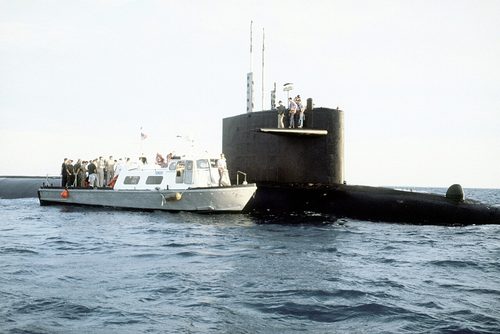
Holystone was a US Navy code name for close-in submarine spying on the Soviet Navy. The New York Times exposed it in May 1975, and Ford White House papers show how officials argued over the leak.
 1 July 1969 – 16 June 1975
Project Azorian (the Glomar Explorer)
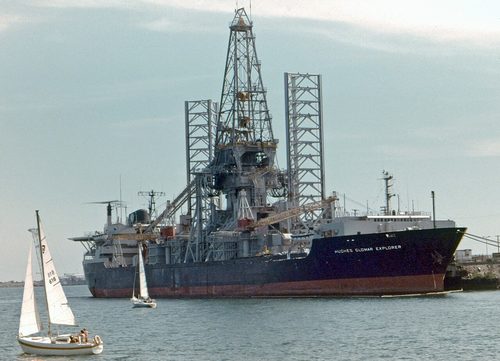
In 1974 the CIA used a purpose-built ship, passed off as Howard Hughes's deep-sea mining vessel, to lift part of the sunken Soviet submarine K-129 from 16,500 feet down in the Pacific.
 16 April – 25 November 1985
1985, the Year of the Spy
In 1985 the FBI arrested a string of Americans spying for Moscow, Beijing and Israel, a KGB officer defected and re-defected, and the CIA lost almost every agent it had inside Soviet intelligence.
 December 1967 – 20 May 1985
The Walker spy ring
For seventeen years US Navy communications specialist John Walker sold cipher keys and secret messages to the KGB, later recruiting a friend, his brother and his son. The FBI arrested him in May 1985.
 1914–1990s
Signals intelligence
Intelligence from intercepted communications and electronic emissions, from Room 40 and the Zimmermann telegram to Ultra, Venona, the Berlin tunnel and NSA's domestic programs exposed by the Church Committee.
 December 1953 – 22 April 1956
Operation Gold (the Berlin Tunnel)
From 1955 to 1956 the CIA and British SIS tapped Soviet military phone and teleprinter cables in East Berlin from a 1,476-foot tunnel, unaware that a KGB mole had betrayed the plan before digging began.