

American newspapers called 1985 the Year of the Spy because of the arrests: in a few months the FBI caught a Navy family selling cipher keys to the KGB, an NSA veteran who had sold the Soviets an undersea intelligence operation, a Navy analyst spying for Israel and a retired CIA translator who had worked for China for three decades1,6. The phrase undersold the year. Behind the headlines, two men inside the CIA and FBI were handing the KGB the names of nearly every source the United States had in Soviet intelligence2.
The arrests
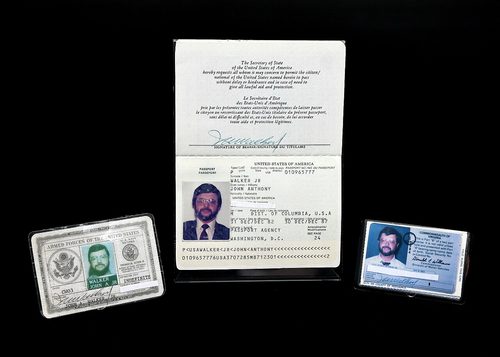
The run began on 20 May 1985, when the FBI arrested John Walker in a Maryland motel after watching him leave classified Navy documents at a roadside drop for the KGB. His son, his brother and his friend Jerry Whitworth were in custody within two weeks (the Walker ring)1. In July a CIA clerk who had passed agent identities to Ghanaian intelligence was charged after a routine polygraph raised concerns1.
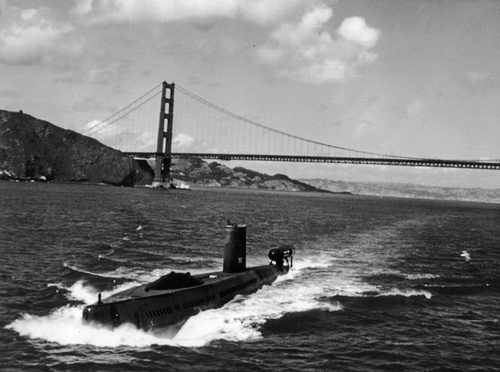
In November the pace quickened. On 21 November Jonathan Pollard, a civilian analyst for naval intelligence, was arrested outside the Israeli embassy in Washington after being refused asylum there; he later pleaded guilty to conspiring to deliver defense information to Israel and was sentenced to life1,6. On 22 November the FBI arrested Larry Wu-tai Chin, a retired CIA translator accused of a 33-year career of espionage for China; convicted in February 1986, he killed himself in his cell before sentencing1. On 25 November it arrested Ronald Pelton, a former NSA communications specialist who had sold the KGB what he knew of a US collection project against the Soviet Union, later identified as the undersea cable tap Ivy Bells1,6.
A defector, a fugitive
Several of the leads came from Vitaly Yurchenko, a senior KGB officer who walked into the US embassy in Rome in the summer of 1985 and was in CIA hands by early August1,2. He told the CIA of a former CIA employee, code-named "Robert" in KGB cables, who had sold secrets; the CIA identified him as Edward Lee Howard, fired in 1983 after failing a polygraph, who had been trained for duty in Moscow. On 21 September, two days after an FBI interview, Howard slipped past surveillance at his New Mexico home and fled; he surfaced in Moscow and was granted asylum in 19862,1. Yurchenko also pointed to Pelton1. Then, in November 1985, he walked away from his CIA handlers in Washington and went back to the Soviets, prompting reviews of how the CIA treated defectors5,1.
The hidden disaster
The arrests were American successes. The losses running in the opposite direction were far larger, and almost no one outside a few offices knew of them.
On 16 April 1985 Aldrich Ames, a CIA counterintelligence officer, entered the Soviet embassy and began selling secrets. On 13 June, according to the Senate's later inquiry, he handed the KGB documents identifying more than ten top CIA and FBI sources reporting on Soviet activities; Ames, who pleaded guilty to espionage in 1994, admitted in court papers that he had named Soviet officers cooperating with the CIA2. On 1 October 1985 an anonymous FBI agent, later identified as Robert Hanssen, mailed the KGB the names of three FBI sources, two of whom Ames had already given up (the Hanssen case)4.
The roll-up was fast. In May the KGB recalled Oleg Gordievsky, its resident-designate in London and a British agent; in July MI6 smuggled him out across the Finnish border7. On 13 June the KGB seized a CIA officer on his way to meet the radar engineer Adolf Tolkachev, whom it had already arrested (the Tolkachev case)5. Valeriy Martynov, a KGB officer working for the FBI, was arrested on arrival in Moscow in November, having been sent home as part of Yurchenko's escort; he and Sergey Motorin were executed4. GRU General Dmitri Polyakov (TOPHAT), long retired, was arrested in 1986 and shot in 19888.
The Senate report counted over 20 operations compromised in this period, fewer than half of which could be blamed on Howard, and called the result "a virtual collapse of the CIA's Soviet operations"2.
Why 1985
The cluster was partly a statistical accident. A US counterintelligence summary notes that 1984 had more reported espionage cases than 19851, while a Defense Department research center counting Americans known to have spied found that the number peaked in 19853. What changed was the motive: the new spies, the summary observes, were driven by money rather than ideology1. Congress responded with the Stilwell Commission on Pentagon security and, in October 1986, a Senate report on the espionage challenge3,1.
The deeper story took far longer to emerge. Ames was not arrested until 21 February 1994, and Hanssen was not under FBI surveillance until the end of 20002,4.
The documents
Declassified records of this operation, with the scans and their full text hosted here.
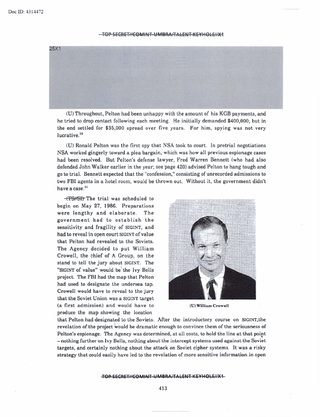 1999 · 3 p.NSA's secret history of the Pelton trial and the Ivy Bells leak (1999)Thomas R. Johnson, NSA Center for Cryptologic History (American Cryptology during the Cold War, 1945–1989, Book IV: Cryptologic Rebirth, 1981–1989)Four pages from Book IV of NSA's classified Cold War history, released in 2024: how the Agency took Ronald Pelton to trial, what it would and would not say about Ivy Bells, and its fight with the Washington Post.
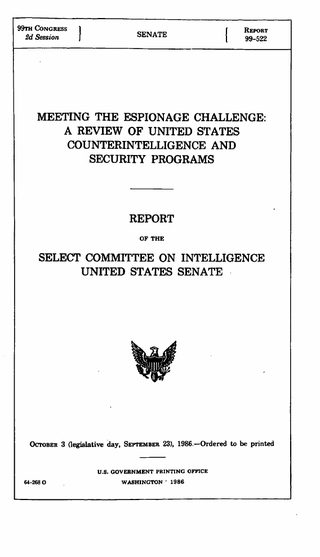 3 October 1986 · 122 p.Meeting the Espionage Challenge: the Senate's verdict on the Year of the Spy (1986)Senate Select Committee on Intelligence (chairman: Dave Durenberger; vice chairman: Patrick J. Leahy)The Senate Intelligence Committee's public report of October 1986 on US counterintelligence after the Walker, Pelton, Howard and Pollard cases: what the spies cost, what failed, and 95 findings and recommendations.
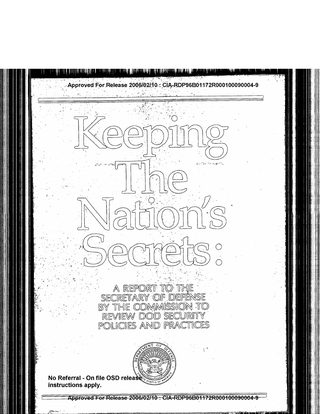 19 November 1985 · 117 p.Keeping the Nation's Secrets: the Stilwell Commission report (1985)DoD Security Review Commission (Commission to Review DoD Security Policies and Practices), Gen. Richard G. Stilwell, USA (Ret.), chairmanThe Pentagon's security review ordered after the Navy spy arrests of May 1985: 63 unanimous recommendations on clearances, polygraphs, document control and counterintelligence, delivered to Weinberger in November 1985.
Checking the record
Dates and outcome compared in two independent sources: they agree.
- Official history
- Walker arrested 20 May 1985; Howard charged 23 September 1985 after fleeing; Pollard arrested 21 November, Chin 22 November and Pelton 25 November 1985. Over 60 Americans arrested or neutralized for espionage in the 1980s; Walker, Pelton and Pollard given life sentences; Howard granted Soviet asylum in 1986.
- Wikipedia
- Walker arrested 20 May 1985; Pollard arrested November 1985; Chin and Pelton arrested late 1985. Eight major spies exposed; heightened US–Soviet tension; Howard fled to the Soviet Union.
The cases and outcomes agree. Small date differences exist: Wikipedia's article gives Pollard's arrest as 18 November and its Chin article 23 November, against 21 and 22 November in the US summary, which this page follows.
Sources
- Official history A Counterintelligence Reader, Volume III, Chapter 3: Decade of the Spy, US Office of the National Counterintelligence Executive, via FAS.
- Congress An Assessment of the Aldrich H. Ames Espionage Case and Its Implications for U.S. Intelligence, US Senate Select Committee on Intelligence (S. Prt. 103-90), via FAS (1994-11-01).
- Official history Espionage Against the United States by American Citizens 1947–2001 (Technical Report 02-5), Defense Personnel Security Research Center (PERSEREC), via FAS (2002-07).
- Court record Affidavit in Support of Criminal Complaint, Arrest Warrant and Search Warrants, United States v. Robert Philip Hanssen (E.D. Va.), US District Court for the Eastern District of Virginia, via FAS (2001-02).
- CIA Tolkachev, A Worthy Successor to Penkovsky (Studies in Intelligence 47, no. 3), Central Intelligence Agency, Center for the Study of Intelligence (Barry G. Royden) (2003).
- Wikipedia 1985: The Year of the Spy, Wikipedia.
- Wikipedia Oleg Gordievsky, Wikipedia.
- Wikipedia Dmitri Polyakov, Wikipedia.
- Wikipedia English Wikipedia article (used for cross-checking).
Elsewhere in the files
- Agency Federal Bureau of Investigation (FBI)
- Agency KGB
- Document Keeping the Nation's Secrets: the Stilwell Commission report (1985)
- Document Meeting the Espionage Challenge: the Senate's verdict on the Year of the Spy (1986)
- Document NSA's secret history of the Pelton trial and the Ivy Bells leak (1999)
- Document Soviet Acquisition of Militarily Significant Western Technology: An Update (1985)
- Document The FBI's affidavit against Robert Hanssen (2001)
- Operation Operation Ivy Bells
- Operation TOPHAT: the Polyakov case
- Operation The Farewell Dossier
- Operation The Hanssen case
- Operation The Tolkachev case
- Operation The Walker spy ring
- Person Adolf Tolkachev
- Person Dmitri Polyakov
- Person John Anthony Walker
- Person Robert Hanssen
- Person Vladimir Vetrov (FAREWELL)
- Tradecraft The "Moscow Rules"
Read next
 December 1967 – 20 May 1985
The Walker spy ring
For seventeen years US Navy communications specialist John Walker sold cipher keys and secret messages to the KGB, later recruiting a friend, his brother and his son. The FBI arrested him in May 1985.
 November 1979 – 18 February 2001
The Hanssen case
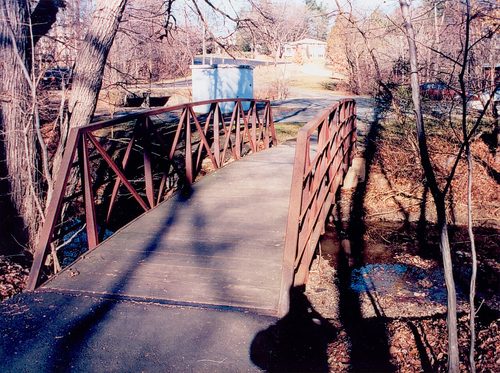
FBI agent Robert Hanssen spied for Soviet and Russian intelligence in three bursts from 1979 to 2001 without revealing his name. Caught at a Virginia dead drop in 2001, he was the most damaging spy in FBI history.
January 1977 – 24 September 1986
The Tolkachev case
From 1979 to 1985 Soviet radar engineer Adolf Tolkachev photographed secret designs for the CIA in Moscow, handing over hundreds of rolls of film. Betrayed in 1985, he was executed in September 1986.
November 1961 – 15 March 1988
TOPHAT: the Polyakov case
From 1961 to 1980 GRU officer Dmitri Polyakov, later a major general, spied for the FBI and CIA. Betrayed by Robert Hanssen and Aldrich Ames, he was arrested in 1986 and shot in 1988.
 October 1971 – 1981
Operation Ivy Bells
From 1971 US Navy divers working from submarines tapped a Soviet military cable on the floor of the Sea of Okhotsk. Former NSA analyst Ronald Pelton sold the secret to the KGB, and the Soviets removed the tap in 1981.
February 1981 – 23 January 1985
The Farewell Dossier
In 1981–82 a disaffected KGB officer, Vladimir Vetrov, gave French counterintelligence thousands of documents on Soviet technology theft. The West expelled scores of Soviet officers and fed Moscow doctored technology.