
 Page 1 of 39
From the document
Virtually every Soviet military research project—well over 4,000 each year in the late 1970s and over 5,000 in the early 1980s—benefits from these technical documents and hardware.
This information was obtained directly by the United States and Allied countries.
Each year the VPK publishes a report based on the evaluation of the individual ministries. It includes aggregate statistics on numbers of technical documents and samples (hardware) obtained, gross ruble savings, and the numbers and priority of requirements satisfied.
The largest KGB complements are probably in Bonn, Cologne, London, New York, Tokyo, and Vienna. (Paris was one of the largest until mass expulsions in 1983.)
Excerpts are passages from a US government work (public domain), quoted exactly as they read in the scan, and checked against the full text on every rebuild.
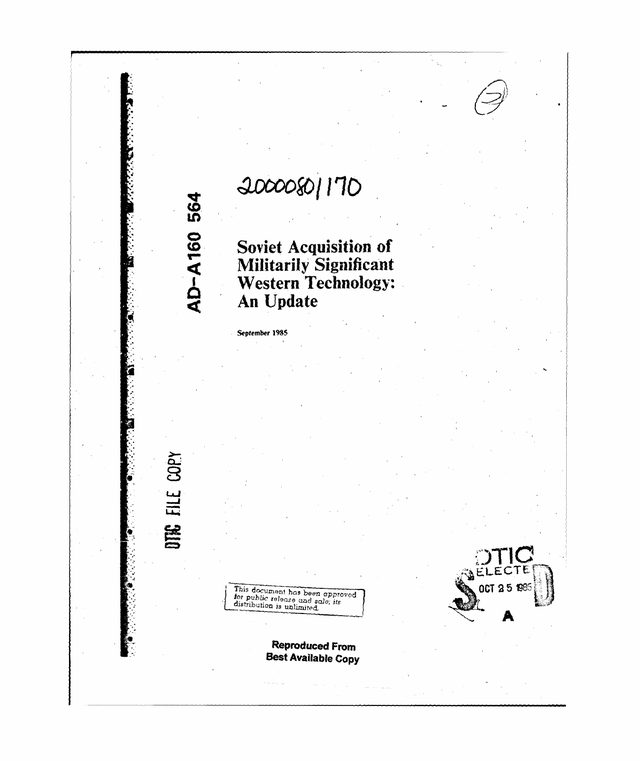
On 18 September 1985 Defense Secretary Caspar Weinberger held a crowded news conference, took no questions, and handed out a 33-page booklet. Its subject was the Soviet effort to obtain Western military technology, and its tone was set by the first paragraph: the West was "subsidizing the Soviet military buildup." UPI reported that the booklet came from a committee chaired by the CIA, drew on data from 22 government agencies, and updated a report given to Congress in 19821,2.
What it says
The paper describes two Soviet programs. The first, run by the Military Industrial Commission (VPK), turned requests from weapons designers in 12 defense industries into collection "requirements" for one-of-a-kind hardware and documents, backed by a fund of about half a billion rubles a year. The second, run through the Ministry of Foreign Trade and the intelligence services, diverted export-controlled production equipment in bulk1.
What made the paper new was its numbers, which it presents as the Soviets' own. Over 3,500 requirements were fulfilled in 1976–80; more than 5,000 military research projects a year in the early 1980s drew on Western material; documents on the F-18's fire-control radar were credited with saving five years and millions of rubles. The VPK, it explains, compiled such figures in an annual report for the Soviet leadership1. An annex lists several hundred Soviet weapons said to have benefited, from Space Shuttle heat-shielding documents to the Mk 48 torpedo1.
The section on the KGB describes Directorate T of the First Chief Directorate, about 1,000 officers with nearly 300 abroad in units called Line X, and notes in passing that Paris had been one of its largest stations "until mass expulsions in 1983." The GRU, with about 1,500 officers abroad, is judged the more successful collector. It closes with a call for tighter export controls and counterintelligence1.
The Farewell connection
The paper never says where its Soviet figures came from. It says only that the information was obtained directly by the United States and its allies, and gives "much more detail than could be revealed previously"1. The obvious candidate is the Farewell material: about 4,000 Directorate T documents that the KGB officer Vladimir Vetrov gave French counterintelligence in 1981–82, including the directorate's reports on its own results. Gus Weiss, the National Security Council economist who read them, wrote that they showed Line X had met two-thirds to three-quarters of its requirements, with the largest gains in radar, computers, machine tools and semiconductors3.
The link is made by journalists, not by the government. John J. Fialka, writing in 1997, attributed the figure of 5,000 Soviet systems a year to Russian documents copied by Vetrov and quoted the paper's "subsidizing" line as the verdict of "one government report." Dwayne A. Day, writing in 2012, presented the paper as the CIA's account of the program Vetrov exposed4,5. Weiss's own article does not mention the paper3.
How to read it
This is an argument for export controls as much as an intelligence summary, and it says nothing about what the West was doing in return. Weiss later wrote that by then the CIA and the Pentagon were feeding Line X "improved" products designed to fail3.
The DTIC scan is a black-and-white copy of a color original; some figures are hard to read. Nothing is redacted1.
Sources
- Other Soviet Acquisition of Militarily Significant Western Technology: An Update (DTIC AD-A160564), US Department of Defense, Defense Technical Information Center (1985-09).
- Other The 'dangerous flow' of Western technology to the Soviet Union (Richard C. Gross), United Press International (1985-09-18).
- CIA Duping the Soviets: The Farewell Dossier (Gus W. Weiss, Studies in Intelligence, 1996), Central Intelligence Agency, Center for the Study of Intelligence (1996).
- Other How the Secrets Moved East (John J. Fialka), Air Force Magazine (now Air & Space Forces Magazine) (1997-04-01).
- Other Theft, the sincerest form of flattery (Dwayne A. Day), The Space Review (2012-04-16).
- Other KGB Veteran Denies CIA Caused '82 Blast (Anatoly Medetsky), The Moscow Times (2004-03-18).