
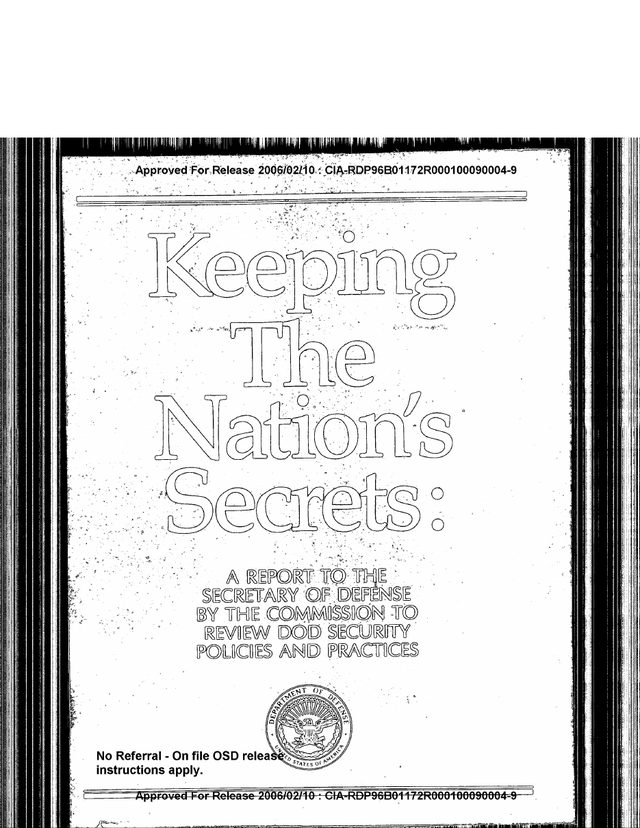
 Page 1 of 117
From the document
On June 25, 1985, Secretary of Defense Caspar W. Weinberger established the Department of Defense Security Review Commission in the wake of the arrests of three retired and one active duty Navy member on charges of espionage.
inasmuch as the Commission wished to avoid any action that could jeopardize any pending prosecution, this report does not refer to them, or to actions alleged to have been committed by any defendant, as the basis for specific recommendatons.
Although the counterintelligence-scope polygraph examination is the one investigative tool which might have prevented — or earlier detected recent acts of espionage, its use in the Department is severely restricted, in time and scope, by the Congress.
But, on the whole, DoD must be willing to pay a higher price, in terms of both resources and operational convenience, to protect its classified information.
Excerpts are passages from a US government work (public domain), quoted exactly as they read in the scan, and checked against the full text on every rebuild.
Nowhere in this report does the name Walker appear. The Pentagon's security commission of 1985 was set up, its introduction says, "in the wake of the arrests of three retired and one active duty Navy member on charges of espionage", and it deliberately left the cases out of its text so as not to prejudice pending prosecutions1. Those four were the Walker ring: John A. Walker Jr., arrested by the FBI on 20 May 1985, his brother, his son, then an active-duty seaman on the carrier Nimitz, and his former Navy colleague Jerry Whitworth4. Reporting at the time made the link explicit. One account, filed in the CIA's press files, called the study the result of the Pentagon's embarrassment over a ring that had gone undetected for 17 years; the Los Angeles Times presented the first action taken on it as an attack on the weaknesses the Walker case had exposed2,3.
Who wrote it
Caspar Weinberger created the commission on 25 June 1985. Its chairman was Gen. Richard G. Stilwell, a retired Army officer; its members were mostly serving officials, including the directors of NSA, the Defense Intelligence Agency and Naval Intelligence and the Pentagon's general counsel, plus one industry security director1. It met 17 times between 26 June and 6 November 1985, heard 34 witnesses, interviewed defense-industry executives, and received more than 1,000 suggestions. Stilwell sent the report to Weinberger on 19 November with 63 recommendations, all unanimous1.
What it found
The verdict was measured: the Defense Department's security program had been "reasonably effective", with few known losses, but "some losses, however, have proved gravely damaging." The main weakness was people, not technology1. With almost four million people holding access to classified information, the commission's findings run in a line from clearance to punishment1:
- Fewer clearances. Top Secret clearances should attach to positions, not people, and contractors should justify every request.
- Better investigations. A Secret clearance rested on a personal history form and a records check; the commission wanted credit checks and employer inquiries, and periodic reinvestigation of all Secret holders by 1995.
- The polygraph. It called the counterintelligence-scope polygraph the one tool that might have caught recent spies earlier, and asked Congress to let the Secretary build a gradually expanding programme. It also proposed a special "crypto-access" programme for people handling cryptographic material, the material the Walkers had sold.
- Document control. Accountability for Secret documents, destruction of unneeded files after five years, no working alone where Top Secret material was in use, and searches of briefcases at installation gates.
- Counterintelligence. Parity with the Soviet diplomatic presence, travel limits on Warsaw Pact diplomats at the United Nations, and reporting of foreign travel and contacts.
The appendices list the witnesses and industry officials consulted and reprint Weinberger's August 1985 order adding security questions to performance reports1.
What followed and how to read it
Within days the Pentagon ordered the "top-to-bottom" security inspection the commission had recommended3. Later reviews cite the report for its finding that decisions to classify got "little scrutiny"5. A Senate review in 1986 covered the same ground with the cases named: see Meeting the Espionage Challenge: the Senate's verdict on the Year of the Spy (1986).
The report is a public document from a body drawn largely from the institution it judged. It assesses policy, not the damage done; for that, and for the spies themselves, see the 1985, the Year of the Spy page. This copy, from the CIA's records database, is complete, apart from a few blacked-out marks1.
Sources
- Official history Keeping the Nation's Secrets: A Report to the Secretary of Defense by the Commission to Review DoD Security Policies and Practices (CIA-RDP96B01172R000100090004-9), Department of Defense, via CIA CREST (1985-11-19).
- Other Report Urges Security Crackdown to Curb Spying at U.S. Installations (press clipping in CIA files, CIA-RDP90-00965R000301850006-2), Central Intelligence Agency, FOIA Electronic Reading Room (1985-11).
- Other Defense Dept., Adhering to Panel's Recommendation, Orders Security Inspection (James Gerstenzang), Los Angeles Times (1985-11-22).
- Wikipedia John Anthony Walker, Wikipedia.
- National Archives Public Interest Declassification Board meeting, 22 June 2007: summary of past classification studies (incl. the 'Stilwell Commission'), National Archives, Public Interest Declassification Board (2007-06-22).