
 Page 1 of 122
From the document
The hostile intelligence threat is more serious than anyone in the Government has yet acknowledged publicly. The combination of human espionage and sophisticated technical collection has done immense damage to the national security.
once the U.S. Navy began to improve its security awareness briefings after the Walker case, co-workers of Jonathan Pollard noted his unusual pattern of document requests and alerted authorities.
The cryptographic material passed by John Walker and Jerry Whitworth was exceptionally harmful, because the Soviets could use it to decipher encrypted U.S. Naval communications.
From his briefings, Yurchenko learned that the K.G.B. regarded the Walker/Whitworth operation to be the most important operation in the K.G.B.'s history.
Excerpts are passages from a US government work (public domain), quoted exactly as they read in the scan, and checked against the full text on every rebuild.
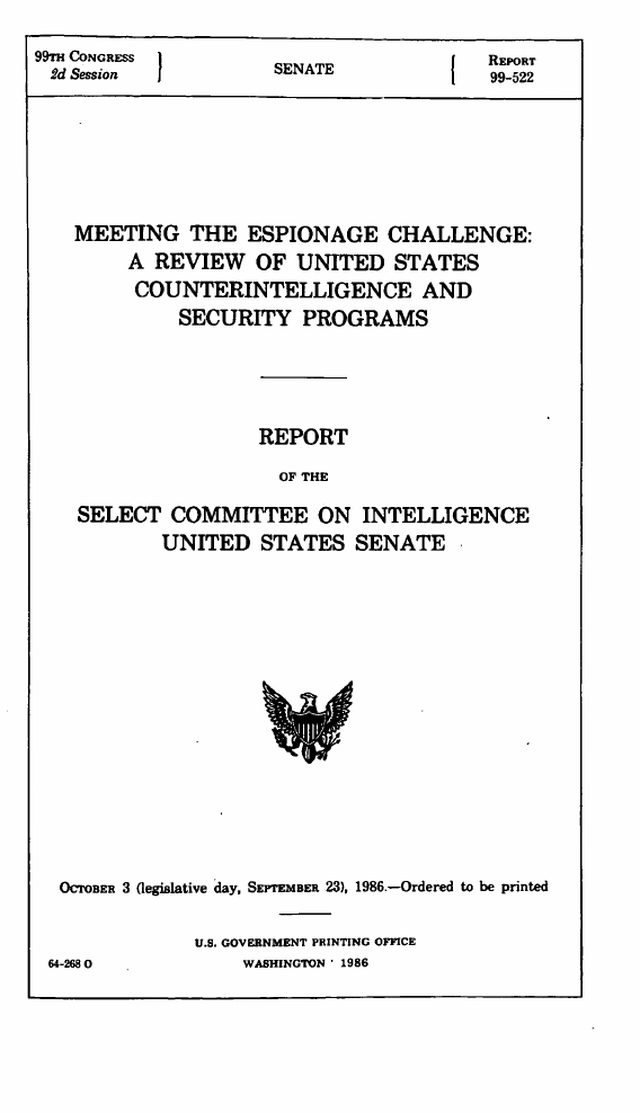
The Senate Select Committee on Intelligence started a general review of counterintelligence at the opening of the 99th Congress in January 1985. Within months the arrests began: John Walker in May, then Jonathan Pollard, Ronald Pelton, Larry Wu-tai Chin and others, while Edward Lee Howard escaped to Moscow. The press called 1985 the Year of the Spy1,2. The Senate dropped plans for a national commission on espionage and left the job to the committee. Under its chairman, Dave Durenberger, it held sixteen closed hearings on individual cases and on the state of US programs. This public report was ordered printed on 3 October 1986; a fuller version with classified findings went to the Senate1.
The threat and the damage
The report opens with a blunt judgment: the threat was worse than anyone in government had admitted in public. Between 1984 and 1986, it says, twenty-five people had been convicted of spying against the United States or had pleaded guilty. Some 4,250 officials from Communist countries were in the United States in 1985, and the FBI estimated that at least 30 percent were intelligence officers1.
The case summaries put a price on the losses. John Walker and Jerry Whitworth may have let the Soviets read some of the Navy's most secret traffic from the 1960s to 1985. James Harper was paid about $250,000 by Polish intelligence for ballistic-missile defense documents that Army experts rated "beyond calculation." Thomas Cavanagh tried to sell Stealth material and was caught by FBI agents posing as the KGB1. Among intelligence losses, the committee rated Howard and Pelton the worst, because both exposed collection aimed at high-priority targets in the Soviet Union. The report describes Pelton's betrayal only as a "highly classified U.S. intelligence collection project"; NSA's own history calls it Ivy Bells1.
What it recommended
The report contains 95 numbered findings and recommendations. Counterintelligence, it judged, was "fundamentally sound" but needed a national strategy tying together the FBI, the CIA, State, Defense and Justice. Defensive security was in worse shape. The committee called for a National Strategic Security Program. It also proposed abolishing the Confidential classification and putting Defense Investigative Service staff full-time inside large contractors. Other measures included a cap of 320 accredited Soviet embassy and consular staff and laws requiring banks and telephone companies to answer FBI counterintelligence requests. Its spending proposals for fiscal 1987 came to at least $500 million a year above 1985 levels1. It also found the Senate's own handling of classified material lax and proposed a Senate security office, with a draft security manual printed as Appendix G1.
The appendices kept here
Appendix A reprints two court papers from Whitworth's sentencing in August 1986. In the first, Rear Admiral William Studeman, Director of Naval Intelligence, describes cryptographic key as the thing that "will unlock the secrets" and lists what Whitworth handed over. The second is a declaration by John L. Martin of the Justice Department, which relays what Vitaly Yurchenko told his debriefers about the case1. Whitworth was later sentenced to 365 years4. Appendix F prints Soviet-bloc forgeries the committee had seen, among them a 1986 letter about Chernobyl propaganda falsely attributed to a US Information Agency official and addressed to Durenberger himself1.
Read the report as a political document. It praises executive-branch cooperation and keeps the details of cases classified, and much of its picture of KGB thinking comes from Yurchenko, who later returned to Moscow1,3.
Sources
- Congress Meeting the Espionage Challenge: A Review of United States Counterintelligence and Security Programs, Report of the Select Committee on Intelligence, S. Rep. 99-522 (archived copy of the Committee's PDF), US Senate, Select Committee on Intelligence (Wayback Machine capture, February 2016) (1986-10-03).
- Wikipedia 1985: The Year of the Spy, Wikipedia.
- Wikipedia John Anthony Walker, Wikipedia.
- Wikipedia Jerry Whitworth, Wikipedia.