
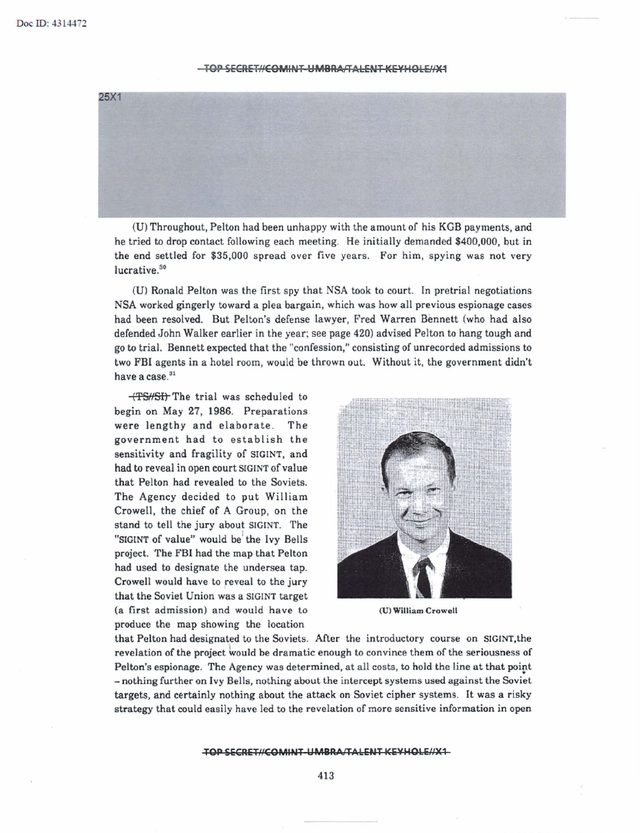
 Page 1 of 3
From the document
Ronald Pelton was the first spy that NSA took to court. In pretrial negotiations NSA worked gingerly toward a plea bargain, which was how all previous espionage cases had been resolved.
The Agency was determined, at all costs, to hold the line at that point – nothing further on Ivy Bells, nothing about the intercept systems used against the Soviet targets, and certainly nothing about the attack on Soviet cipher systems.
Ronald Pelton was the most damaging cryptologic spy since William Weisband in the 1940s.
Excerpts are passages from a US government work (public domain), quoted exactly as they read in the scan, and checked against the full text on every rebuild.
Thomas R. Johnson spent years at the NSA's Center for Cryptologic History writing a four-book internal history of American cryptology from 1945 to 1989. Book IV, finished in 1999, covers the 1980s and was classified Top Secret with codeword caveats. The National Archives posted it in five parts on 8 November 2024, after an appeal to the Interagency Security Classification Appeals Panel1,3. Its section on Ronald Pelton, the former NSA analyst who sold the secret of the Ivy Bells cable tap to the KGB, begins near the end of part 3 with the FBI's recording of his first call to the Soviet embassy on 14 January 19802. The pages here pick up the story at the trial.
The trial NSA had never fought
Johnson starts with money. Pelton, he writes, first asked the KGB for $400,000 and settled for $35,000 over five years1. He then turns to strategy. Every earlier espionage case had ended in a plea bargain, but Pelton's lawyer advised him to go to trial, expecting that his unrecorded admissions to two FBI agents in an Annapolis hotel room would be thrown out1,4.
The government had to show the jury that what Pelton sold mattered without giving away more. NSA chose William Crowell, chief of A Group, to explain signals intelligence in open court and to produce the map on which Pelton had marked the undersea tap for the Soviets. That meant admitting publicly, for the first time, that the Soviet Union was a SIGINT target. Ivy Bells was to be the one example; everything else stayed off limits. The director, General William Odom, told the workforce the disclosures were a one-time event and would not change classification rules1.
Johnson judges that the strategy worked. The judge let the agents testify about the hotel-room admissions, and the jury convicted on four of six counts. A debriefing ran from July to December 1986 in the hope of a lighter sentence; the judge nonetheless gave the maximum1. Johnson calls Pelton the most damaging cryptologic spy since William Weisband and says his losses far exceeded what Aldrich Ames later gave the Soviets, but most of that assessment is blacked out1.
The Washington Post and "Ivy Bells"
The rest of the section is about the press. After Pelton's arraignment in Baltimore in December 1985 the code name surfaced in court and in the papers. Bob Woodward of the Washington Post had been following the program for years, and his editor, Benjamin Bradlee, took the story to the government. At a meeting on 5 December Odom told Bradlee that the Soviets did not know everything and that publication could do serious damage, and Bradlee agreed to wait1.
In the spring of 1986 the story came back. Johnson says William Casey phoned Bradlee, and that on 10 May President Reagan called the publisher, Katharine Graham, with a warning about prosecution under Section 798 of the criminal code. After NBC broadcast a general report in May, the Post ran its own story with details deleted. Johnson records that Justice Department lawyers would not prosecute news organizations for "speculation"1.
How to read it
This is the Agency's account of its own case, written for cleared readers, and generous to its own trial strategy. Its numbers are not all the court's: the appeals court says only that Pelton received three life terms plus ten years, while Johnson calls them consecutive and other accounts say concurrent1,4,5. The appeals court refers to the compromised program only as "Project A"4. For the operation itself, see Operation Ivy Bells; for the wider cluster of 1985 cases, the Year of the Spy and the Senate's 1986 review6.
Sources
- NSA Thomas R. Johnson, American Cryptology during the Cold War, 1945–1989, Book IV: Cryptologic Rebirth, 1981–1989, ISCAP appeal 2016-220, part 4, National Security Agency, Center for Cryptologic History (released by the National Archives, ISCAP) (1999).
- NSA American Cryptology during the Cold War, Book IV, ISCAP appeal 2016-220, part 3 (opening of the Pelton section), National Security Agency (released by the National Archives, ISCAP) (1999).
- National Archives ISCAP Releases, National Archives and Records Administration, Interagency Security Classification Appeals Panel.
- Court record United States v. Pelton, 835 F.2d 1067 (4th Cir. 1987), Caselaw Access Project (Harvard Law School) (1987-12-18).
- Wikipedia Ronald Pelton, Wikipedia.
- Wikipedia Operation Ivy Bells, Wikipedia.