
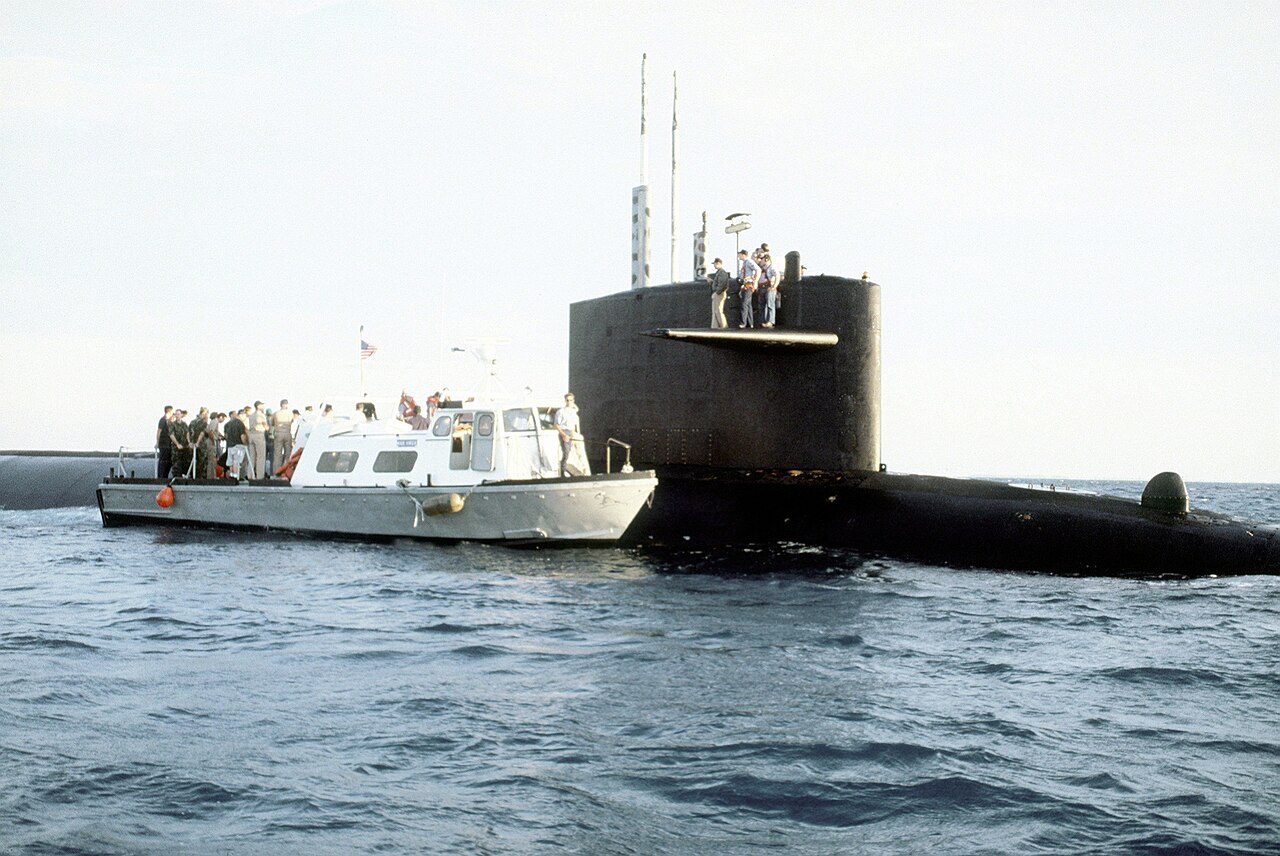
A holystone was a block of soft sandstone sailors used to scrub wooden decks on their knees. The US Navy borrowed the word as a code name for one of the most sensitive things it did in the Cold War: sending submarines close to, and reportedly into, Soviet waters to watch and listen to the Soviet Navy3. The name became public in 1975, three years after the Navy had stopped using it, and the most solid record of the program is not a Navy file at all but the paper trail of an angry White House2,1.
What the program was
The Federation of American Scientists lists Holystone and Barnacle among the code names used within the Navy's Special Naval Collection Program, a series of submarine surveillance and intelligence efforts3. Secondary accounts give the sequence of names as HOLYSTONE, PINNACLE, BOLLARD and BARNACLE and date the work to 19594. By those accounts the submarines gathered signals intelligence close to Soviet harbors, measured the acoustic signatures of Soviet submarines and surface ships, and collected data on Soviet missiles4.
Close-in work carried real risk. On 15 November 1969 USS Gato collided with a Soviet submarine in the Barents Sea at a depth of about 200 feet; later accounts identify the Soviet boat as K-19, whose bow sonar was wrecked6. The same accounts group the undersea cable taps, of which Ivy Bells in the Sea of Okhotsk is the best known, with this family of missions4.
The leak of May 1975
On Sunday 25 May 1975 the New York Times published Hersh's account of Navy submarines spying on the Soviet Union, inside its coastal waters, for some fifteen years5. It came in the middle of the 1975 intelligence investigations, a few months after Hersh's reporting on Operation CHAOS and the Family Jewels, and two months after his story on the Glomar Explorer5.
Two days later Ford called in Defense Secretary James Schlesinger, CIA Director William Colby, Donald Rumsfeld, Deputy Secretary of State Robert Ingersoll and Brent Scowcroft. The meeting record, released in part by the Ford Library, opens with the President's anger:
"I was shocked when I read in the newspaper about our submarines operating off Soviet waters. Of all the things happening, I knew less about it than I saw in the paper. That is a helluva note. Where does he get it? It jeopardizes the operation and the lives of the people involved."
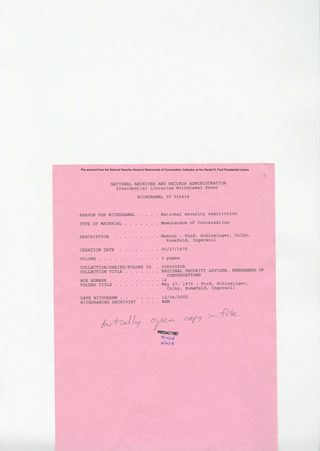
That passage is from2. Schlesinger called the article "a flagrant violation of the law" and suggested a search warrant for files of signals intelligence material he believed Hersh held. Colby noted that a less detailed Times story had appeared in 1974 and that the material seemed to trace back to Victor Marchetti's book on the CIA, which had been the subject of court proceedings. Scowcroft argued that "the real problem is not the press" but the people leaking to it. In a passage whose speaker is redacted, the record notes that "the codeword has been obsolete since 1972." Ford decided to have the FBI investigate2.
The argument over an investigation
The Cheney files at the Ford Library show the arguments that followed. On 30 May a memo from Robert McFarlane of the NSC staff to Dick Cheney reported that the Navy wanted to continue the operation, with the next arrival in the operating area scheduled for 7 July, and judged that an investigation which drew publicity and a Soviet reaction was "a bad idea." Schlesinger concurred. Cheney passed this to Rumsfeld, then in Brussels, recommended that no investigation be launched for the time being, and set out three options ranging from taking no action against the Times to ending the operation and enforcing the disclosure laws1.
Rumsfeld cabled back from Brussels on 31 May that the investigation should start soon unless it would damage the operation. By then Attorney General Edward Levi had told the Criminal Division and the FBI to draft a plan for an investigation. The Director of Naval Intelligence concluded that much of Hersh's information had been published before and probably came from former employees and the Marchetti court file, and pointed to "the use of the outdated codename Holystone" as a telling sign that no current employee had leaked1. A Justice Department memorandum in the same file weighed prosecution under the espionage statutes, 18 U.S.C. 793 and 798, and a contempt action over a document about a submarine collision that sat under a court protective order in the Marchetti case. It noted that any prosecution would require the government to confirm in open court that the leaked information was accurate1.
What came of it
The released files do not record a final decision, and no case against Hersh or the Times ever came to court. The Navy's view prevailed in substance: the exposure did not end close-in submarine reconnaissance, which went on under later code names1,2,4.
The episode left an unusual record. The program's operational files remain closed, but the Ford Library's papers preserve, in the words of the officials themselves, how a government weighed the value of a secret operation against the costs of pursuing the people who revealed it1,2.
The documents
Declassified records of this operation, with the scans and their full text hosted here.

Checking the record
Dates and outcome compared in two independent sources: they agree.
- National Archives
- Times article published the Sunday before 27 May 1975; code word obsolete since 1972. Ford orders an FBI investigation of the leak; operations not ended by the exposure (Navy recommends continuing, source 1).
- Wikipedia
- Hersh article 25 May 1975; program had run for at least 15 years. Program exposed; the Ford White House considered action against Hersh.
The two agree on the date of exposure and the reaction. Wikipedia's platforms article gives 1959 as the start and says the program ended with Pelton's compromise in 1981, while the Ford Library record says the code word Holystone had been obsolete since 1972; this page uses 1972 as the end of the code name and treats later operations as its successors.
Sources
- National Archives Richard B. Cheney Files, Box 6, folder 'Intelligence – New York Times Articles by Seymour Hersh (2)', Gerald R. Ford Presidential Library (1975-05-30).
- National Archives Memorandum of Conversation: Ford, Schlesinger, Colby, Rumsfeld, Ingersoll, Scowcroft, 27 May 1975, Gerald R. Ford Presidential Library, National Security Adviser Memoranda of Conversation (1975-05-27).
- Other HOLYSTONE, Federation of American Scientists, Intelligence Resource Program (2000-02-20).
- Wikipedia Signals intelligence operational platforms by nation, Wikipedia.
- Wikipedia Seymour Hersh, Wikipedia.
- Wikipedia USS Gato (SSN-615), Wikipedia.
Elsewhere in the files
Read next
 October 1971 – 1981
Operation Ivy Bells
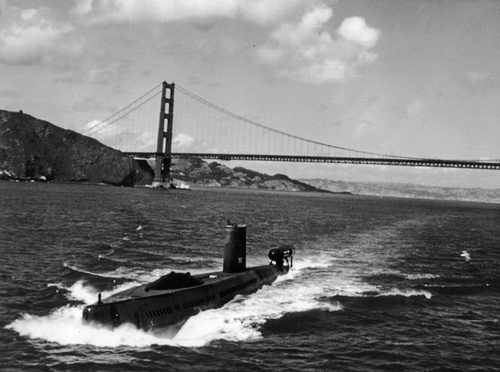
From 1971 US Navy divers working from submarines tapped a Soviet military cable on the floor of the Sea of Okhotsk. Former NSA analyst Ronald Pelton sold the secret to the KGB, and the Soviets removed the tap in 1981.
 1 July 1969 – 16 June 1975
Project Azorian (the Glomar Explorer)
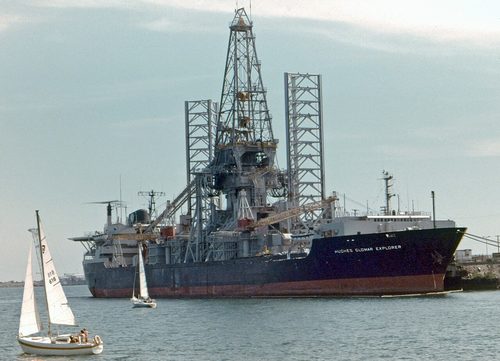
In 1974 the CIA used a purpose-built ship, passed off as Howard Hughes's deep-sea mining vessel, to lift part of the sunken Soviet submarine K-129 from 16,500 feet down in the Pacific.
 1914–1990s
Signals intelligence
Intelligence from intercepted communications and electronic emissions, from Room 40 and the Zimmermann telegram to Ultra, Venona, the Berlin tunnel and NSA's domestic programs exposed by the Church Committee.
 May 1973
The "Family Jewels" (1973)
The CIA's own 1973 inventory of activities that might have broken its charter, from mail opening and wiretaps on reporters to plots against Castro. Kept secret for 34 years, it was released in June 2007.
 15 August 1967 – 5 March 1974
Operation CHAOS
Pressed by two presidents to prove that foreign communists were behind the antiwar movement, the CIA built files on 7,200 Americans from 1967 to 1974 and kept finding no such proof.
 United States · 1952
National Security Agency (NSA)
America's signals intelligence and communications security agency, created by a secret Truman directive in 1952 out of the Armed Forces Security Agency, and exposed to public scrutiny by the Church Committee in 1975.