
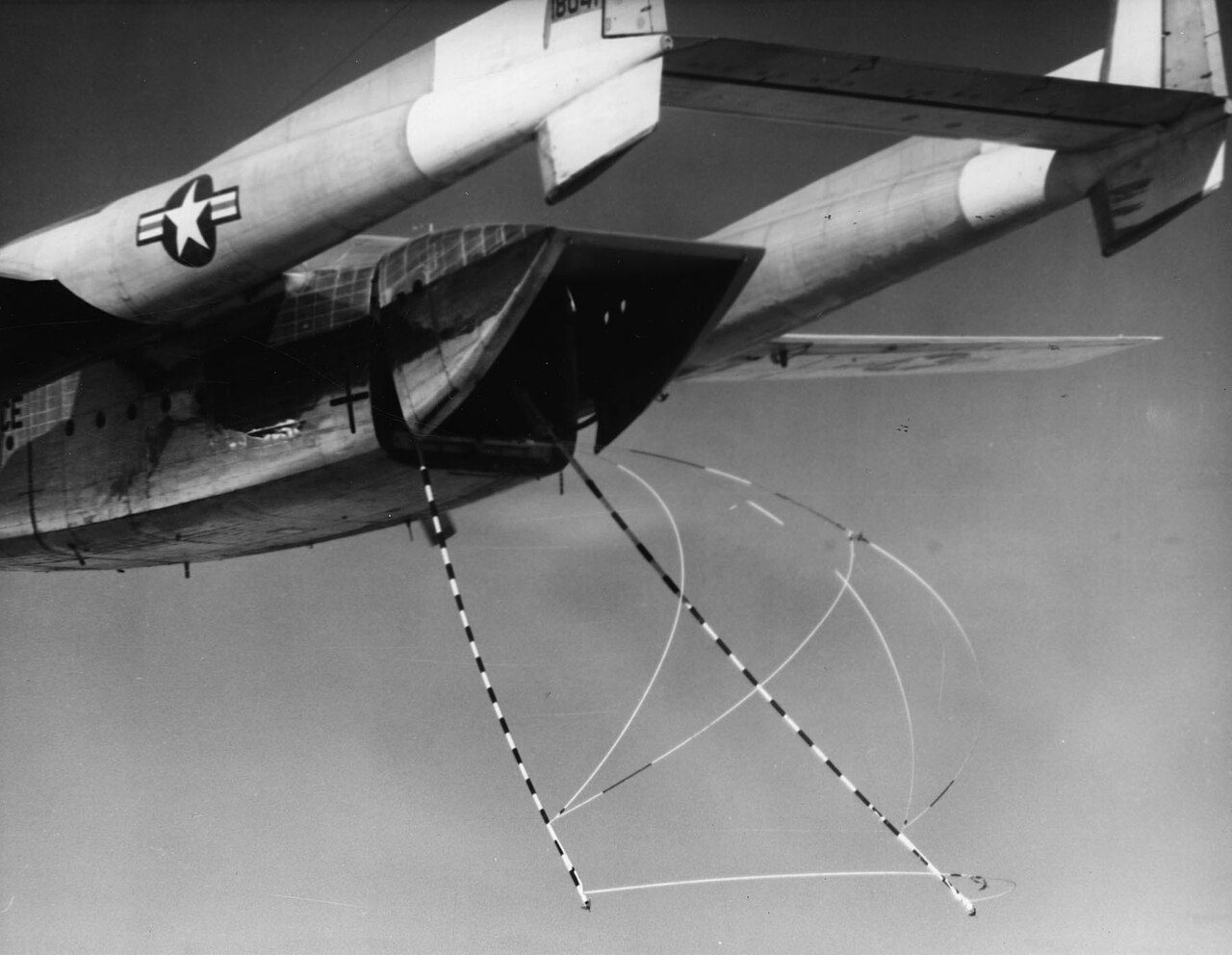
Before CORONA, the United States had looked into the Soviet interior a few miles at a time, along the tracks of individual U-2 flights. The first CORONA capsule to come home with film, on 19 August 1960, carried pictures of more Soviet territory than all the U-2 missions put together. Eisenhower and Allen Dulles looked at the prints six days later1.
A program split off in secret
The Air Force had been working on a reconnaissance satellite, WS-117L, since the mid-1950s. After Sputnik in October 1957, Eisenhower's intelligence advisers urged a faster interim system. What followed was a bureaucratic sleight of hand. The film-return part of WS-117L was carved out, named CORONA, and placed under joint CIA and Air Force management, copying the arrangement that had produced the U-2. Richard Bissell ran it for the CIA; Brigadier General Osmond Ritland was his Air Force counterpart1,3.
To hide the move, the new Advanced Research Projects Agency issued a directive on 28 February 1958 that appeared to cancel the Thor-boosted interim satellite. Contractors received cancellation notices; a handful of cleared people were then told the program would carry on covertly. The CIA's own history says there are no records in its CORONA files between 5 December 1957 and 21 March 1958, although major decisions were clearly taken in that time1. Lockheed built the Agena spacecraft, General Electric the reentry capsule, and Itek the panoramic camera, made under subcontract by Fairchild1.
Cover story: DISCOVERER
The public was told that the launches from Vandenberg Air Force Base in California were DISCOVERER, a scientific program testing satellite recovery and carrying biological specimens. Some capsules did carry mice. When the first test capsule, on DISCOVERER II in April 1959, came down near Spitsbergen instead of Hawaii, it was never found1,5.
The failures were relentless. Boosters failed, cameras failed, film snapped in the vacuum, and spin rockets exploded during recovery. By mid-April 1960 there had been eleven launches, seven had reached orbit, and no capsule had been recovered. Bissell later called it "a most heartbreaking business": with no pilot and no hardware to inspect, engineers could only infer faults from telemetry, make a fix and launch again1. Eastman Kodak's switch from acetate to a polyester film base solved one of the worst problems1.
August 1960
DISCOVERER XIII, launched on 10 August 1960 without a camera, put a capsule into the Pacific that a ship recovered, and Eisenhower displayed it at the White House. It was the first object retrieved from orbit1,5. Eight days later, on 18 August, DISCOVERER XIV went up carrying film. Its capsule, internally Mission 9009, descended under a parachute on 19 August and was snagged in midair by a C-119 flown by Air Force Captain Harold E. Mitchell1.
The timing mattered. On 1 May that year the Soviets had shot down Francis Gary Powers and ended U-2 flights over the Soviet Union. CORONA succeeded 110 days later. According to the CIA history, analysts found 64 Soviet airfields and 26 new surface-to-air missile sites on the first film1. The NRO's chronology records the very first image as Mys Shmidta, a bomber base in northeast Siberia3.
What the cameras found
The first KEYHOLE cameras resolved objects of about 40 feet; by 1967 the KH-4B's J-3 camera was down to about 5 feet. The KH-4 introduced paired cameras for stereo coverage, and later versions carried two film buckets1. From 1961 the program ran under the new National Reconnaissance Office3.
Coverage settled the "missile gap" argument. In September 1961, National Intelligence Estimate 11-8/1-61 reported "a sharp downward revision" of Soviet ICBM strength, to 10 to 25 launchers able to fire at the United States. The Air Force intelligence chief dissented, holding that the Soviets had about 50 launchers in mid-19611. An intelligence community study quoted in the CIA's documentary history credits CORONA with imaging all Soviet medium-range, intermediate-range and intercontinental missile complexes, finding the Plesetsk test range and the Severodvinsk submarine yards, and spotting the first Soviet antiballistic-missile sites1. It also tracked China's path to its first nuclear test in October 1964, and in 1970 it photographed the Suez cease-fire zone1.
Not every mission worked: of the first 30 missions, from 1960 through 1962, only 12 were judged productive. In 1964 the first bucket of Mission 1005, which had refused every command to eject, came down on its own in the mountains of southwestern Venezuela. Two farm workers found it in July. CORONA officers, presenting themselves as Air Force representatives, bought the charred capsule from the Venezuelan government and let it be dismissed as a failed NASA experiment1,5.
End of the program and declassification
The 145th and last CORONA flight was launched on 25 May 1972; the final capsule was recovered on 31 May. The CIA history counts 165 recoveries and about 750 million square nautical miles photographed1. The close-look GAMBIT satellites and the broad-area HEXAGON system took over its work5,3.
The US government did not admit using reconnaissance satellites until President Carter did so in October 19781,3. On 22 February 1995 President Clinton signed Executive Order 12951, directing the release of more than 800,000 images from CORONA and two allied systems, ARGON and LANYARD, to the National Archives and the US Geological Survey4,2. Vice President Gore unveiled the first pictures at CIA headquarters two days later2. The film is now used by archaeologists and environmental scientists as a record of landscapes in the 1960s5. For the wider story of spying from the air and from orbit, see Overhead reconnaissance.
The documents
Declassified records of this operation, with the scans and their full text hosted here.

Checking the record
Dates and outcome compared in two independent sources: they agree.
- CIA
- First film recovered from Mission 9009 (DISCOVERER XIV), launched 18 August 1960 and caught in midair on 19 August 1960; 145th and final launch 25 May 1972, last recovery 31 May 1972. CORONA imaged all Soviet MRBM, IRBM and ICBM complexes and supported NIE 11-8/1-61, which cut the estimate of Soviet ICBM launchers to 10–25.
- Wikipedia
- Operated June 1959 to May 1972; Discoverer 14 launched 18 August 1960 and its film recovered by a C-119; last launch 25 May 1972. First clear picture of Soviet strategic forces; ICBM estimate refined to 10–25; replaced by KH-9 HEXAGON.
Dates and outcome agree. Wikipedia counts from the first camera launch in June 1959; this page also counts the 1958 decision to split CORONA from the Air Force WS-117L program, as the CIA history does.
Sources
- CIA CORONA: America's First Satellite Program (CIA Cold War Records), ed. Kevin C. Ruffner, full PDF, Central Intelligence Agency, History Staff, Center for the Study of Intelligence (archived copy) (1995).
- CIA CORONA: America's First Satellite Program (foreword and download page), Central Intelligence Agency, Center for the Study of Intelligence (1995).
- Official history The National Reconnaissance Office at 50 Years: A Brief History (Bruce Berkowitz), National Reconnaissance Office, Center for the Study of National Reconnaissance (archived copy) (2011-09).
- National Archives Executive Orders disposition tables, 1995 (EO 12951, Release of imagery acquired by space-based national intelligence reconnaissance systems), National Archives, Office of the Federal Register (1995-02-22).
- Wikipedia CORONA (satellite), Wikipedia.
- Wikipedia English Wikipedia article (used for cross-checking).
Elsewhere in the files
- Agency Central Intelligence Agency (CIA)
- Agency National Reconnaissance Office (NRO)
- Document After the U-2: the President and his advisers (May 1960)
- Document CORONA: the CIA's 1995 documentary history of its first spy satellite
- Document The CIA's history of OXCART: 'The U-2's Intended Successor' (1992)
- Operation Project Oxcart
- Operation The U-2 program and the 1960 shoot-down
- Tradecraft Overhead reconnaissance
Read next
 24 November 1954 – 16 May 1960
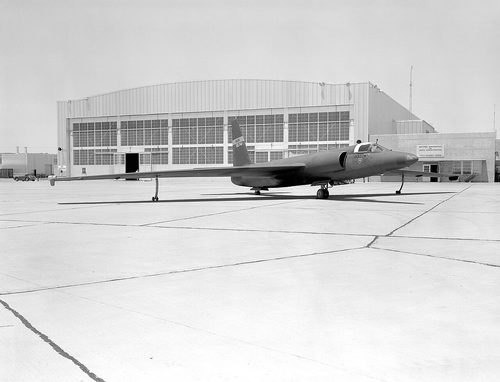
The U-2 program and the 1960 shoot-down
From 1956 the CIA's U-2 photographed the Soviet Union from 70,000 feet. On 1 May 1960 a missile brought down Francis Gary Powers near Sverdlovsk, the cover story collapsed and the Paris summit failed.
 United States · 1961
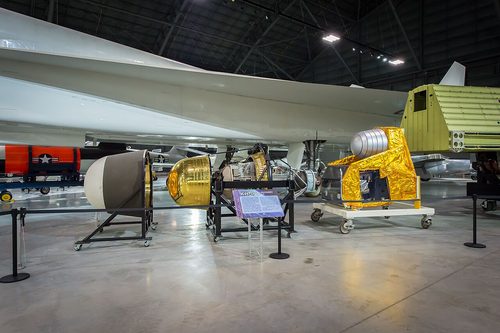
National Reconnaissance Office (NRO)
The joint Pentagon-CIA office set up in 1961 to build and fly America's spy satellites and, for a time, its spy planes. Its name was secret until 1992.
 29 August 1959 – 21 June 1968
Project Oxcart
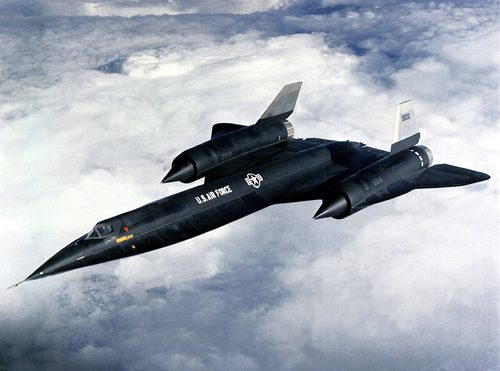
The CIA's Mach 3 titanium spy plane, the Lockheed A-12, was built to replace the U-2 over the Soviet Union. It never flew there; its only operation, BLACK SHIELD, covered Vietnam and North Korea in 1967–68.
 1956–1990s
Overhead reconnaissance
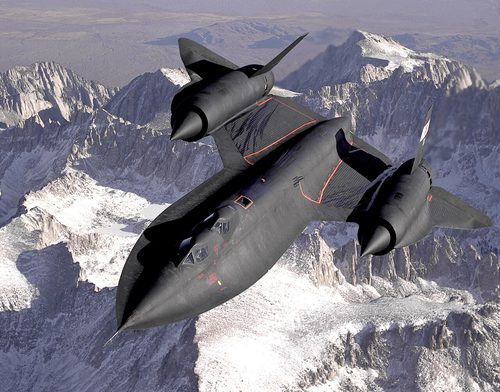
Balloons, the U-2, the A-12 and the CORONA satellites gave the United States its first reliable picture of Soviet military power. The programs were secret for decades; the NRO itself was not acknowledged until 1992.
 10 August – 20 November 1962
Intelligence in the Cuban Missile Crisis
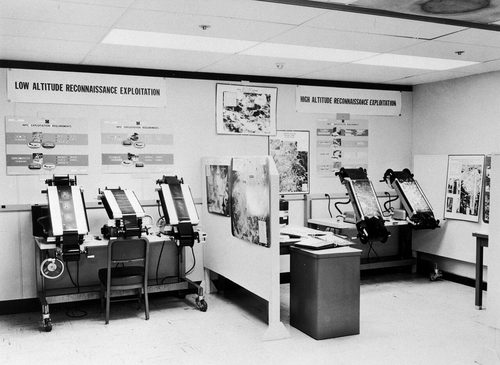
How US intelligence missed, then found, Soviet missiles in Cuba in 1962: a wrong estimate, a five-week gap in U-2 coverage, the 14 October flight over San Cristóbal, and what the photographs never showed.