
 Page 1 of 66
From the document
President William Clinton in February of this year ordered the declassification within 18 months of historical intelligence imagery from the early satellite systems known as the CORONA, ARGON, and LANYARD.
Eight THOR-AGENA combinations and five cameras had been expended with nothing to show for the effort except accumulated knowledge of the system’s weaknesses.
These marks showed that the program security officer had had great insight when he named the program.
Average ground resolution is in the order of 20 to 30 feet on a side.
Excerpts are passages from a US government work (public domain), quoted exactly as they read in the scan, and checked against the full text on every rebuild.
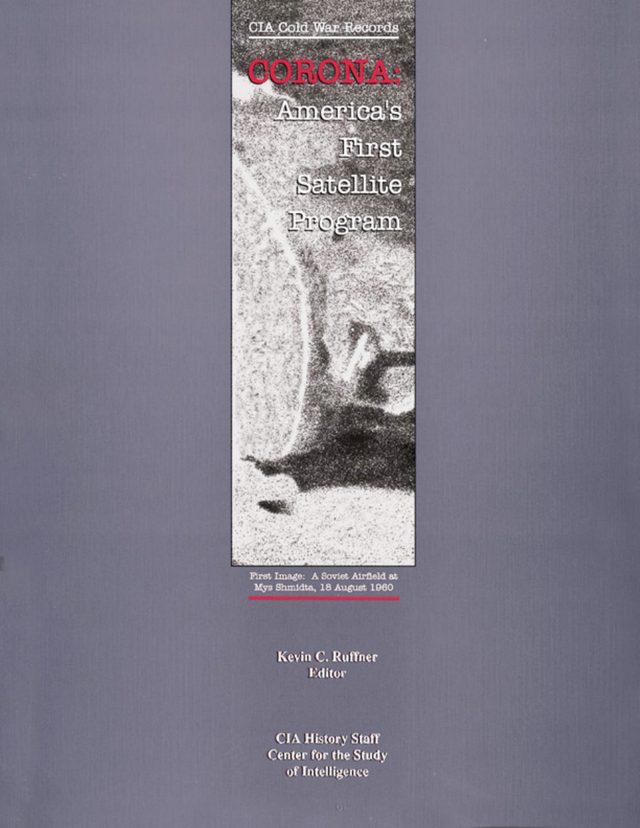
On 24 February 1995 Vice President Al Gore unveiled the first CORONA photographs at CIA headquarters, two days after President Clinton signed Executive Order 12951 ordering the release of more than 800,000 early satellite images1,2. Three months later the CIA History Staff published this book for a conference it co-sponsored with George Washington University's Space Policy Institute. It was the fourth volume in the CIA Cold War Records series; its editor, Kevin C. Ruffner, had joined the History Staff in 19911.
What the volume holds
The editor's preface explains the program's terms: KEYHOLE designations from KH-1 to KH-4B, the cameras from the original C to the J-3, and the failed ARGON and LANYARD systems that ran alongside it1. The book then reprints documents in four parts: a history of the program, the Committee on Overhead Reconnaissance, reports from the National Photographic Interpretation Center, and one non-military use of the imagery1. The copy served here contains the opening matter and all of Part I, plus a dozen pages from Part III.
Greer's 1973 history
Part I is Kenneth E. Greer's "Corona," published in a Top Secret supplement to the CIA's in-house journal Studies in Intelligence in spring 1973, the year after the last mission1. It is the Agency's own story of CORONA and dwells on the early years. Greer explains how the photographic part of the Air Force's WS-117L program was split off in 1958 and placed under joint CIA and Air Force management with Richard Bissell in charge, copying the U-2 arrangement. He says the CIA's CORONA files hold no records for the period of the key decisions, and that Eisenhower's approval was oral, recorded only in a note by Deputy Director Charles Cabell1.
Much of the article is a list of failures. The cover story was a scientific series called DISCOVERER, complete with mice that died on the launch pad. Twelve launches from February 1959 to June 1960 returned no film1. Then on 19 August 1960 a C-119 caught the capsule from DISCOVERER XIV near Hawaii; its film covered more Soviet territory than all the U-2 flights combined, and the static fogging on the frames proved the program's name apt1. Greer follows the cameras through MURAL and the two-capsule J-1 to the J-3, and ends with the 145th and final launch in May 19721. One odd episode, a capsule that came down in Venezuela in 1964 and was carried out of a farm, gets two pages, one of them photographs.
The first take, and its limits
The later pages served here come from the index the photo interpreters compiled for Mission 9009, the first film recovered: eight passes over the Soviet Union and parts of China and Eastern Europe, Kapustin Yar, new SA-2 sites and the Sarova weapons laboratory, at 20 to 30 feet resolution1. They are followed by the opening pages of National Intelligence Estimate 11-8/1-61 of 21 September 1961, which cut the estimate of Soviet ICBM launchers to 10 to 25, with the Air Force's intelligence chief dissenting1,3.
Read Greer as an insider's account written for cleared colleagues: proud, informal and sometimes vague on dates. Dollar figures and some names are still blacked out in the 1995 reprint, and the book was compiled to celebrate a declassification, not to weigh the program critically1. For what CORONA achieved and how it compares with other accounts, see the CORONA page and the history of the NRO, which ran the program from 19613.
Sources
- CIA CORONA: America's First Satellite Program (CIA Cold War Records), ed. Kevin C. Ruffner, Central Intelligence Agency, Center for the Study of Intelligence (1995).
- National Archives Executive Orders disposition tables, 1995 (EO 12951, Release of imagery acquired by space-based national intelligence reconnaissance systems), National Archives, Office of the Federal Register (1995-02-22).
- Wikipedia CORONA (satellite), Wikipedia.