
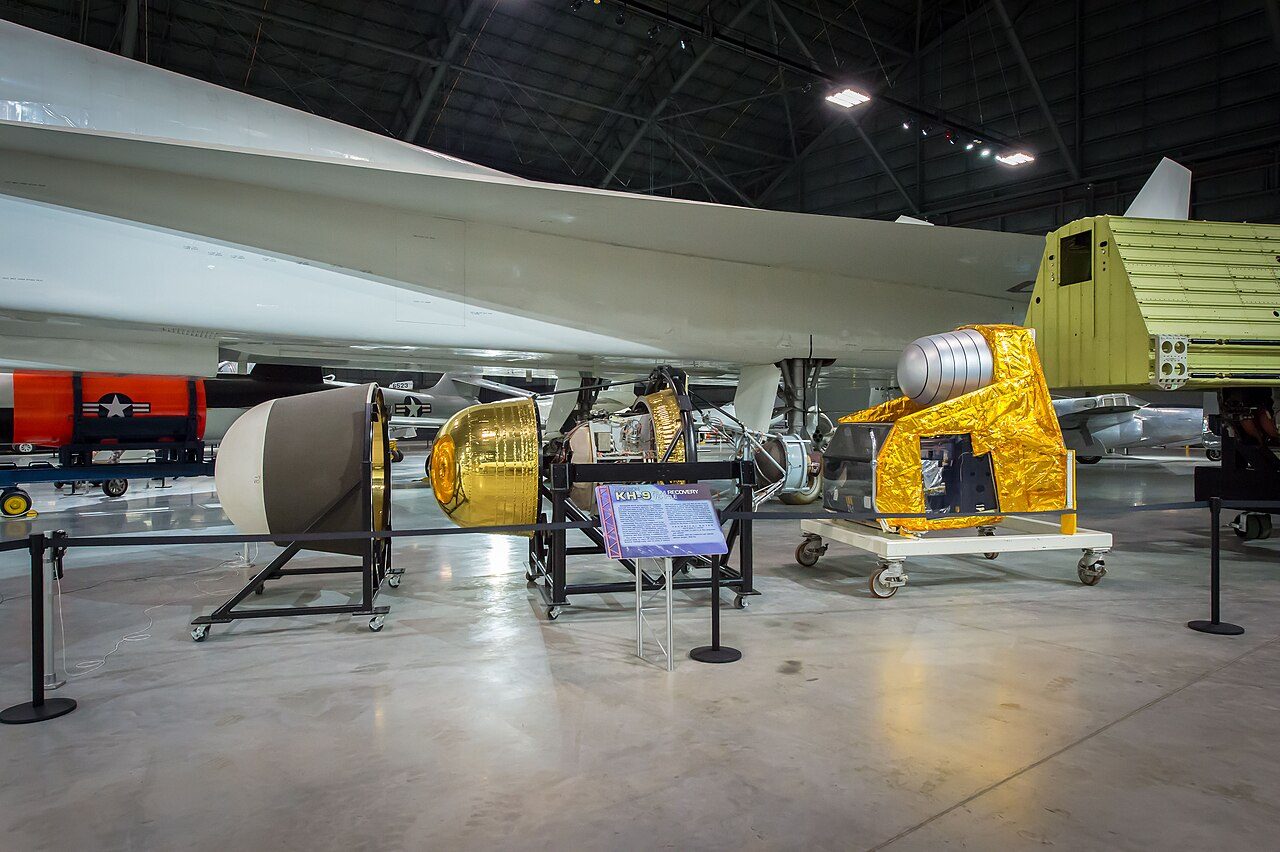

For thirty-one years the National Reconnaissance Office did not officially exist. It ran the most expensive intelligence systems the United States owned, and its satellites photographed every Soviet missile field, but its name was classified until 18 September 19921,2. The first known mention of it in the press came in a New York Times article in January 1971; a Senate committee report let the name slip again in October 19731.
Origins: satellites without an owner
By 1960 the United States had three overhead programs pulling in different directions: the CIA's U-2 aircraft, the CIA–Air Force CORONA satellite, and the Air Force's own SAMOS satellite. The Navy had a fourth, Grab, a small signals-intelligence satellite built by the Naval Research Laboratory and first launched on 22 June 1960; it collected Soviet air-defense radar signals and was not declassified until 19981.
The loss of a U-2 over the Soviet Union on 1 May 1960 made satellites the only way to look deep into Soviet territory. That summer Eisenhower ordered a review, and on 31 August 1960 the Air Force created a civilian-led Office of Missile and Satellite Systems under Under Secretary Joseph Charyk. That office became the core of the NRO1.
On 6 September 1961 Defense Secretary Robert McNamara and Director of Central Intelligence Allen Dulles agreed to establish the NRO, run jointly by Charyk and the CIA's Richard Bissell. It managed a new National Reconnaissance Program covering both CORONA and SAMOS1.
The alphabet programs
Bissell left the CIA in February 1962 after the Bay of Pigs, and a second Defense–CIA agreement on 2 May 1962 gave the NRO a single director and brought in the Navy's Grab. On 23 July 1962 Charyk organized the office into four parts that lasted thirty years1:
- Program A, the Air Force satellite effort, in El Segundo, California.
- Program B, the CIA satellite effort, in the northern Virginia suburbs.
- Program C, the Navy effort, drawing on the Naval Research Laboratory and the NSA.
- Program D, the U-2 and the A-12/SR-71 aircraft (see Project Oxcart).
The NRO's own history describes the result as "a highly decentralized federation." The director acted like a corporate chief executive deciding budgets and new starts, while most staff thought of themselves as Air Force, CIA or Navy people first1. Two more agreements, of 13 March 1963 and 11 August 1965, shifted authority back and forth between the Secretary of Defense and the DCI. The 1965 agreement made the Defense Secretary responsible for the NRO's operation, gave him final approval of its budget, and created an executive committee to oversee the program1.
What it flew
CORONA returned its first film in August 1960 and flew until May 19723. About a year after the first CORONA launch the NRO began GAMBIT, a high-resolution system first launched in 1963 with the KH-7 camera; GAMBIT 3, with the KH-8, followed in 1966. HEXAGON, a broad-area search system that sometimes carried a mapping camera, replaced CORONA from 19714. Grab's successor, Poppy, flew seven missions between 1962 and 19711.
The NRO's machinery also had a part in the Cuban Missile Crisis. In early October 1962 the State Department won agreement for an NRO report on whether anything could substitute for U-2 flights over Cuba, one of the delays before the flight of 14 October found the missiles5.
On 1 October 1974 Program D was disbanded and its aircraft were handed to the Air Force1. President Ford's Executive Order 11905 of 18 February 1976 listed the NRO in the intelligence community only as "special offices for the collection of specialized intelligence through reconnaissance programs"1. On 1 October 1978, to support the SALT II treaty, President Carter confirmed publicly that the United States used reconnaissance satellites1,3.
Coming into the open
After the Cold War a task force chaired by the former Lockheed chief executive Robert Fuhrman recommended abolishing the alphabet structure and admitting that the NRO existed. National Security Directive 67, signed on 30 March 1992, approved the reorganization, which took effect on 31 December 1992 with separate directorates for signals intelligence, imagery and communications1. The fact of the NRO was declassified that September, partly because the Senate intelligence committee said it would do so itself unless the President certified serious damage1.
Openness brought scrutiny. In 1994 Senate leaders said the cost of the new headquarters at Westfields in Chantilly, Virginia, had not been properly disclosed; a joint Defense–CIA review found no intent to mislead but faulted the NRO's budgeting. In 1995 the Senate committee found that the agency had built up large unspent "forward funding," eventually estimated at $3.7 billion, and in February 1996 DCI John Deutch removed the director and deputy director1. CORONA imagery was released in 1995 and Grab declassified in 19983,1. A national commission reported in 2000 that the NRO, once a small organization serving a few strategic customers, had become a large agency supplying data to the NSA, the imagery agency and military users2.
Key dates
- 22 June 1960 Grab, the Naval Research Laboratory's signals-intelligence satellite and later an NRO program, is launched from Cape Canaveral.
- 19 August 1960 First CORONA film capsule recovered from orbit.
- 6 September 1961 Defense Secretary McNamara and DCI Allen Dulles agree to create the NRO under co-directors Joseph Charyk and Richard Bissell.
- 23 July 1962 Charyk sets up the "alphabet" structure: Program A (Air Force), B (CIA), C (Navy) and D (aircraft).
- 14 October 1962 U-2 overflight finds Soviet missile sites in Cuba.
- 11 August 1965 Fourth Defense-CIA agreement confirms the NRO as a Defense agency with the Secretary of Defense in final control of its budget.
- 25 May 1972 Last CORONA launch.
- 1 October 1978 President Carter publicly confirms that the United States uses reconnaissance satellites.
- 18 September 1992 The government declassifies the fact of the NRO's existence.
- 22 February 1995 Executive Order 12951 releases CORONA imagery.
Operations in these files
 February 1958 – 31 May 1972
CORONA
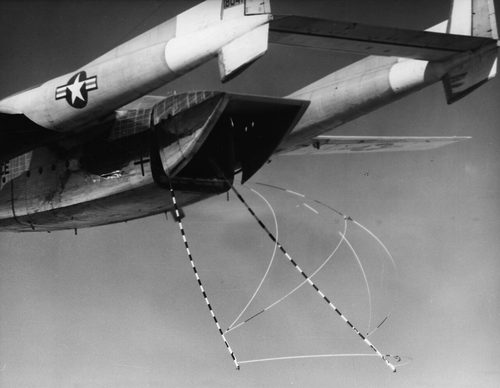
America's first photographic reconnaissance satellite, run by the CIA and Air Force from 1958 to 1972. Its film buckets, caught in midair, ended the missile-gap guesswork and stayed secret until 1995.
 10 August – 20 November 1962
Intelligence in the Cuban Missile Crisis
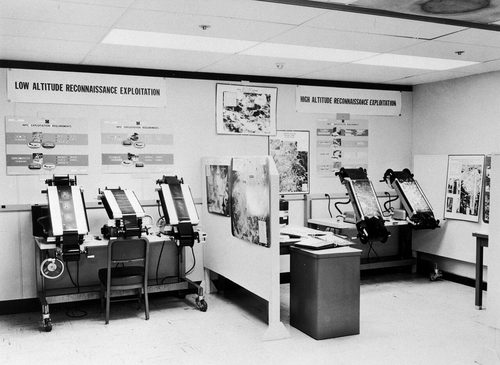
How US intelligence missed, then found, Soviet missiles in Cuba in 1962: a wrong estimate, a five-week gap in U-2 coverage, the 14 October flight over San Cristóbal, and what the photographs never showed.
Sources
- Official history The National Reconnaissance Office at 50 Years: A Brief History (Bruce Berkowitz), National Reconnaissance Office, Center for the Study of National Reconnaissance (archived copy) (2011-09).
- Congress Report of the National Commission for the Review of the National Reconnaissance Office: The Evolving Role of the NRO, National Commission for the Review of the NRO (mirrored by the Federation of American Scientists) (2000-11).
- CIA CORONA: America's First Satellite Program (CIA Cold War Records), ed. Kevin C. Ruffner, Central Intelligence Agency, History Staff (archived copy) (1995).
- Official history Hexagon fact sheet (Center for the Study of National Reconnaissance), National Reconnaissance Office (archived copy) (2011-09).
- CIA The "Photo Gap" that Delayed Discovery of Missiles (Max Holland), Studies in Intelligence 49, no. 4, Central Intelligence Agency, Center for the Study of Intelligence (archived copy) (2005).
- Wikipedia National Reconnaissance Office, Wikipedia.
- Wikipedia English Wikipedia article (used for cross-checking).