
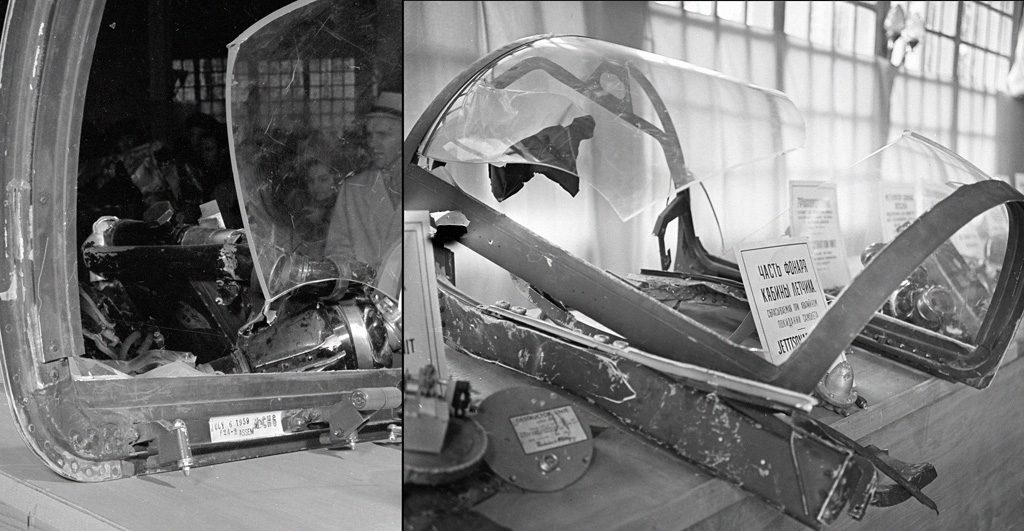

From the document
Reconnaissance activity had been going on for years; consequently it was inevitable that it would be revealed sooner or later.
Our reconnaissance was discovered and we would just have to endure the storm and say as little as possible.
if we discovered a Soviet spy, we would have to expose all our intelligence sources and methods in order to obtain a conviction.
Khrushchev might have been motivated by the following: (1) deep conviction, which appears common among Soviet leaders, that secrecy is a major asset of the USSR
Excerpts are passages from a US government work (public domain), quoted exactly and checked against the text on history.state.gov on every rebuild.
By the morning of Monday 9 May 1960, the cover story was gone. Eight days earlier a U-2 flown by Francis Gary Powers, a pilot employed by the CIA, had been shot down near Sverdlovsk, about 1,200 miles inside the Soviet Union2. Washington's first answer, a NASA statement of 3 May, described it as a weather research aircraft lost near Lake Van in Turkey2. On 5 May Khrushchev announced that an American spy plane had been shot down. On 7 May he told the Supreme Soviet that the pilot was alive and that the Soviets had his aircraft and film2. The State Department then admitted that a flight to gather intelligence had probably taken place, while saying that Washington had not authorized it2.
From Moscow, Ambassador Llewellyn Thompson cabled that he doubted the United States could go on denying a deliberate overflight. He recommended that the President's personal role be kept out of it if possible3. Eisenhower went the other way. The National Security Council met on 9 May, and the document printed here is the official record of that meeting, drafted by the NSC's Marion Boggs and dated 13 May1.
What the record shows
FRUS prints only part of the memorandum. The participant list and agenda items 2 and 3 are left out (the summit discussion appears in another volume), as is the rest of the intelligence briefing under item 4. One paragraph of 15½ lines remains classified1. What remains is the first agenda item and the opening of the fourth.
Eisenhower opened by saying the incident "had produced a great storm"1. While the Council met, Allen Dulles was briefing congressional leaders at a session called by Secretary of State Herter, "fully but without apology." The State Department would issue a statement that afternoon, which the President said he had made less defensive1. His argument was simple. Reconnaissance had been going on for years, the Joint Chiefs, the Director of Central Intelligence and the scientists had all insisted on it, and exposure had always been likely. What to do in future would have to be reviewed1.
He then told the Council to say nothing to the press. Different statements from different officials would be compared, and any differences would become the story1.
The discussion then turned, unexpectedly, to Soviet spies in America. Eisenhower complained that convicting a spy meant exposing American sources and methods, and that a convicted spy might get six years and be replaced by six more1. Attorney General William Rogers said most Soviet bloc spies had diplomatic immunity. He noted that J. Edgar Hoover had been compiling a list of bloc spy cases and that at least sixteen bloc diplomats had been expelled. He pointed to the The Hollow Nickel case: Rudolf Abel (William Fisher), a spy with no immunity, had received a twenty-year sentence1. The President said he hoped no one would let him forget it1. Less than two years later, Abel would be exchanged for Powers4.
The Council's formal action was short. It noted the President's statement and his instruction that all executive branch officials stay silent except through authorized State Department statements1.
Under item 4, the CIA's Deputy Director for Intelligence, Robert Amory, gave four possible reasons why Khrushchev was pressing the incident so hard. They were the Soviet leaders' belief that secrecy was a major asset, anxiety about any violation of Soviet territory, possible pressure from a military unhappy with troop cuts, and a wish to embarrass the President before the summit. Amory saw no serious opposition to Khrushchev inside the Soviet leadership1.
What happened next
That afternoon Herter publicly conceded that the President had authorized intelligence-gathering, though not each individual flight2. On 11 May Eisenhower read his own statement at a news conference2. In Paris on 16 May, Khrushchev demanded an apology and punishment of those responsible. Eisenhower said overflights had been suspended but refused to apologize, and the summit collapsed2. Powers was tried in Moscow on 17–19 August and sentenced to ten years' confinement2. In February 1962 he was exchanged for Abel4.
Using the document
This record is useful because it is not a public statement. It shows the President defending the program as a whole rather than denying his own knowledge, as Thompson had recommended, and treating the affair as a problem of press discipline1,3. It also shows the CIA's analysts already reading the incident in terms of the summit and Soviet politics1. On the cover story, Wikipedia's account dates NASA's statement to 5 May. The FRUS editors record a first NASA statement on 3 May and further NASA and State Department statements on 5 May. This page follows FRUS2,5.
Sources
- FRUS Foreign Relations of the United States, 1958–1960, Volume X, Part 1, Eastern Europe Region; Soviet Union; Cyprus, Document 149, US Department of State, Office of the Historian (1993).
- FRUS Foreign Relations of the United States, 1958–1960, Volume X, Part 1, Document 147 (Editorial Note on the U-2 incident), US Department of State, Office of the Historian (1993).
- FRUS Foreign Relations of the United States, 1958–1960, Volume X, Part 1, Document 148 (Telegram from Ambassador Thompson, Moscow, 7 May 1960), US Department of State, Office of the Historian (1993).
- Official history U-2 Overflights and the Capture of Francis Gary Powers, 1960 (Milestones in the History of US Foreign Relations), US Department of State, Office of the Historian.
- Wikipedia 1960 U-2 incident, Wikipedia.