
 Page 1 of 63
From the document
being told that if something like this should happen that I may as well tell them everything ... because they would get it out of you somehow anyway.
I remember thinking of the good luck charm with the needle in it, or the pin, and I thought: that is just too big, it would be found too easily.
I tried to give the impression that 68,000 feet was the maximum altitude of the aircraft.
Excerpts are passages from a US government work (public domain), quoted exactly as they read in the scan, and checked against the full text on every rebuild.
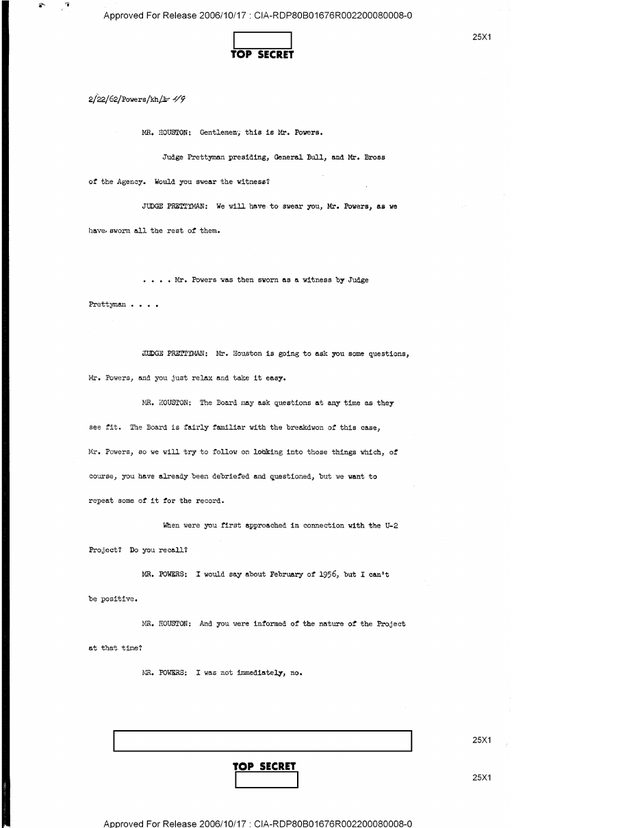
Francis Gary Powers came back from Soviet captivity on 10 February 1962, exchanged for Rudolf Abel on the Glienicke Bridge in Berlin2,3. After his debriefing, the new Director of Central Intelligence, John McCone, wanted a closer look at how he had behaved, and set up a Board of Inquiry under Judge E. Barrett Prettyman of the federal appeals court in Washington2,4. This is the stenographic record of the afternoon of 22 February, when Powers himself was sworn. The questioning is led by a Mr. Houston, with Prettyman, a General Bull and a Mr. Bross "of the Agency" joining in1.
What Powers told the board
He was approached about February 1956, resigned from the Air Force, became a CIA contract employee, and reached the U-2 base at Adana, Turkey, in late August 19561. Before May 1960 he had made one flight into Soviet territory, between the Caspian and the Black Sea, and turned back at the Soviet border on another; he had been back-up pilot for the overflight of 9 April 19601.
Then, in his own words and at the judge's invitation, the flight of 1 May from Peshawar: cloud over much of the route, trouble with the autopilot, two condensation trails near the Aral Sea, and the turn near Sverdlovsk at 70,000 feet. While he was writing up his log he felt a push and saw that everything around him was orange1. The controls went slack, the aircraft fell into a violent spin, and he could not get back into his seat to eject. He released the canopy at about 34,000 feet, hung half out of the cockpit by his oxygen hose, and his parachute opened by itself1. On the way down he tore up his escape map and took the poison pin out of its hollow coin, dropping the coin and keeping the pin loose in his pocket1. He landed near a tractor on what he was later told was a collective farm and was driven to Sverdlovsk, then flown to Moscow1.
The interrogation ran from 1 May to 30 June, mostly by two majors, at first for as long as 11 or 12 hours a day1. His plan, he said, was to seem wholly truthful so that his lies on the important points would be believed. He named a Colonel Shelton because he expected the press to print the name anyway, refused the names of other pilots, said nothing of overflights of Middle Eastern countries, and understated the aircraft's ceiling1. Shown a radar plot that had him descending to 37,000 feet, he denied it and offered to take a polygraph1. The hearing closed at 5:55 p.m., after questions about his prison reading and his cellmate in Vladimir1.
The verdict and the record
The board reported on 27 February that Powers had acted in accordance with his instructions and recommended his back pay. McCone, still doubtful, had it reconvene on 1 March to weigh the National Security Agency's report; it did not change its view2. Powers testified to the Senate Armed Services Committee on 6 March, but the CIA gave him its Intelligence Star only on 25 April 19652. The release blacks out the names of other pilots and much detail about the U-2 detachment1. This is the testimony of a man whose conduct was under review; the board weighed it against debriefings, a polygraph and the photographs of the wreckage2. The crisis the shoot-down caused is covered under The U-2 program and the 1960 shoot-down and After the U-2: the President and his advisers (May 1960).
Sources
- CIA Transcript of testimony of Francis Gary Powers before the Board of Inquiry, 22 February 1962 (CIA-RDP80B01676R002200080008-0), archived copy of the CIA CREST PDF, Central Intelligence Agency (Wayback Machine capture, March 2025) (1962-02-22).
- Official history Gregory W. Pedlow and Donald E. Welzenbach, The CIA and the U-2 Program, 1954–1974, Chapter 4, Central Intelligence Agency, History Staff (copy posted by the National Security Archive) (1992).
- Wikipedia Francis Gary Powers, Wikipedia.
- Wikipedia E. Barrett Prettyman, Wikipedia.