
Portrait: Rudolf Abel (Vilyam Fisher) in an AP wire photograph from the day of his indictment in New York, 7 August 1957. AP Wire. Wikimedia Commons, Public domain.

The man the world knew as Colonel Rudolf Abel was born William August Fisher in Benwell, Newcastle upon Tyne, in 1903, the son of Russian revolutionary émigrés4,5. He grew up in the north of England, apprenticed as a draughtsman, and in 1921 went with his family to Soviet Russia5. Fluent in English, he served in a Red Army radio battalion and in May 1927 was recruited by the OGPU, a forerunner of the KGB, as a radio operator; he served abroad in the 1930s and in the Second World War trained radio operators for work behind German lines5.
An illegal in New York
Fisher was sent to the United States as an "illegal", a Soviet officer living under a false identity with no diplomatic cover. According to the FBI's reconstruction, he sailed from Le Havre in 1948 on the passport of Andrew Kayotis, a Lithuanian-born American believed to have died while visiting relatives in Lithuania, landed at Quebec on 14 November 1948 and slipped across the border1. In New York he became "Emil R. Goldfus", using the birth certificate of a child who had died in infancy, and from January 1954 kept a photographer's and painter's studio on the fifth floor of 252 Fulton Street in Brooklyn1. His KGB covername was MARK1.
His assistant from 1954 was Reino Hayhanen, another illegal who had entered as "Eugene Maki". Hayhanen proved a drunk and a poor operator, and Fisher asked Moscow to recall him5. In May 1957, on his way home, Hayhanen defected at the US Embassy in Paris and told the FBI about "Mark" and the Brooklyn studio1,4.
Arrest
Agents watched the studio and on 13 June 1957 followed a man from it to the Hotel Latham on East 28th Street, where he was registered as Martin Collins; Hayhanen identified his photograph two days later1. On 21 June officers of the Immigration and Naturalization Service arrested him on an alien warrant1,2. Among his belongings were forged and borrowed birth certificates for Collins and Goldfus, a bank book, a hollow pencil holding eighteen microfilms and a block of wood wrapped in sandpaper containing a cipher pad2. In detention he said he was Rudolf Ivanovich Abel, a Soviet citizen, and would say nothing more1. The name belonged to a dead KGB colleague; by later accounts, he chose it so that Moscow would recognize from the newspapers who had been caught5.
Trial and the Supreme Court
Fisher was tried in federal court in New York in October 1957, defended by the Brooklyn lawyer James B. Donovan; Hayhanen was the chief witness against him1,5. On 25 October the jury convicted him on all three conspiracy counts, and on 15 November he was sentenced to thirty years and fined1.
His appeal reached the Supreme Court, which heard argument twice. The question was whether evidence seized without a search warrant after an immigration arrest could be used in a criminal trial. On 28 March 1960 the Court, in an opinion by Justice Felix Frankfurter, held 5 to 4 that it could and affirmed the conviction; Justices Douglas and Brennan wrote dissents, Brennan's joined by Chief Justice Warren and Justices Black and Douglas2,3.
Exchange
On 10 February 1962 Fisher was exchanged at the Glienicke Bridge between West Berlin and Potsdam for Francis Gary Powers, the U-2 pilot shot down over the Soviet Union in 19601,5. In Moscow he lectured within the KGB and appeared in a Soviet spy film5. He died of lung cancer on 15 November 1971 and was buried in Moscow under his real name5. Benson and Warner note that his arrest "marked the first time the government had caught a Soviet 'illegal' working in America", and that he may have been the KGB's chief illegal in the United States4.
Key dates
- May 1927 Recruited by the OGPU as a radio operator.
- 14 November 1948 Lands at Quebec on the passport of Andrew Kayotis and soon enters the United States.
- January 1954 Takes a photo studio at 252 Fulton Street, Brooklyn, as 'Emil Goldfus'.
- 21 June 1957 Arrested at the Hotel Latham, New York; gives his name as Rudolf Ivanovich Abel.
- 25 October 1957 Convicted on three counts of conspiracy.
- 28 March 1960 Supreme Court upholds his conviction, 5 to 4.
- 10 February 1962 Exchanged for Francis Gary Powers in Berlin.
Sources
- FBI Hollow Nickel/Rudolf Abel, Federal Bureau of Investigation (archived copy).
- Court record Abel v. United States, 362 U.S. 217 (1960), Legal Information Institute, Cornell Law School (1960-03-28).
- Court record Abel v. United States, 362 U.S. 217 (United States Reports, official PDF), Library of Congress (1960).
- CIA Venona: Soviet Espionage and the American Response, 1939–1957 (Introduction), Central Intelligence Agency and National Security Agency (1996).
- Wikipedia Rudolf Abel, Wikipedia.
- Wikipedia English Wikipedia article (used for cross-checking).
Elsewhere in the files
- Agency Federal Bureau of Investigation (FBI)
- Agency KGB
- Document Abel v. United States: the Supreme Court and the spy's wastebasket (1960)
- Document After the U-2: the President and his advisers (May 1960)
- Document Francis Gary Powers before the CIA Board of Inquiry (22 February 1962)
- Operation Operation Monastery
- Operation The Hollow Nickel case
- Operation The U-2 program and the 1960 shoot-down
- Person Francis Gary Powers
- Person Konon Molody (Gordon Lonsdale)
- Person Morris and Lona Cohen
- Person Theodore Hall
- Tradecraft Brush passes
- Tradecraft Concealment devices
- Tradecraft Dead drops
- Tradecraft Illegals and legends
- Tradecraft Microdots
- Tradecraft Numbers stations
- Tradecraft One-time pads
- Tradecraft Surveillance and countersurveillance
Read next
 22 June 1953 – 15 November 1957
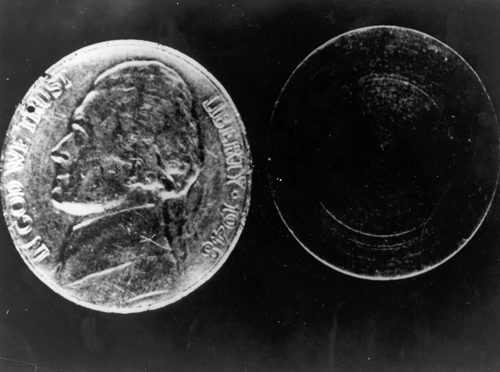
The Hollow Nickel case
A Brooklyn newsboy's trick nickel held a coded message the FBI could not read for four years, until a drunken KGB defector explained it and led agents to the illegal known as Rudolf Abel.
 1920s–1980s
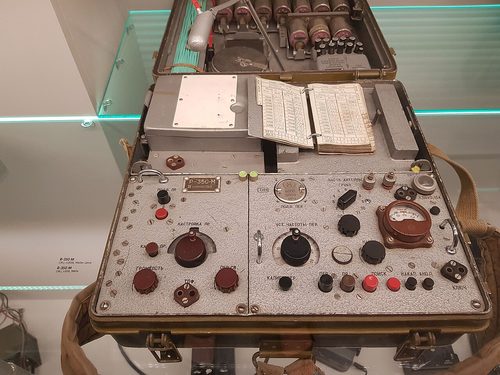
Illegals and legends
Soviet officers who lived abroad as private citizens under borrowed identities, with no diplomatic protection. The Abel and Portland court records show how their legends were built and how they came apart.
 24 November 1954 – 16 May 1960
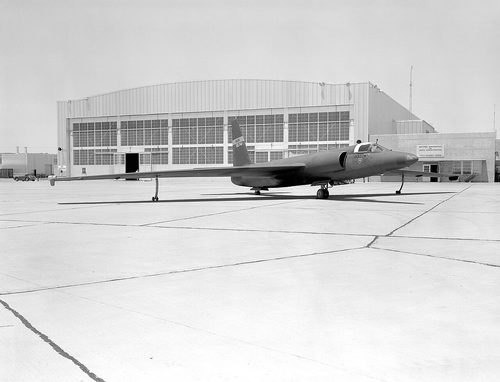
The U-2 program and the 1960 shoot-down
From 1956 the CIA's U-2 photographed the Soviet Union from 70,000 feet. On 1 May 1960 a missile brought down Francis Gary Powers near Sverdlovsk, the cover story collapsed and the Paris summit failed.
 1940s–1980s
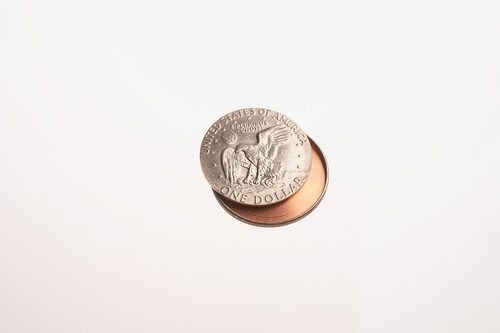
Concealment devices
Hollow coins, bolts, batteries and books: the everyday objects spies used to carry film and messages. Many now sit in FBI and CIA collections, and nearly all were found the same way, through an informant or an arrest.
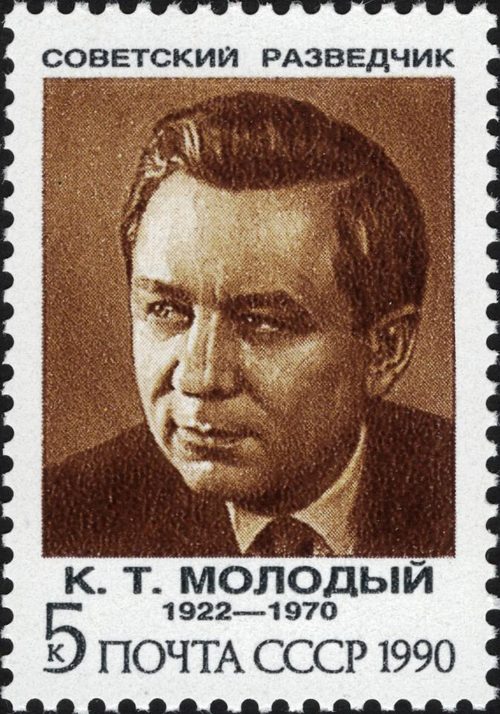 1922–1970
Konon Molody (Gordon Lonsdale)
Soviet intelligence officer who lived in London as the Canadian businessman 'Gordon Lonsdale', ran the Portland spy ring, was jailed in 1961 and was exchanged for Greville Wynne in 1964.