
 Page 1 of 40
From the document
(6) a hollowed-out pencil containing 18 microfilms; and (7) a block of wood, wrapped in sandpaper, and containing within it a small booklet with a series of numbers on each page, a so-called “cipher pad.”
The test is whether the decision to proceed administratively toward deportation was influenced by, and was carried out for, a purpose of amassing evidence in the prosecution for crime. The record precludes such a finding by this Court.
So far as the record shows, petitioner had abandoned these articles. He had thrown them away. So far as he was concerned, they were bona vacantia.
The Amendment’s protection is thus made effective for everyone only by upholding it when invoked by the worst of men.
Excerpts are passages from a US government work (public domain), quoted exactly as they read in the scan, and checked against the full text on every rebuild.
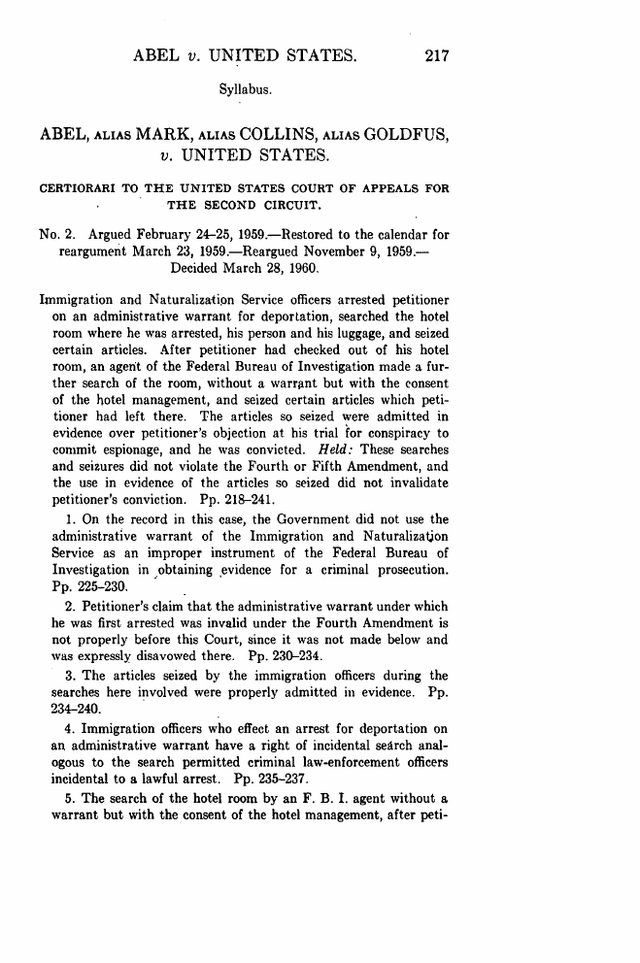
The man the government called Rudolf Ivanovich Abel never told an American court his real name, William Fisher, or what he had done for the KGB. His last appeal turned instead on a narrower question: whether seven objects taken from him without a search warrant could be used to convict him1,5. This is the Supreme Court's answer, decided on 28 March 1960 by five votes to four1.
How the case reached the Court
The opinion's statement of facts is one of the most detailed public accounts of the arrest that ended the The Hollow Nickel case. It records that Reino Hayhanen, "a recently defected Russian spy", had named Abel to the FBI, but would not then agree to testify; the Justice Department judged the evidence too thin for an espionage arrest and passed the case to the Immigration and Naturalization Service1. At 7 a.m. on 21 June 1957, FBI agents entered Abel's room at the Hotel Latham in New York, questioned him for about twenty minutes, and, when he would not "cooperate", signalled the INS officers waiting next door to serve their deportation warrant1,2.
The INS search of the room produced a forged birth certificate for "Martin Collins" and a coded message on graph paper that Abel tried to slip into his sleeve. Three more items, a birth certificate and bank book in the name of "Emil Goldfus" and a vaccination certificate, turned up at INS headquarters. After Abel checked out, an FBI agent searched the room for three hours with the hotel's consent and recovered a hollow pencil holding eighteen microfilms and a sandpaper-wrapped block of wood containing a cipher pad from the wastebasket1. Abel was convicted of conspiracy to commit espionage and sentenced to thirty years and a $3,000 fine; the Second Circuit affirmed1. His lawyer, James B. Donovan, argued the case twice before the Court1,4.
What the Court decided
Justice Frankfurter's opinion makes three moves. First, the lower courts had found the INS acted "in entire good faith", not as a tool of the FBI, and the Court would not overturn that finding, though it admitted the record held evidence pointing the other way1. Second, Abel had never challenged the administrative warrant itself in the lower courts, so the Court refused to consider it1. Third, officers making a deportation arrest may search incidentally, as police may on a criminal arrest, so the first five items were lawfully seized; and the pencil and wood block, thrown away in a room Abel had given up, were abandoned property anyone could take1.
The dissents
Justice Douglas, joined by Justice Black, warned that "cases of notorious criminals" make bad law, and accused the FBI of acting behind "the masks of immigration officials" while preparing a criminal case1. Justice Brennan, joined by Chief Justice Warren and Justices Black and Douglas, argued that a search incident to an arrest made on a warrant issued inside the immigration service, not by a judge, went further than any the Court had approved; he would have ordered a new trial without the tainted evidence1.
Reading it
The opinion is a legal document, not a history of the spy: it says nothing about what Abel passed to Moscow, and its facts come from the hearing record as the courts found them1. Its value is the sworn sequence of the arrest and the inventory of his kit, which matches the FBI's own later account1,2. Less than two years later, on 10 February 1962, Abel was exchanged in Berlin for the U-2 pilot Francis Gary Powers2,5.
Sources
- Court record Abel v. United States, 362 U.S. 217 (1960), United States Reports, Supreme Court of the United States (Library of Congress digitization) (1960-03-28).
- FBI Hollow Nickel/Rudolf Abel, Federal Bureau of Investigation (archived copy).
- Court record Abel v. United States, 362 U.S. 217 (1960), full text, Legal Information Institute, Cornell Law School (1960-03-28).
- Wikipedia Abel v. United States, Wikipedia.
- Wikipedia Rudolf Abel, Wikipedia.
- Wikipedia English Wikipedia article (used for cross-checking).