
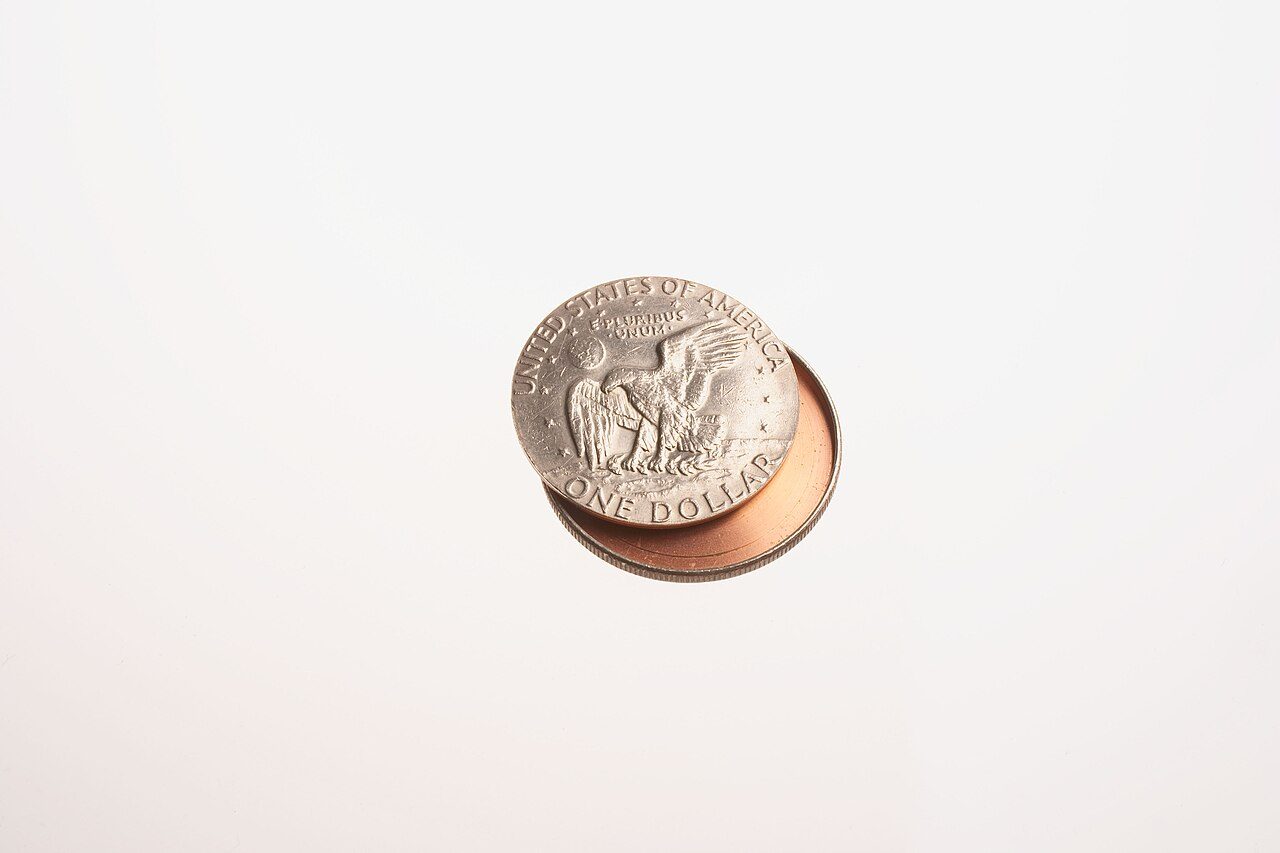

Most espionage material is small: a roll of film, a few sheets of one-time pad, a folded note, a wad of banknotes. A concealment device is anything made to carry such material while looking like something else. The more ordinary the object, the better it served, which is why the surviving examples look like the contents of a junk drawer: coins, bolts, pencils, batteries, a shaving brush, a tin of talcum powder.
The Brooklyn nickel
The FBI's acquaintance with Soviet hollow containers began by accident. On 22 June 1953 a newspaper delivery boy in Brooklyn was given change that included a nickel that felt too light. When he dropped it, it fell apart; inside was a tiny photograph of columns of numbers.1 FBI Laboratory examiners found that the face was a 1948 Jefferson nickel and the back came from a wartime nickel, with a tiny hole drilled in the "R" of "TRUST" so the coin could be prised open. Novelty dealers shown photographs said the cavity was too small to be any use for a magic trick.1
The coin sat unexplained for four years (see The Hollow Nickel case). The answer came in May 1957, when the KGB officer Reino Häyhänen defected and told the FBI that "trick" containers were standard issue: he had been supplied with hollow pens, pencils, screws, batteries and coins, some magnetized to stick to metal.1 In his house in Peekskill agents found a hollowed Finnish 50-markka coin with a tiny hole in one letter, built the same way as the nickel. In a dead drop in Prospect Park they found a hollow bolt about two inches long, holding a message that had been sealed in by a cement repair crew two years before.1
When agents arrested Häyhänen's superior, Rudolf Abel, in June 1957, his studio and hotel room were, in the FBI's words, "virtual museums of modern espionage equipment," including a hollow shaving brush, cuff links and "numerous other 'trick' containers."1
The Krogers' household objects
The British equivalent came from the Portland case in 1961. Searching the Ruislip bungalow of the Soviet agents living as Peter and Helen Kroger (Morris and Lona Cohen), investigators found a tin of talcum powder with hidden compartments, one holding a Microdots reader, and a battery with a removable top containing US$6,000.7 Earlier, MI5 had secretly opened a safe-deposit box rented by their controller, Gordon Lonsdale (Konon Molody (Gordon Lonsdale)), and found a Ronson cigarette lighter which, when X-rayed, proved to contain one-time pads.7
Western devices
The CIA's own concealments are now partly on public display. The CIA Museum holds a hollow metal spike for burying in the ground at a drop site and a hollow coin made to resemble an Eisenhower silver dollar, used to carry messages or film.2,6 The agency's account of the TRIGON case in Moscow describes artificial bricks that could be left at a construction site and, more surprisingly, dead rats used as drop containers, their body cavities large enough for money or film; hot pepper sauce discouraged cats from carrying them off.3
Concealment cut both ways. When the KGB searched the Moscow hotel room of Greville Wynne, the courier in the Penkovsky case, in July 1962, it photographed a shaving-cream can with a false bottom.4 When the KGB seized a CIA officer on his way to meet Adolf Tolkachev in June 1985, his package included five miniature cameras and a hollowed book holding 250 pages of Western press articles that Tolkachev had asked for.5
A coin with a pin
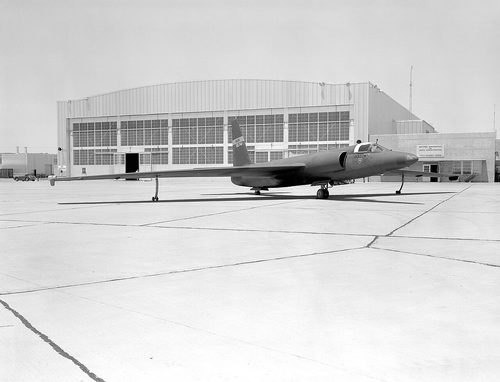
Not every concealment held a message. In 1960 the U-2 pilot Francis Gary Powers carried a silver dollar on a cord around his neck containing a pin laced with poison, an optional suicide device. After his aircraft was shot down over the Soviet Union on 1 May 1960 he got rid of the coin during his descent but kept the pin (see The U-2 program and the 1960 shoot-down).8
How they were found
A well-made hollow object was close to invisible in ordinary handling; the Brooklyn nickel was discovered only because a boy noticed its weight. In the documented cases above, the devices were found because a person had been identified first: a defector named the method, investigators searched a known suspect's home, or surveillance led to a safe-deposit box.1,5,7 The objects tend to survive as exhibits for exactly that reason.
Sources
- FBI Hollow Nickel/Rudolf Abel, Federal Bureau of Investigation, History (archived by the Internet Archive).
- CIA "Silver Dollar" Hollow Container, Central Intelligence Agency, CIA Museum.
- CIA TRIGON: Spies Passing in the Night, Central Intelligence Agency, Stories (2016-06-20).
- CIA Review Essay: The True Story Behind the Movie "The Courier" (Randy P. Burkett), Studies in Intelligence 66, no. 1, Central Intelligence Agency, Center for the Study of Intelligence (2022-03).
- CIA Tolkachev, A Worthy Successor to Penkovsky (Barry G. Royden), Studies in Intelligence 47, no. 3, Central Intelligence Agency, Center for the Study of Intelligence (archived by the Internet Archive) (2003).
- CIA "Dead" Drop Spike, Central Intelligence Agency, CIA Museum.
- Wikipedia Portland spy ring, Wikipedia.
- Wikipedia Francis Gary Powers, Wikipedia.
- Wikipedia English Wikipedia article (used for cross-checking).
Elsewhere in the files
- Document Abel v. United States: the Supreme Court and the spy's wastebasket (1960)
- Document The CIA's trained-cats memo (1967)
- Operation Acoustic Kitty
- Operation The Hollow Nickel case
- Operation The Portland spy ring
- Person Konon Molody (Gordon Lonsdale)
- Person Morris and Lona Cohen
- Person Rudolf Abel (William Fisher)
- Tradecraft Brush passes
- Tradecraft Dead drops
- Tradecraft Microdots
- Tradecraft Secret writing
- Tradecraft The "Moscow Rules"
Read next
 1940s–2001
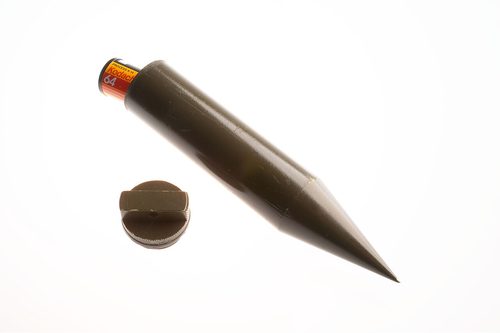
Dead drops
A hiding place where one spy leaves material for another to collect later, so the two never meet. The Abel, Ames and Hanssen cases show how it worked and how the FBI turned it against its users.
 1870–1960s
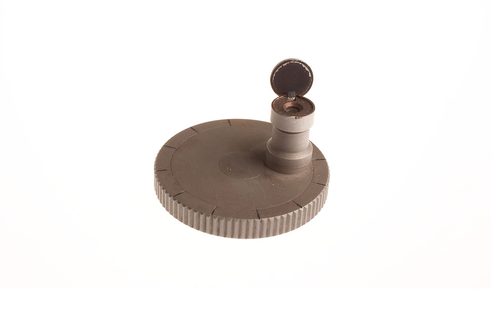
Microdots
A page of text photographed down to the size of a printed full stop. The Abwehr's wartime microdots, Popov's Pearl Harbor questionnaire and the Soviet illegals' kits in New York and London show how far the trick went.
 22 June 1953 – 15 November 1957
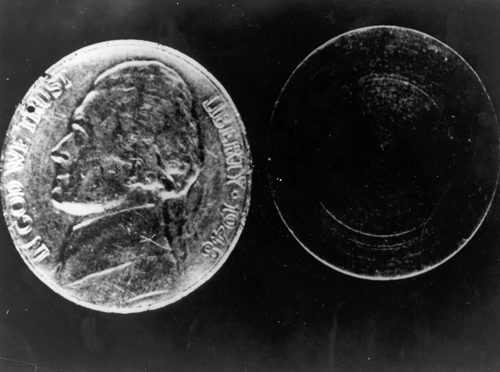
The Hollow Nickel case
A Brooklyn newsboy's trick nickel held a coded message the FBI could not read for four years, until a drunken KGB defector explained it and led agents to the illegal known as Rudolf Abel.
 1951 – 22 March 1961
The Portland spy ring
A Soviet network that took naval secrets from the Admiralty's underwater research establishment at Portland, run by the KGB illegal 'Gordon Lonsdale' and broken up by MI5 in January 1961.
 24 November 1954 – 16 May 1960
The U-2 program and the 1960 shoot-down
From 1956 the CIA's U-2 photographed the Soviet Union from 70,000 feet. On 1 May 1960 a missile brought down Francis Gary Powers near Sverdlovsk, the cover story collapsed and the Paris summit failed.
1960s–1980s
The "Moscow Rules"
The unwritten working habits of CIA officers in Cold War Moscow, later popularized as a ten-line list. What the record shows about where they came from and the Moscow cases that shaped them.