
 Page 1 of 50
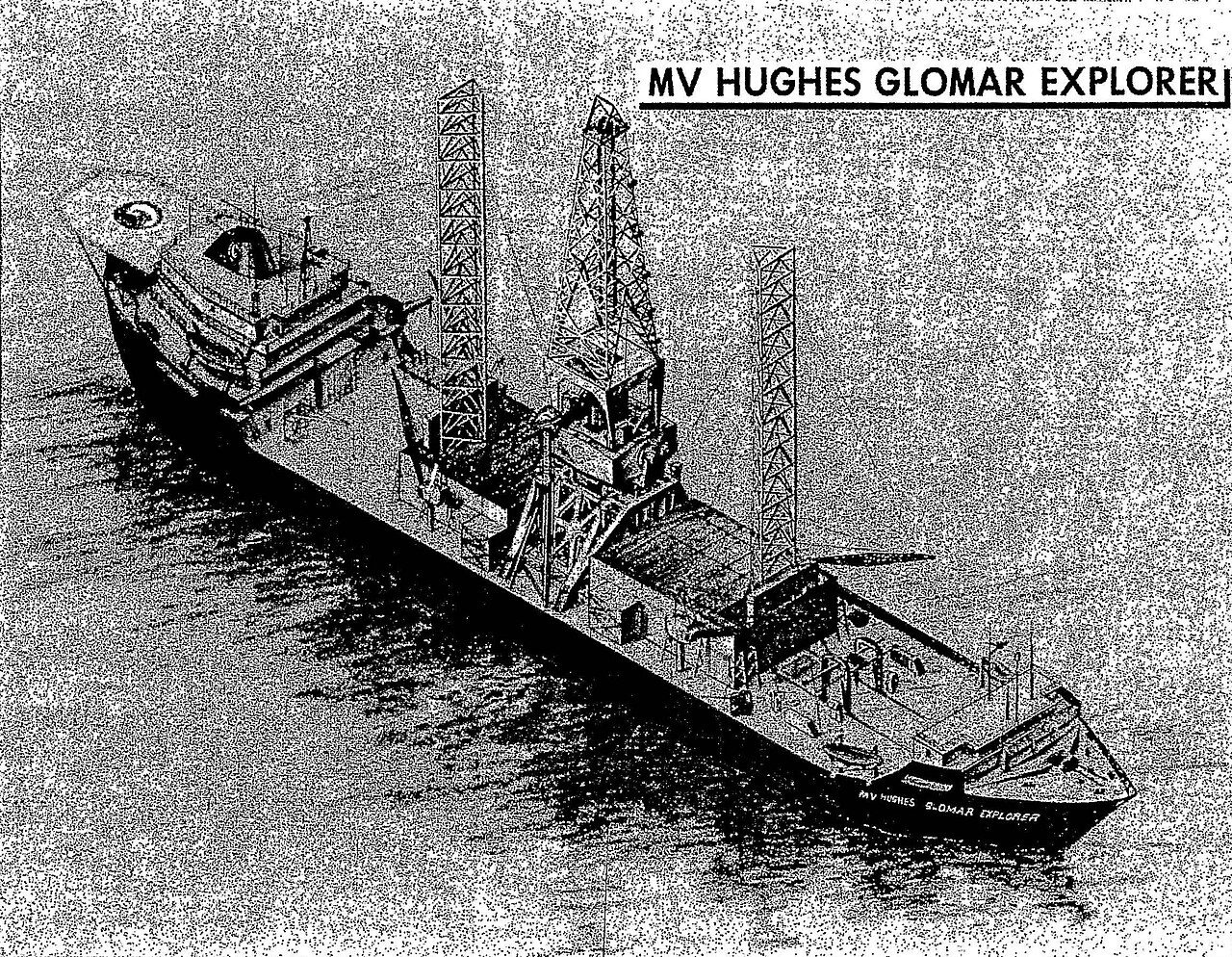

From the document
AZORIAN ranks in the forefront of imaginative and bold operations undertaken in the long history of intelligence collection.
This article describes how the Glomar project—code-named AZORIAN, not "JENNIFER" as stated in the press—came about, how it was managed and conducted, and to what extent it met its goal.
Lifting a submarine weighing approximately 1,750 tons from a depth of 16,500 feet had never been attempted or accomplished anywhere before.
Excerpts are passages from a US government work (public domain), quoted exactly as they read in the scan, and checked against the full text on every rebuild.
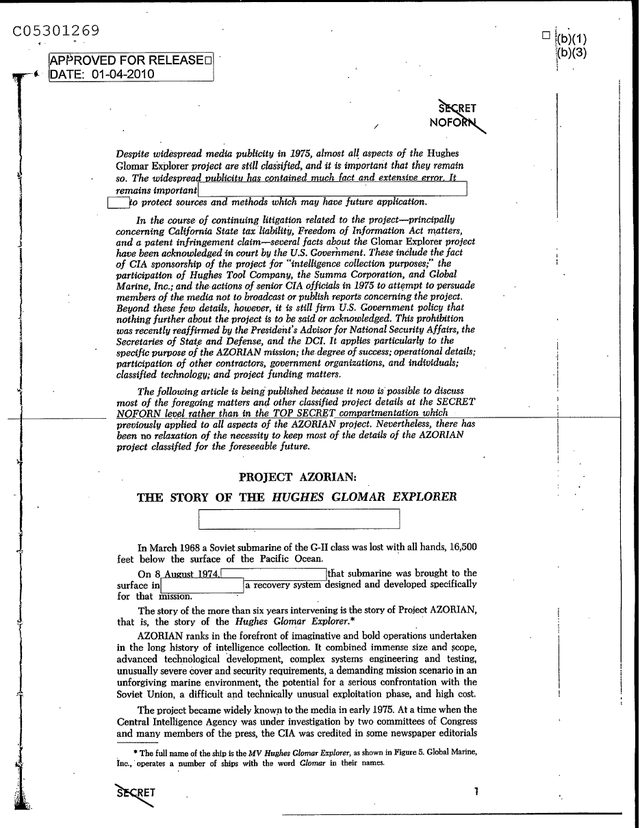
For 35 years the US government would say nothing about the Hughes Glomar Explorer, and its refusal to confirm or deny gave American law the "Glomar response." This article is the CIA's own account of the operation behind that refusal. It appeared in the agency's classified journal Studies in Intelligence in the fall of 1985. The author took part in the project and is still unnamed. The CIA approved it for release in January 2010 after a FOIA request from the National Security Archive, which published it on 12 February 20101,2. The full story of the operation is at Project Azorian (the Glomar Explorer).
Why it was written
An editor's note at the head explains the timing. Almost everything about the project was still classified despite the press coverage of 1975. Lawsuits over California taxes, FOIA and a patent had forced the government to acknowledge a few facts: the CIA had sponsored the ship for intelligence collection, Hughes Tool, Summa and Global Marine had taken part, and senior officials had tried to persuade the press not to publish1. With those facts conceded, the editors judged that most of the story could be told at the SECRET NOFORN level rather than inside the original TOP SECRET compartment1.
The text also has a dating puzzle. Near the end the author writes that, "as this article is published," a commercial consortium was preparing the ship for deep-ocean mining "late in the fall of 1978"1. The article therefore seems to have been drafted in about 1978, seven years before Studies printed it.
What it covers
The author follows the project from start to finish. A Soviet G-II-class ballistic-missile submarine, pendant number 722, sailed from Petropavlovsk on about 1 March 1968 and sank with all hands some 1,560 miles northwest of Hawaii1. On 1 April 1969 Deputy Secretary of Defense David Packard asked what could be done to recover it, and Director Richard Helms gave the CIA lead to Carl Duckett's Directorate of Science and Technology. A Special Projects Staff was set up on 1 July 1969 under John Parangosky, a veteran of the U-2 and A-12 programs1. The author notes that the project's security system was called JENNIFER. That compartment name, not AZORIAN, was the one the press later used1.
The middle of the article describes how engineers weighed ways of lifting such a weight from 16,500 feet and settled on a ship-based heavy-lift system. It covers the cover story of manganese-nodule mining, the 1974 mission, and day-by-day close surveillance by a Soviet vessel, the SB-10, which left after 13 days and 16 hours1. The author states that the recovery phase ended on 9 August 1974 and that the ship anchored off Lahaina, Maui, on 16 August to change crews1. One passage reports plutonium contamination in the recovered section, apparently from nuclear torpedoes whose explosive had detonated without a nuclear yield1.
The article closes with a defense of the project's cost and risk. It argues that the decision to proceed was "courageous" and that the ship advanced deep-ocean mining and heavy-lift technology1.
What is blacked out
The redactions are as informative as the text. Entire pages are blank, including most of the description of what was recovered, what it yielded, and the costs1. The opening sentence about 8 August 1974 is cut in the middle, so the reader learns that "that submarine was brought to the surface" but not how much of it1. William Colby appears near the end, as the director who told the mission director to trust his own judgment at sea1.
How it has been used
Since 2010 the article has been the backbone of every serious account of Azorian. It gives the official dates, the organization, and a frank admission that senior officials disagreed about whether a six-year-old submarine was worth the money1. Historians pair it with the 40 Committee and White House papers that the State Department later printed in Foreign Relations of the United States, which fill in the debate the article only alludes to (see Project Azorian (the Glomar Explorer)). The article remains a participant's history written for insiders, and it is generous to the project.
Sources
- CIA Project AZORIAN: The Story of the Hughes Glomar Explorer (Studies in Intelligence, Fall 1985), CIA document C05301269, Central Intelligence Agency, via the National Security Archive (1985).
- National Security Archive Project Azorian: The CIA's Declassified History of the Glomar Explorer (Electronic Briefing Book No. 305), National Security Archive (2010-02-12).
- Other Project Azorian Released Files 01-04-2010.pdf, Wikimedia Commons (public-domain copy of the CIA release).
- Wikipedia Project Azorian, Wikipedia.