
 Page 1 of 148

From the document
I have ordered all the senior operating officials of this Agency to report to me immediately on any activities now going on, or that have gone on in the past, which might be construed to be outside the legislative charter of this Agency.
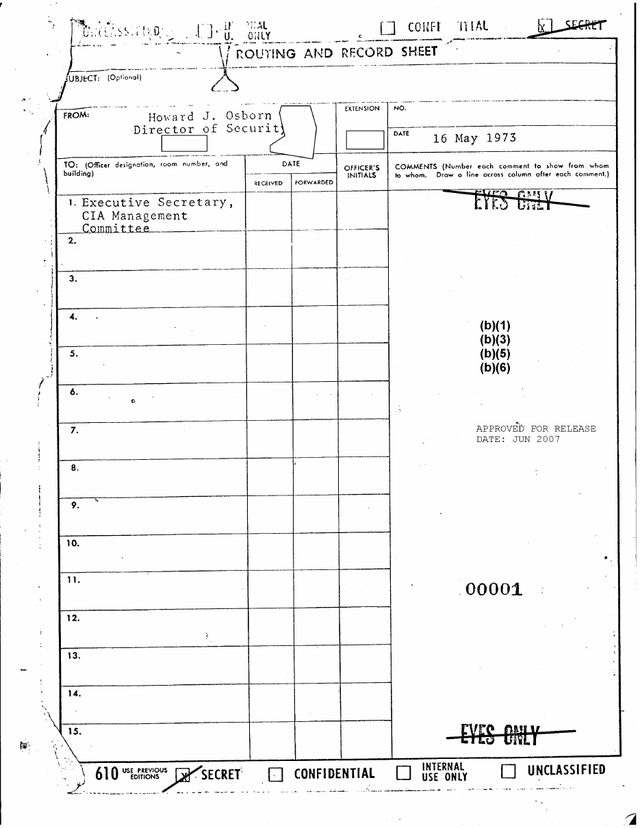
The purpose of this memorandum is to forward for your personal review summaries of activities conducted either by or under the sponsorship of the Office of Security in the past which in my opinion conflict with the provisions of the National Security Act of 1947.
I believe that the activities occurring since that time still have a viable "flap potential" in that many of the people involved, both Agency and non-Agency are still alive
Johnny Roselli -- The use of a member of the Mafia in an attempt to assassinate Fidel Castro.
Excerpts are passages from a US government work (public domain), quoted exactly as they read in the scan, and checked against the full text on every rebuild.
The trigger was Watergate. In the spring of 1973 the press reported that the CIA had helped E. Howard Hunt, a former officer by then working for the Nixon White House. James R. Schlesinger, Director of Central Intelligence for only a few months, conceded that the agency had given "limited assistance" at the request of senior officials2. On 9 May 1973 he sent a memorandum to every CIA employee. He promised to keep the agency within "a strict interpretation of its legislative charter" and ordered staff, past and present, to tell him about anything that might fall outside it2. Anyone with information was to ask his secretary, on extension 6363, to speak about "activities outside CIA's charter"2.
The replies came in over the following weeks, as memoranda from directorates, offices and individuals. Bound together, they became the file known inside the agency as the "Family Jewels." It passed to William Colby when he succeeded Schlesinger later in 19733,6.
What is in the file
The released compilation runs to about 700 pages, mostly typed memoranda with handwritten routing slips and many blacked-out passages2,3. It has no single argument and no conclusions.
A typical submission is the Office of Security's of 16 May 1973. Its director said he was reporting activities that in his opinion conflicted with the National Security Act of 1947, going back to March 1959, because many of the people involved were still alive and the matters kept their "flap potential"2. His list opens with a redacted first item, then names Johnny Roselli and the use of the Mafia against Castro (see The plots against Fidel Castro). It goes on to Project MOCKINGBIRD, telephone taps on two Washington newsmen from 12 March to 15 June 1963 (see Project Mockingbird (1963)), and the confinement of the KGB defector Yuri Nosenko in a specially built cell from August 1965 to October 19672. Other items cover surveillance of reporters and equipment lent to local police2.
The rest of the file covers similar ground. It includes the opening of mail between the United States and the Soviet Union, the MHCHAOS program that watched American dissidents for signs of foreign support (see Operation CHAOS), papers on Sidney Gottlieb's drug experiments (see Project MKUltra), a plan to poison the Congolese leader Patrice Lumumba (see The CIA and the Congo crisis, 1960–61), warrantless wiretapping, and material involving James Angleton's counterintelligence staff3. A January 1975 summary prepared for the White House listed 18 matters that raised legal questions6.
From leak to investigation
The file stayed secret, but its contents did not. On 22 December 1974 Seymour Hersh reported in the New York Times that the CIA had run a large domestic operation against the antiwar movement during the Nixon years3. The story led President Ford to appoint a commission under Vice President Nelson Rockefeller. In January 1975 the Senate set up the select committee chaired by Frank Church, and the House set up its own inquiry4,6.
The Senate Historical Office describes the Family Jewels as the best-known of the internal reports the investigators obtained, and says they used it as a road map4. The committee's interim report on assassination plots, published in November 1975, is described at Alleged Assassination Plots Involving Foreign Leaders (1975).
Release in 2007
For more than three decades the CIA refused FOIA requests for the file. On 21 June 2007 Director Michael Hayden announced that it would be declassified. On 26 June CIA officers delivered the release to the National Security Archive, which had asked for it 15 years earlier3. Hayden spoke of a 693-page file. The archive counted 702 pages in what it received3. Whole pages and many names are still withheld, and the first item on the Office of Security list is entirely blacked out2.
How to read it
The file is a set of answers to a question, not a history. Its contents depend on what officers chose to report in a few weeks of May 1973, and on what the 2007 reviewers chose to release. It says little about who authorized what. The Office of Security assured the reader that each activity it listed had been approved by "higher authority," meaning the Director, Deputy Director or senior support officials2. Historians use it mainly as the agency's own catalogue of what it feared the public would find out, read alongside the congressional reports that turned the leads into evidence.
Sources
- CIA "Family Jewels" (MORI DocID 1451843), full release, Central Intelligence Agency, FOIA Electronic Reading Room (2007-06-26).
- CIA CIA's "Family Jewels": full report as released 26 June 2007 (PDF of the CIA release), National Security Archive (hosting the CIA document) (1973).
- National Security Archive The CIA's Family Jewels (Electronic Briefing Book No. 222), National Security Archive (2007-06-26).
- Congress Select Committee to Study Governmental Operations with Respect to Intelligence Activities (Church Committee), United States Senate.
- Other Family jewels of the Central Intelligence Agency.pdf, Wikimedia Commons (public-domain copy of the CIA release).
- Wikipedia Family Jewels (Central Intelligence Agency), Wikipedia.
- Wikipedia English Wikipedia article (used for cross-checking).
Elsewhere in the files
- Document "Project AZORIAN: The Story of the Hughes Glomar Explorer"
- Document Alleged Assassination Plots Involving Foreign Leaders (1975)
- Document Ford's meeting on the submarine leak (27 May 1975)
- Document The CIA Inspector General's inspection of MKULTRA (1963)
- Document The National Security Act of 1947
- Document The Rockefeller Commission on Operation CHAOS (1975)
- Document The congressional Iran-Contra report (1987)
- Operation Operation CHAOS
- Operation Operation Holystone
- Operation Project Azorian (the Glomar Explorer)
- Operation Project MKUltra
- Operation Project Mockingbird (1963)
- Person James Jesus Angleton
- Person William Colby