
 Page 1 of 5
From the document
Where does he get it? It jeopardizes the operation and the lives of the people involved. Somehow someone must be made an example of.
The real problem is not the press. The real problem is the people who are leaking the material to the press. They are the ones we have to go after.
Director Colby: We need better legislation. Our protection of secrets is lousy.
Also, Justice should look into the alternatives of getting at Hersh and the New York Times.
Excerpts are passages from a US government work (public domain), quoted exactly as they read in the scan, and checked against the full text on every rebuild.
On Sunday 25 May 1975 the New York Times ran Seymour Hersh's report that US Navy submarines had for years been gathering intelligence inside Soviet coastal waters, under a program he called Holystone4. At five o'clock on the Tuesday afternoon, President Gerald Ford met in the Cabinet Room with Defense Secretary James Schlesinger, CIA Director William Colby, Donald Rumsfeld, Deputy Secretary of State Robert Ingersoll and Brent Scowcroft. This memorandum of conversation is the record of that 55-minute meeting1. It is the clearest document on Operation Holystone in the open record, and it is about the leak, not the submarines.
What was said
Ford opened by saying he had learned more about the operation from the newspaper than he knew himself, and that "someone must be made an example of." He wanted State, CIA and Defense to investigate1. Schlesinger called the story a flagrant violation of the law, said there was some indication that Hersh held files of signals intelligence material, and floated a search warrant to get them, while doubting a jury would convict1.
Colby linked the story to earlier disclosures: a less detailed Times article in June 1974, and material from Victor Marchetti's book on the CIA, which the agency had fought in court. He noted that the Espionage Act section on communications intelligence, 18 U.S.C. 798, made publication a crime but had produced only one conviction, by guilty plea, and that the government was seeking to indict Philip Agee under it1. Scowcroft put the opposite case: the people to pursue were the leakers, not the press1.
The record then says that the code word "has been obsolete since 1972." Ford ordered an FBI investigation on Schlesinger's advice. Colby complained that protection of secrets was "lousy" and asked for new laws. Ford closed by asking Justice to look at "getting at Hersh and the New York Times"1.
The redactions
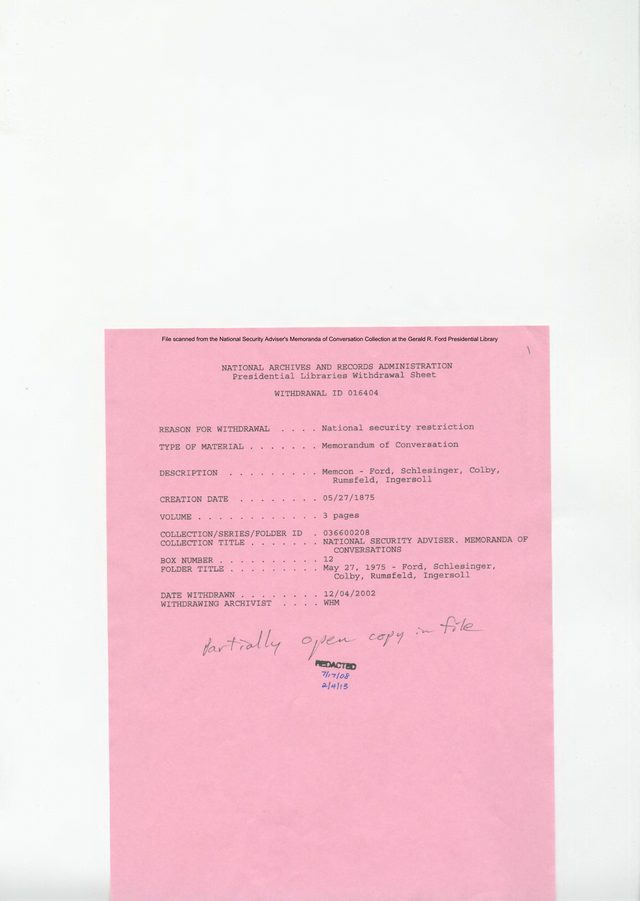
The released copy is a three-page memorandum between two National Archives withdrawal sheets. The first records that the memo was withdrawn in 2002 and later opened in part; the second marks five pages of handwritten notes of the meeting that are still withheld1. Inside the memo, the code word in the classification line is blacked out on every page, along with a full statement by Schlesinger on page 2, most of Colby's answer to Ford's question about how many people knew of "one or both of these operations," and the name of a "mission" Schlesinger proposed to "turn off" before seeking a warrant. The redactions cite section 3.3(b)(1) of Executive Order 13526, which covers intelligence sources and methods1. The phrase "one or both" shows that a second operation was being discussed; the record does not say which.
What happened next
The Cheney files at the Ford Library show the push to prosecute running out. On 30 May the NSC staff reported that the Navy wanted the operation to continue, with its next arrival in the operating area set for 7 July, and judged a visible investigation "a bad idea"2. A memo of 31 May in the same file reported that Attorney General Edward Levi had asked the Criminal Division and the FBI to draw up a plan but would not open an FBI case unless there was an intention to prosecute. It added that the Director of Naval Intelligence thought Hersh's sources were probably former employees and the Marchetti court file, citing his use of "the outdated codename Holystone"2. The file records no final decision, and no case against Hersh or the Times was brought2,4.
Reading it
This is the NSC staff's summary, not a transcript. It confirms that submarine operations off the Soviet coast existed and mattered to the President. It says nothing about what they collected. The Federation of American Scientists lists Holystone among the code names of the Navy's Special Naval Collection Program, whose mission records remain closed3.
Sources
- National Archives Memorandum of Conversation: Ford, Schlesinger, Colby, Rumsfeld, Ingersoll, Scowcroft, 27 May 1975, Gerald R. Ford Presidential Library, National Security Adviser, Memoranda of Conversations (1975-05-27).
- National Archives Richard B. Cheney Files, Box 6, folder 'Intelligence – New York Times Articles by Seymour Hersh (2)', Gerald R. Ford Presidential Library (1975-05).
- Other HOLYSTONE, Federation of American Scientists, Intelligence Resource Program.
- Wikipedia Seymour Hersh, Wikipedia.