
 Page 1 of 46
From the document
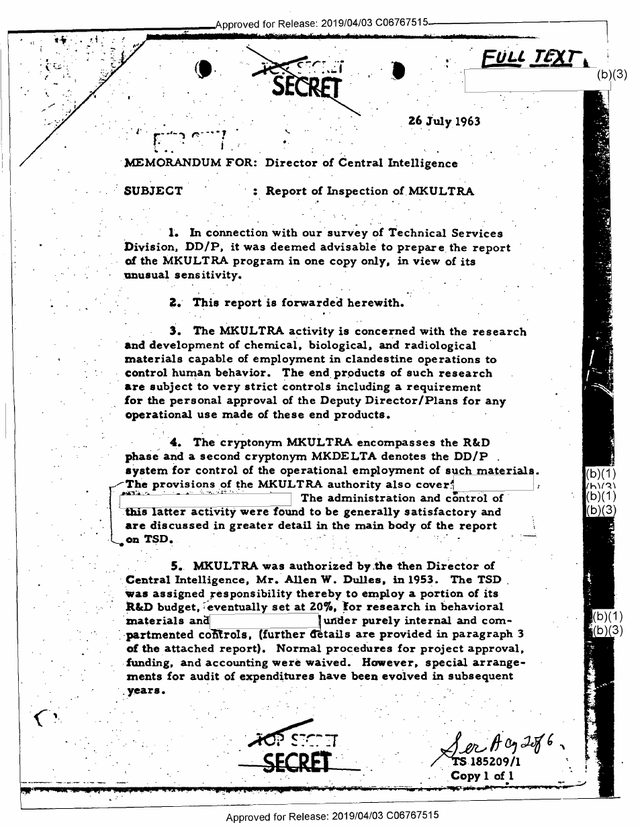
it was deemed advisable to prepare the report of the MKULTRA program in one copy only, in view of its unusual sensitivity.
A final phase of the testing of MKULTRA products places the rights and interests of U. S. citizens in jeopardy.
The final stage of covert testing of materials on unwitting subjects is clearly the most sensitive aspect of MKULTRA. No effective cover story appears to be available.
Weighing possible benefits of such testing against the risks of compromise and of resulting damage to CIA has led the Inspector General to recommend termination of this phase of the MKULTRA program.
Excerpts are passages from a US government work (public domain), quoted exactly as they read in the scan, and checked against the full text on every rebuild.
In the spring of 1963 the CIA's Inspector General, John S. Earman, was surveying the Technical Services Division of the clandestine service. One part of what his inspectors found was too sensitive to go into the main report. On 26 July 1963 Earman sent the Director of Central Intelligence a separate report on MKULTRA, typed "in one copy only." It is stamped "Copy 1 of 1"1.
What the inspectors found
The covering memo sets out the basics. MKULTRA was the research and development program for chemical, biological and radiological materials "capable of employment in clandestine operations to control human behavior"; MKDELTA was the system governing their use in operations. Allen Dulles had authorized it in 1953, with normal procedures for approval, funding and accounting waived, and it took up 20 percent of the division's research budget; the dollar figure is redacted1.
The report itself, 26 numbered pages, opens with four reasons for the secrecy: many doctors considered the research unethical; some of it raised "questions of legality"; the final phase of testing put Americans' rights "in jeopardy"; and disclosure could provoke public outrage1. It then describes a pipeline. University, hospital and drug-company specialists were paid through front foundations, usually without their institutions knowing; doctors in mental hospitals, narcotics hospitals and prisons then tested the products on human subjects1.
The last stage, from 1955, was testing on people who did not know they were being drugged. Under an informal arrangement with officers of the Bureau of Narcotics, first on the West Coast and from 1961 on the East Coast, each project received $10,000 a year to cultivate subjects and keep a safehouse where effects could be watched. Some subjects became ill for hours or days; at least one was hospitalized. The narcotics agents were not trained observers and seldom saw the subjects after the first hours1.
A normal inspection was impossible: only two people in the division had full knowledge of the program, and most of it was unrecorded. Of 144 projects started in ten years, 25 were still active1. Drawing on a 1960 study by Sidney Gottlieb, by 1963 the division's deputy chief, the report noted about 100 operations using harassment materials and only nine using disabling drugs; "no effective knockout pill, truth serum, aphrodisiac, or recruitment pill" was known to exist1.
Its recommendations: a new written charter approved by the Director, proper records and audit, testing only in accredited research institutions, and an end to testing on unwitting subjects1. The attachments include the founding papers: Richard Helms's memo of 3 April 1953 asking for the "Two Extremely Sensitive Research Programs," Dulles's approval of 13 April, and the 1960 instruction on MKDELTA materials signed by Richard Bissell1.
What happened next
Testing on unwitting subjects was suspended. Helms, by then Deputy Director for Plans, argued for resuming it in December 1963, June 1964 and November 1964, warning that without it the agency would live "with the illusion of a capability." No formal decision followed2.
How to read it
Because most MKULTRA files were destroyed in 1973, this report was the main source for the investigations of 1975–1977, and both the Church Committee and the 1977 hearing quote it by page2,3. It is an auditor's document, concerned with risk, waived controls and missing records more than with the people tested. The 2019 release still withholds budget figures and some passages under national-security exemptions1. The last two pages of the hosted file are not part of the CIA release: a separator sheet and an older copy of report page 9 with handwritten marginal notes, both added by the National Security Archive.
Sources
- CIA Report of Inspection of MKULTRA, 26 July 1963 (C06767515), CIA FOIA reading room entry (Internet Archive capture of 29 April 2025), Central Intelligence Agency (1963-07-26).
- Congress Final Report of the Select Committee to Study Governmental Operations with Respect to Intelligence Activities, Book I (S. Rep. 94-755), pp. 385–422, 'Testing and Use of Chemical and Biological Agents by the Intelligence Community', US Senate, digitized by the Internet Archive (1976-04).
- Congress Project MKULTRA, the CIA's Program of Research in Behavioral Modification: Joint Hearing before the Select Committee on Intelligence and the Subcommittee on Health and Scientific Research, US Senate, 3 August 1977, US Senate, digitized by the Internet Archive (1977-08-03).