
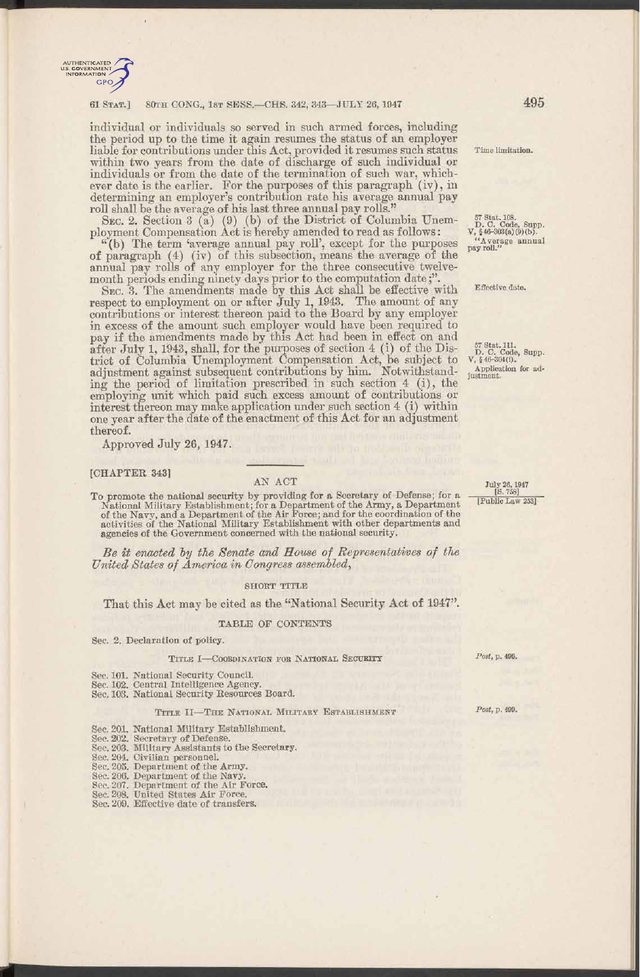
 Page 1 of 16
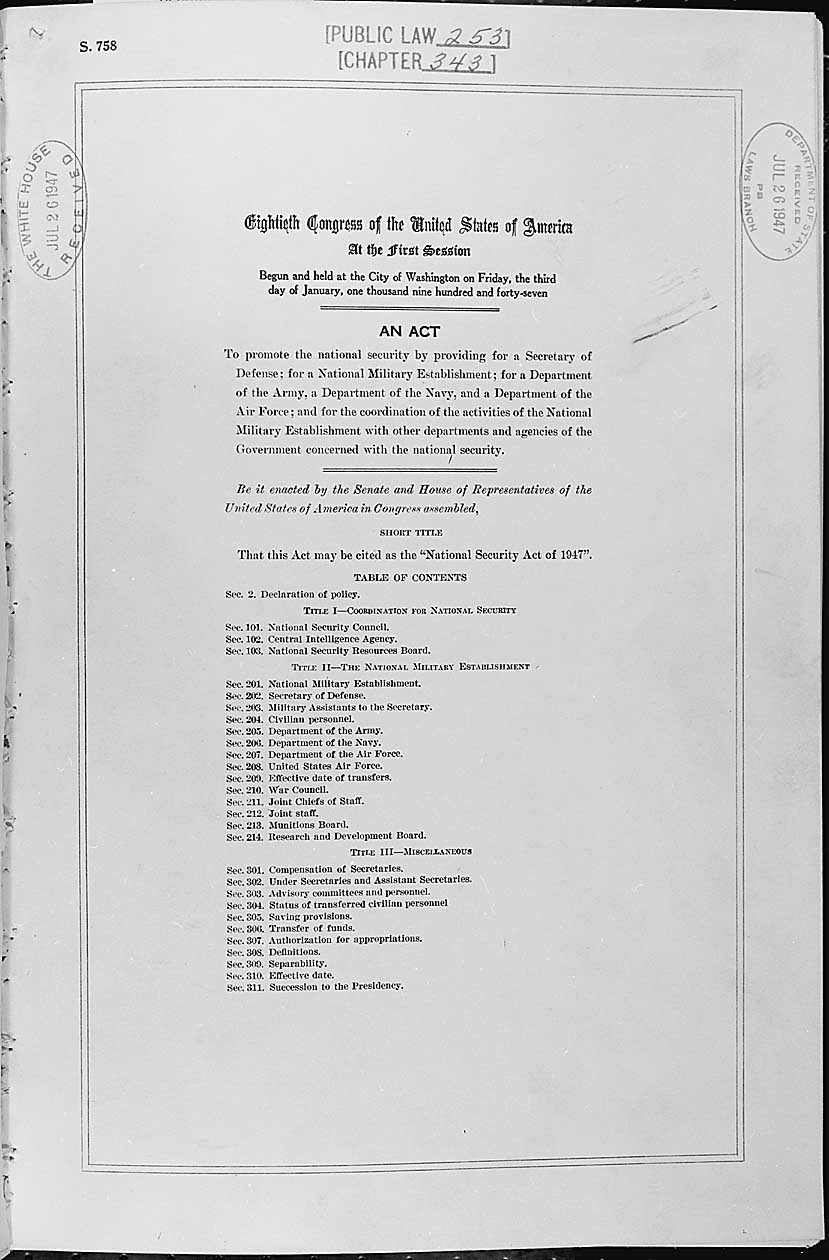

From the document
The function of the Council shall be to advise the President with respect to the integration of domestic, foreign, and military policies relating to the national security so as to enable the military services and the other departments and agencies of the Government to cooperate more effectively in matters involving the national security.
There is hereby established under the National Security Council a Central Intelligence Agency with a Director of Central Intelligence, who shall be the head thereof.
Provided, That the Agency shall have no police, subpena, law-enforcement powers, or internal-security functions
to perform such other functions and duties related to intelligence affecting the national security as the National Security Council may from time to time direct.
Excerpts are passages from a US government work (public domain), quoted exactly as they read in the scan, and checked against the full text on every rebuild.
Most of the National Security Act of 1947 is about the armed forces. It came out of years of argument between the Army and the Navy, and most of its text in the Statutes at Large deals with secretaries, departments, boards and pay1,5. The parts that matter most to the history of intelligence take up barely two pages. They created the National Security Council and placed under it a new Central Intelligence Agency1.
President Harry S. Truman signed the bill, S. 758, on 26 July 1947. It became Public Law 253 of the 80th Congress1,5.
Where it came from
Truman had abolished the wartime Office of Strategic Services in 1945. Its remnants went first into a War Department unit and then, in January 1946, into a new Central Intelligence Group. The Group's authority came from the executive branch, not from Congress, and it was constrained by the State Department and the armed services3. Meanwhile Truman had been pressing for a unified military establishment since the war, against strong Navy resistance5. The Act settled both questions together: a single defense structure under a civilian secretary, and a permanent, legally based central intelligence agency1,3.
What it says
Section 2 states the purpose: a comprehensive program for national security, with the services coordinated under civilian control "but not to merge them"1.
Title I is "Coordination for National Security." Section 101 creates the National Security Council, chaired by the President, with the Secretaries of State, Defense, Army, Navy and Air Force and the chairman of a new National Security Resources Board as members. Its job is to advise the President on integrating domestic, foreign and military policy1. Section 102 creates the CIA under the Council, headed by a Director of Central Intelligence who could be a military officer or a civilian, at $14,000 a year1. The Director could dismiss any employee "in the interests of the United States"1. The agency's duties were to advise the Council on intelligence activities, recommend how to coordinate them, correlate, evaluate and disseminate national intelligence, perform services of common concern, and carry out "such other functions and duties" as the Council might direct1. Three provisos follow. The agency would have no police or internal-security powers. The departments would keep their own intelligence services. The Director would protect "intelligence sources and methods"1. When the first Director took office, the Central Intelligence Group and its supervising National Intelligence Authority would cease to exist1.
Title II creates the National Military Establishment under a Secretary of Defense, sets up a Department of the Air Force and a separate Air Force, and puts the Joint Chiefs of Staff on a statutory footing with a Joint Staff of no more than 100 officers1. Title III covers pay, transfers, definitions and the effective date1.
What happened next
Most of the Act took effect the day after the first Secretary of Defense, James Forrestal, took office. That was 18 September 1947, the date the CIA counts as its founding1,3,5. Rear Admiral Roscoe Hillenkoetter became its first director3. Congress revisited the law in 1949. One amendment turned the National Military Establishment into the Department of Defense, and the Central Intelligence Agency Act of the same year gave the agency its own budgetary and personnel powers3,5.
How it has been used
The Act became the CIA's charter in every later argument about the agency. In 1973 the CIA's own Director of Security measured the activities in the The "Family Jewels" (1973) against "the provisions of the National Security Act of 1947." Two years later the Senate's assassination report began its analysis of covert action with the same statute4. It has been amended many times since, but the 1947 text explains the institutions the Cold War was fought with.
Sources
- Other National Security Act of 1947, Public Law 80-253, 61 Stat. 495 (United States Statutes at Large, vol. 61, part 1), US Government Publishing Office, govinfo (1947-07-26).
- Other 61 Stat. 495, details page, US Government Publishing Office, govinfo.
- CIA CIA History, Central Intelligence Agency.
- Congress Alleged Assassination Plots Involving Foreign Leaders, Section II: Covert Action as a Vehicle for Foreign Policy Implementation, US Senate Select Committee on Intelligence Activities, via Internet Archive (1975-11-20).
- Wikipedia National Security Act of 1947, Wikipedia.
- Wikipedia English Wikipedia article (used for cross-checking).