
 Page 1 of 21
From the document
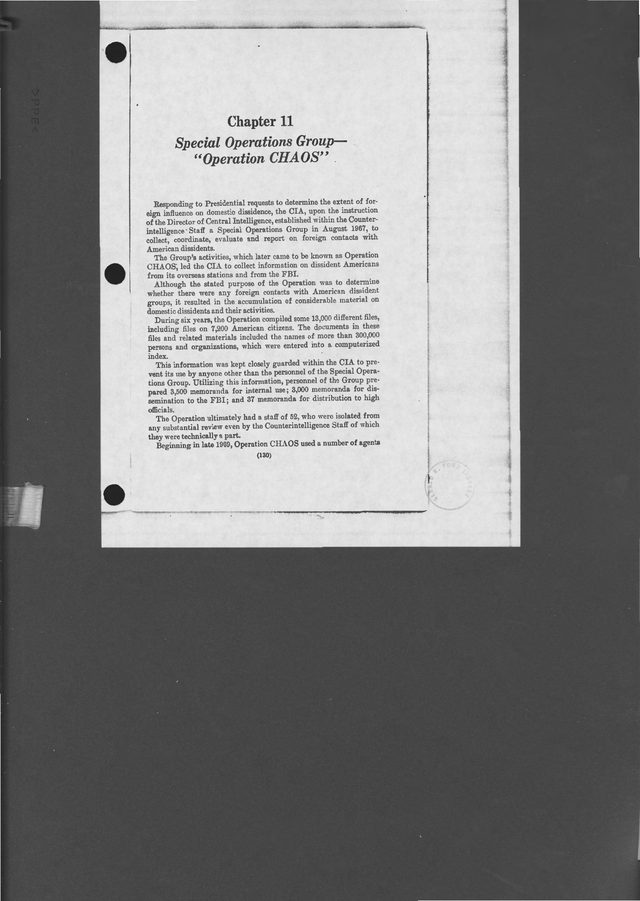
During six years, the Operation compiled some 13,000 different files, including files on 7,200 American citizens. The documents in these files and related materials included the names of more than 300,000 persons and organizations, which were entered into a computerized index.
An extreme example of the extent to which collection could go once a file was opened is contained in the Grove Press, Inc., file. The file apparently was opened because the company had published a book by Kim Philby, the British intelligence officer who turned out to be a Soviet agent.
Some domestic activities of Operation CHAOS unlawfully exceeded the CIA's statutory authority, even though the declared mission of gathering intelligence abroad as to foreign influence on domestic dissident activities was proper.
a. Presidents should refrain from directing the CIA to perform what are essentially internal security tasks.
Excerpts are passages from a US government work (public domain), quoted exactly as they read in the scan, and checked against the full text on every rebuild.
Gerald Ford created the Commission on CIA Activities within the United States on 4 January 1975, two weeks after Seymour Hersh reported in the New York Times that the CIA had spied on the antiwar movement. Vice President Nelson Rockefeller chaired it; its members included Ronald Reagan and General Lyman Lemnitzer4. The report went to Ford on 6 June 19753. Chapter 11, the twenty-one pages served here, was the first official account of Operation CHAOS, the program at the center of Hersh's story1,4.
What the chapter says
The commission explains CHAOS as the product of White House pressure. On 15 August 1967, after Lyndon Johnson set up the Kerner Commission on the riots, Deputy Director for Plans Thomas Karamessines told the Counterintelligence Staff to establish "overseas coverage of subversive student activities." Richard Helms testified that he acted under "continuing, substantial pressure" from the President, and the report quotes an FBI memorandum to the same effect1. One CIA study after another, from "International Connections of the United States Peace Movement" (November 1967) to "Restless Youth" (1968) and a June 1969 report for Nixon aide Tom Charles Huston, found no significant foreign direction of the dissidents. Each answer brought demands for more coverage1.
The chapter then counts what the Special Operations Group built: a staff that reached 52, working in a vaulted basement; about 13,000 files, 7,200 of them on American citizens; a computer index of some 300,000 names, nicknamed "Hydra" because each level of sensitivity needed its own password; 3,000 memoranda to the FBI and 37 to senior officials. It drew on the CIA's New York mail intercept and on about 1,100 pages of international communications from "another agency," which the Church Committee later identified as the NSA1,2. From October 1969 CHAOS ran fewer than 30 agents of its own. Three of them, the report found, were used to report on purely domestic matters, including the May Day protests in Washington in 1971; Helms testified he did not know1.
Section I describes how isolated the group was: the Inspector General's staff was kept out of its files in November 1972, OMB inspectors were not told of it, and the General Counsel was never consulted. Some 600 officers were nonetheless briefed on it, and a group of mid-level officers questioned its propriety in 19711. Colby restricted it in August 1973, and the report dates its termination to 15 March 19741.
Findings and what followed
The conclusions are mixed. The mission of looking abroad for foreign influence was "proper," the commission said, but the accumulation of domestic data, the domestic use of three agents and the domestic sections of a major study were improper or beyond the CIA's authority. Its fifth recommendation asked Presidents not to give the CIA internal security tasks and asked the Agency to destroy CHAOS files with no foreign intelligence value once Congress finished its inquiries1.
How to read it
The chapter rests on CIA records and testimony and names few officers below the top: the chief of the group, whom the Church Committee identified as Richard Ober, appears only by title1,2. Its picture was soon overtaken by the Senate's Church Committee, whose 1976 Book III gave a fuller history, showed that CHAOS also placed names on the NSA watch list behind Minaret, and dated Colby's termination cable to 5 March 1974, ten days earlier than this chapter2. The report as a whole was edited inside the Ford White House by Richard Cheney's staff before publication, and the National Security Archive has documented how softened its language became3. Read this chapter as a careful but cautious first draft; the CIA's own "Family Jewels" compilation was not released until 2007.
Sources
- Official history Report to the President by the Commission on CIA Activities within the United States, Chapters 8–11 (Cheney Files, Box 8, folder 'Intelligence – Rockefeller Commission Report – Final (2)'), Gerald R. Ford Presidential Library (1975-06).
- Congress Final Report of the Select Committee to Study Governmental Operations with Respect to Intelligence Activities, Book III (S. Rep. 94-755), 'CIA Intelligence Collection About Americans: CHAOS and the Office of Security', US Senate, digitized by the Internet Archive (1976-04).
- National Security Archive Gerald Ford White House Altered Rockefeller Commission Report (Electronic Briefing Book, ed. John Prados and Arturo Jimenez-Bacardi), National Security Archive (2016-02-29).
- Wikipedia United States President's Commission on CIA Activities within the United States, Wikipedia.