
 Page 1 of 49
From the document
The Committees' investigation revealed that of the $16.1 million profit from the sales of arms to Iran only about $3.8 million went to support the Contras (the amount representing "the diversion").
The common ingredients of the Iran and Contra policies were secrecy, deception, and disdain for the law. A small group of senior officials believed that they alone knew what was right.
These were not covert actions, they were covert policies; and covert policies are incompatible with democracy.
Money generated by arms sales authorized by a Presidential Finding for only one covert purpose—the Iranian initiative—was used for a wholly different covert purpose—Contra support.
Excerpts are passages from a US government work (public domain), quoted exactly as they read in the scan, and checked against the full text on every rebuild.
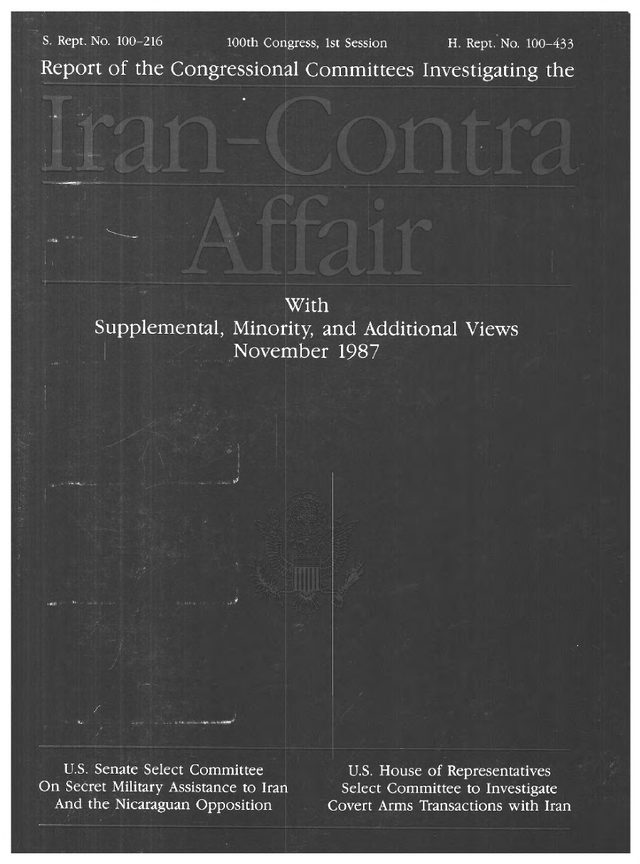
Ten months after the scandal broke, the two select committees that Congress set up in January 1987 delivered a single report. The Senate committee under Daniel Inouye and the House committee under Lee Hamilton had merged their inquiries, reviewed more than 300,000 documents, questioned more than 500 witnesses and held 40 days of joint public hearings. The House committee ordered the report on 5 November 1987, and both chambers ordered it printed that month1.
The copy served here is an extract of the 708-page printed report: the front matter, the preface, the Executive Summary, and Chapter 15, on the diversion of arms-sale profits to the Nicaraguan Contras1.
What the summary says
The preface sets out the problem the committees faced: inconsistent testimony, failing memories, the death of Director of Central Intelligence William Casey in May 1987, and the shredding of documents by the National Security Council staff in the fall of 1986. The record, the committees wrote, was denied to them "and to history"1.
The Executive Summary then tells the story compactly. After Congress cut off military aid to the Contras with the Boland Amendment, the NSC staff, led operationally by Lt. Col. Oliver North, took over support of the war, raised money from foreign governments and private donors, and ran it through a private network the report calls "the Enterprise." From the summer of 1985 the same staff ran the secret arms sales to Iran that the Secretaries of State and Defense opposed as an arms-for-hostages trade. The Enterprise took in nearly $48 million; of $16.1 million in profit from the Iran sales, about $3.8 million reached the Contras1.
The findings are blunt. The committees judged that Casey had encouraged North and kept the CIA's career officers largely in the dark, while noting that the evidence of Casey's role came almost entirely from North. They found no evidence that Vice President Bush knew of the diversion. On President Reagan they concluded that, whether or not he knew, "the ultimate responsibility" rested with him1.
The diversion chapter
Chapter 15 asks who thought of the diversion, who approved it, and how much moved. It traces the idea to late 1985, when $800,000 left over from a halted shipment of HAWK missiles was spent on the Contras, and sets out the conflicting testimony: National Security Adviser John Poindexter said he approved the diversion himself and kept it from the President to give him "deniability"; North said he assumed the President knew. Only one of North's diversion memorandums survived the shredder1.
How to read it
This is the majority's report. The contents list a separate minority report signed by six House members, including Dick Cheney, and two senators, arguing from the President's constitutional powers in foreign affairs; it is not in this extract1. The committees also stated that they made no findings of criminal guilt, which they left to the independent counsel1.
The prosecutions that followed changed the story's legal ending. Independent Counsel Lawrence Walsh charged 14 people and won 11 convictions, but North's and Poindexter's convictions were overturned on appeal because their immunized testimony to these same committees might have influenced witnesses at trial, and President George H. W. Bush pardoned six others on 24 December 19922,3. The scan used here is a copy of the printed report uploaded to the Internet Archive1,4.
Sources
- Congress Report of the Congressional Committees Investigating the Iran-Contra Affair, with Supplemental, Minority, and Additional Views (S. Rept. 100-216, H. Rept. 100-433), US Congress, Government Printing Office (scan hosted by the Internet Archive) (1987-11).
- Official history Final Report of the Independent Counsel for Iran/Contra Matters, Volume I: Summary of Prosecutions (Lawrence E. Walsh), Office of Independent Counsel, 1993 (HTML edition, Federation of American Scientists) (1993-08-04).
- Official history Final Report of the Independent Counsel for Iran/Contra Matters, Volume I (scan), Office of Independent Counsel (hosted by the Internet Archive) (1993).
- Wikipedia Iran–Contra affair, Wikipedia.