
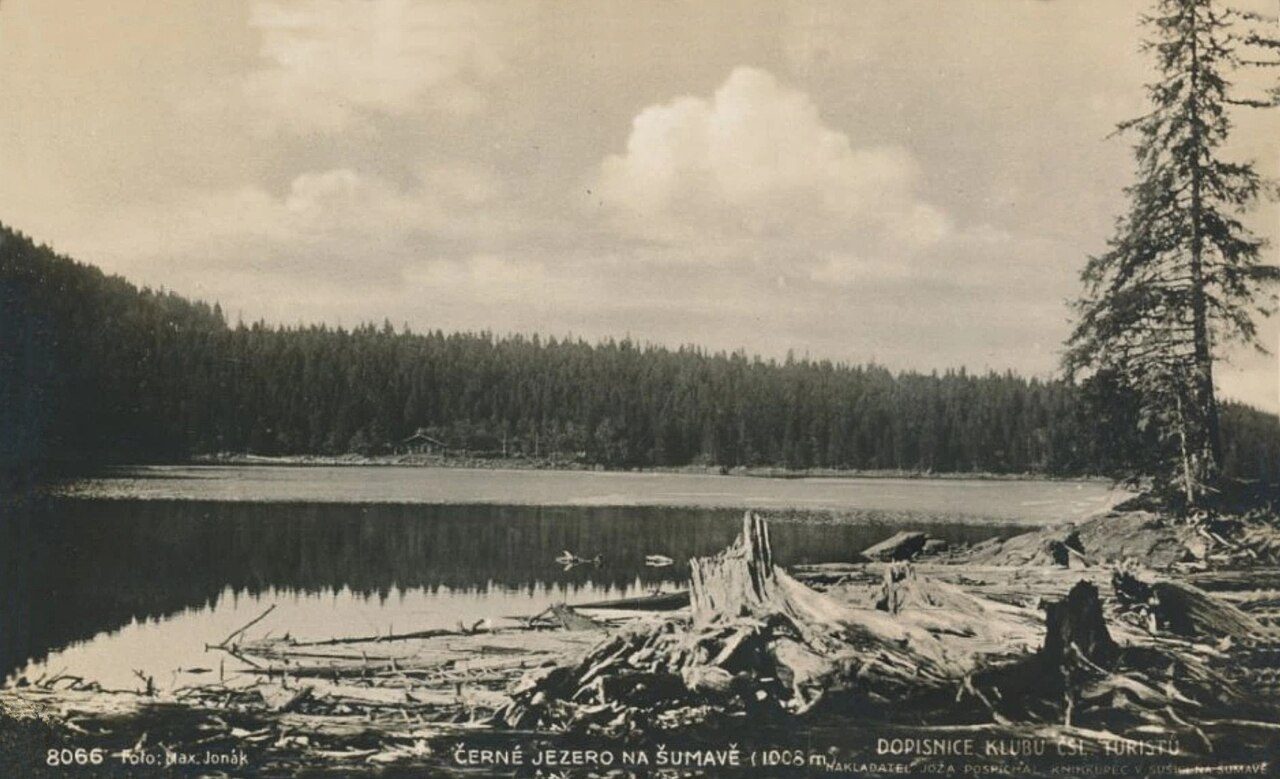

In the summer of 1964 Czechoslovak television was filming a documentary about the legends of two glacial lakes in the Šumava, the Bohemian Forest, on the border with West Germany. Divers working for the program found explosives in Čertovo jezero, Devil's Lake, and four asphalt-coated chests in Černé jezero, Black Lake. The Interior Ministry sealed off the area, its own divers raised the chests, and on 16 July the state news agency announced that they contained "Nazi papers from the time of the Second World War."1 The chests had been put there a few weeks earlier by Czechoslovak intelligence, the StB, with Soviet advisers in the loop.2,3
The plan
The operation was conceived inside the StB's new disinformation department, Department D, by Ladislav Bittman, who became its deputy chief in early 1964.2,4 A CIA history of Soviet-bloc disinformation identifies him as deputy chief of that department from 1964 to 1966.4 The idea drew on publicity about Nazi chests recovered from Austria's Lake Toplitz, and the StB proposal for what it called NEPTUNE is dated 5 May 1964.2
Bittman later set out the goals: to campaign against the lapse in May 1965 of West Germany's statute of limitations on war crimes; to revive anti-German feeling in Western Europe; and, by announcing that the files named Czech wartime collaborators, to make West German intelligence break contact with any such people it was still using as agents. The plan was cleared by the Interior Minister, Lubomír Štrougal, after he consulted the party leader, Antonín Novotný.1
A lake full of blank paper
Searching Czechoslovak archives for suitable documents proved slow; most usable material was already known to historians. With the television crew's schedule approaching, the StB decided to sink the chests filled with blank paper to give them weight. Bittman describes going into the lake himself on a night operation, with the intelligence chief and a Soviet adviser present.1 He dates the deposit to the last days of May 1964; an StB report of 22 June describes the night deposit, so his recollection and the file differ by several weeks.1,2 A team from the Interior Ministry's Ninth Directorate had prepared the chests: sealed metal boxes inside old German military cases, dipped in asphalt.1
The film crew had been steered away from the lakes in May by a cover story about border-guard exercises. Filming ran from 25 June to 10 July, and the "discovery" followed.1 Rumors that men from the ministry had dropped boxes into the lake spread among television staff even before the find; the StB traced the leak to a ministry officer who had helped prepare the chests and confided in a colleague, and chose not to act.1
The press conference
The real contents arrived late. Moscow had offered original German documents, and a Soviet courier delivered several sacks of them less than a week before the press conference.1,2 On 15 September 1964 Štrougal presented the "Black Lake" files. According to Bittman they included records of an SS commission on the failed Nazi putsch in Austria in 1934 and papers on German intelligence operations in Italy, wartime allies spying on each other in breach of their agreement.1 The StB files reviewed by the historian Calder Walton show forged documents mixed in, including names of Czechs alleged to have collaborated.2
Results
The Austrian material was published as a book in Austria in 1965 and drew wide attention; an attempt to use it against the Austrian People's Party before the 1966 election did not work.1 West Germany, under pressure from many directions, extended the period for prosecuting Nazi crimes in 1965, to the end of 1969. Bittman counted Neptune as "one of the factors," alongside Western public opinion, protests from Israel and the Soviet Union and statements at the United Nations.1 Walton notes that the StB measured success largely by press coverage.2
Bittman defected to the United States after the Warsaw Pact invasion of August 1968 and published the story in 1972. In 2007 the Czech civilian intelligence service posted the StB's Neptune files online.3,5 Two decades on, the same methods, a planted story replayed through apparently independent outlets, were used on a far larger scale in Operation INFEKTION.
Checking the record
Dates and outcome compared in two independent sources: they agree.
- Other
- StB proposal 5 May 1964; night deposit of four chests reported 22 June 1964; press conference 15 September 1964 (StB files as reported by Walton). Chests of blank paper planted and 'discovered' for TV; genuine German documents from Soviet intelligence, with forgeries mixed in, shown at the press conference; West Germany extended its statute of limitations to 1969.
- Wikipedia
- 1964. StB and KGB disinformation operation with fake Nazi-era documents found in submerged chests; temporary success.
No US-government record of Neptune was found; the 'gov' slot uses Czechoslovak StB files as cited by the historian Calder Walton. Wikipedia gives no detailed dates and calls the papers fake; this page follows the StB files and Bittman's account, which agree that the chests held blank paper and that the documents shown later came from Moscow.
Sources
- Book The Deception Game: Czechoslovak Intelligence in Soviet Political Warfare, by Ladislav Bittman, Syracuse University Research Corporation (Internet Archive lending copy) (1972).
- Other Cold War Disinformation: New Revelations about Operation NEPTUNE from Czech Archives, by Calder Walton, Wilson Center, Sources and Methods (2021-09-21).
- Other Details of Czechoslovakia's biggest disinformation operation published on web, Radio Prague (2007-06-08).
- CIA Operation INFEKTION: Soviet Bloc Intelligence and Its AIDS Disinformation Campaign, by Thomas Boghardt (Studies in Intelligence 53, no. 4), Central Intelligence Agency, Center for the Study of Intelligence (2009-12).
- Wikipedia Operation Neptune (espionage), Wikipedia.
- Wikipedia English Wikipedia article (used for cross-checking).
Elsewhere in the files
Read next
 Czechoslovakia · 1945–1990
StB (Czechoslovak State Security)
Communist Czechoslovakia's secret police from 1945 to 1990. It staged fake escape routes to the West, broke the post-1948 resistance with show trials, and in the 1970s and 1980s hounded dissidents into exile.
 Soviet Union · 1954–1991
KGB
The Soviet Committee for State Security, 1954–1991: foreign intelligence, counter-intelligence, border troops and political police under one roof, from Khrushchev's reforms to the failed coup of August 1991.
 East Germany · 1950–1990
Stasi (Ministry for State Security)
East Germany's secret police and foreign intelligence service, 1950 to 1990: by the end 91,000 staff and 189,000 informers, answerable only to the ruling party, with a spy placed beside Willy Brandt.
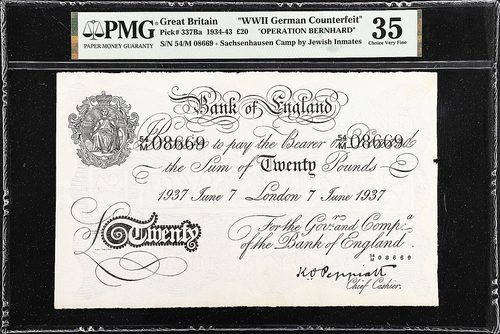 July 1942 – 6 May 1945
Operation Bernhard
The SS forgery of British banknotes, made by 142 Jewish prisoners in an isolated block at Sachsenhausen from 1942 to 1945 and used to pay spies and buy goods abroad. It was the largest counterfeiting effort of the war.