
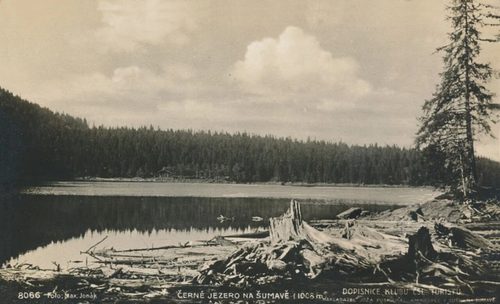
Soon after the Communist takeover of February 1948, people trying to flee Czechoslovakia were guided by a smuggler at night through the forest toward the German border. They reached what looked like a US Army post, where men in American uniforms questioned them closely about who had helped them and who else wanted out. The post was a fake on Czechoslovak soil, the "Americans" were State Security officers, and the refugees had just denounced themselves and their friends1.
Origins
Státní bezpečnost, State Security, was formed on 30 June 1945 as the plain-clothes branch of the new National Security Corps. From the start it was under the control of the Communist Party. Before 1948 it watched and harassed the party's opponents and fabricated evidence against them, helping the Communists to power7.
After February 1948 the government gave the civilian and military security services, in the words of the historian Igor Lukes in the CIA's journal, "unlimited freedom of action against any target, with no regard for the rule of law"1. Soviet advisers arrived in 1949. Older, educated officers were purged and replaced by young cadres of working-class background schooled in class struggle, and confessions were extracted by torture and threats7.
Dangles and fake borders
The early StB borrowed a method from Stalin's security services, whose best-known earlier example was the OGPU's Trust of the 1920s: build a fake resistance organization or escape line, and let real opponents come to it. Lukes describes two cases from 1948 to 19521.
SVETLANA began as a plan to study public opinion and grew into a hybrid of StB provocateurs and genuine anti-Communists. Members signed sworn declarations and received membership cards under the eyes of undercover officers. Between 1949 and 1950 the StB arrested close to 500 people connected with it. The show trials that followed produced 16 death sentences, more than ten executions, 20 life sentences and close to 300 other prison terms. Defendants believed they had "worked for the Americans"; the United States had never been involved1.
KAMEN ("stone" or "border marker") began a few weeks after the coup. It used the fake US border posts, staffed by StB officers from the departments that targeted American intelligence and the US Embassy, to identify people planning to flee and those who helped them. Victims signed statements describing their contacts, which then served as evidence against them. The deception did not always work: one lawyer who had lived in the United States noticed that his "American" interrogator spoke sailors' English and typed on a Czechoslovak typewriter. He refused to cooperate, was arrested anyway, and was sentenced to 15 years of hard labor1.
Normalization
After the Soviet-led invasion of August 1968 ended the Prague Spring, the StB became a central instrument of "normalization." Its surveillance directorate photographed and filmed dissidents, diplomats and ordinary people on Prague's streets from 1969 to 1989; a selection of those pictures, released from the archive, has been exhibited abroad3.
When dissidents published the human rights declaration Charter 77, the regime answered with Operation Asanace ("Clearance"). Launched under Interior Minister Jaromír Obzina, it used interrogations, threats, beatings and break-ins to make life unbearable for signatories until they accepted "offers" to emigrate. Between 1978 and 1984 it targeted some 50 people, by one count, and almost 80 by the estimate of a Czech historian; writers and musicians were among those who left, and others were stripped of citizenship while abroad. Václav Havel was on the list but stayed and was imprisoned6,5.
The end and the files
After the Velvet Revolution of November 1989, StB officers tried to destroy documents, but the volume was too great. The service was abolished at the start of 19904,7.
In December 1996 the files were opened to people who had been watched, allowing them to learn who had informed on them. In 2003 the Interior Ministry published records on some 75,000 people registered as StB informers4. Since 2008 the records have been held by the Security Services Archive, created by law in 2007 to make the files of the Nazi and Communist security forces accessible2.
Czech courts later tried former StB officers and Interior Ministry officials over Asanace; two officers were sentenced to three years in prison for beating and intimidating dissidents in 19815,6.
Key dates
- 30 June 1945 State Security is formed as the plain-clothes branch of the National Security Corps.
- February 1948 The Communist Party takes power; the security services are given a free hand against its opponents.
- March 1948 Operation KAMEN begins: fake border crossings and fake US Army posts to trap people fleeing west.
- 1949 Soviet advisers arrive and reshape the service on the Soviet model.
- 1977 Charter 77 is published; the StB later launches Operation Asanace to force signatories into exile.
- 17 November 1989 Police break up a student march in Prague, starting the Velvet Revolution.
- 1 February 1990 State Security is abolished.
- December 1996 StB files are opened to people who were watched.
Operations in these files

Sources
- CIA Ensnaring the Unwitting in Czechoslovakia. KAMEN: A Cold War Dangle Operation with an American Dimension, 1948–52 (Igor Lukes, Studies in Intelligence 55, no. 1), Central Intelligence Agency, Center for the Study of Intelligence (2011-03).
- Other What is the Security Services Archive, Security Services Archive (Archiv bezpečnostních složek), Czech Republic.
- Other Prague through the Lens of the Secret Police (exhibition), Institute for the Study of Totalitarian Regimes (ÚSTR).
- Other 25 years since opening of Communist-era surveillance archives to public, Radio Prague International (2021-12-06).
- Other Communist officials stand trial for 'Asanace' operation, Radio Prague International (2001-12-04).
- Other Asanace - the Communists' infamous clearance operation - left indelible stain on dissidents' lives, Radio Prague International (2004-08-31).
- Wikipedia StB, Wikipedia.
- Wikipedia English Wikipedia article (used for cross-checking).